Overview
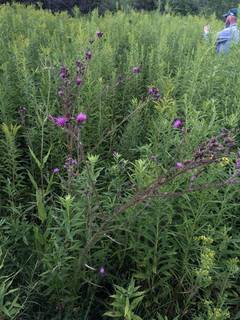
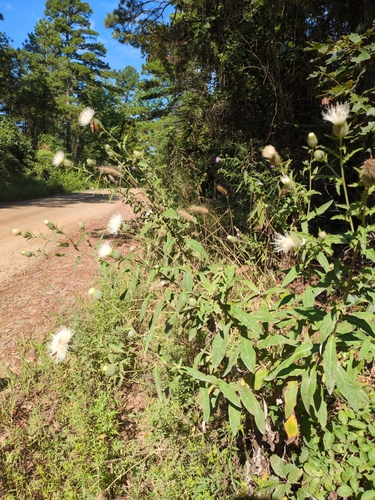
Cirsium altissimum is a tall biennial or short-lived perennial in the aster family (Asteraceae), growing 3-10 feet (0.9-3 m) tall on a single stout, grooved stem that branches near the top. In contrast to many thistles, its lance-shaped leaves are often unlobed or only shallowly lobed, 4-12 inches (10-30 cm) long, green above and densely white-woolly beneath, with weakly spiny margins. The flower heads are pink to rose-purple, 1-2 inches (2.5-5 cm) across, with a brush of slender disk florets above a vase-shaped base of spine-tipped bracts, borne singly at the branch tips. In the first year the plant forms a basal rosette, then bolts and flowers in its second year before dying. Blooming from late summer into fall, the heads draw heavy visits from bees and butterflies, and the seeds, carried on tawny down, feed goldfinches and other birds. One limitation in the garden is its height and biennial habit, which mean it reseeds and shifts position from year to year.
Native Range
Cirsium altissimum is native to central and eastern North America, ranging across the eastern and central United States into southern Canada. It grows in moist prairies, woodland edges, thickets, fencerows, and disturbed open ground.Suggested Uses
This species is used in native pollinator gardens, prairie restorations, and meadow plantings where its late flowers support bees and butterflies. The seeds feed goldfinches and other seed-eating birds. Its height suits the back of borders and naturalized plantings.How to Identify
Appearance
Size & Dimensions
Height3' - 10'
Width/Spread1' - 2'
Bloom Information
Detailed Descriptions
Flower Description
pink to rose-purpleFoliage Description
green above, white-woolly beneathGrowing Conditions
Sun Requirements
Requires 6-12 hours of direct sunlight daily
• Full Sun: 6+ hours of direct sunlight
• Partial Shade: 3-6 hours of direct sunlight
• Full Shade: Less than 3 hours of direct sunlight
Water & Climate
Water Needs