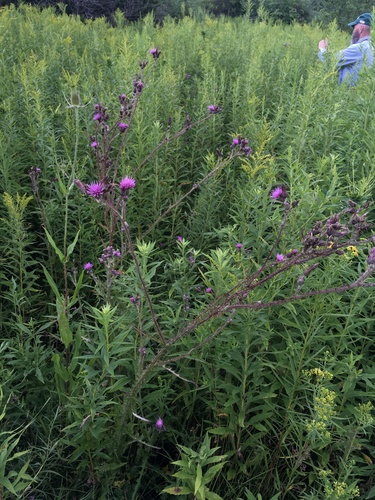
Cirsium, Genus, palustre, Species,
- Genus & species
marsh thistle
Overview
Cirsium palustre is a tall biennial or short-lived perennial thistle in the daisy family, forming a spiny basal rosette in its first year and a stiff, erect flowering stem 3-7 feet (0.9-2 m) tall in its second. The stem is narrowly winged and edged with spines along its length, and the lance-shaped leaves are deeply lobed, prickly, and clasp the stem. From summer into early autumn, small flower heads 0.6-1 inch (1.5-2.5 cm) across cluster tightly near the stem tips, each ringed by spiny bracts and packed with dark reddish-purple, occasionally white, disc florets. The heads give way to seeds carried on a feathery pappus that spreads on the wind. The plant grows in marshes, wet meadows, damp woodland, ditches, and streamsides on neutral to acidic soils. It self-sows heavily and has naturalised in parts of North America, where it is treated as an invasive weed in some states. After flowering and setting seed, the plant dies. The spines make it unwelcome near paths and grazing animals.
Native Range
Native to Europe and western Asia, where it grows in marshes, wet meadows, fens, damp woodland, and along ditches and streams. It has naturalised in North America, New Zealand, and other temperate regions, and is listed as a noxious weed in parts of the northern United States and Canada.Suggested Uses
Grown in wildlife and bog gardens and wet meadow plantings where its nectar-rich heads draw bees, butterflies, and hoverflies through summer. The seeds feed finches and other birds in autumn. In regions where it has naturalised, it is kept out of natural wetlands to limit its spread.How to Identify
Appearance
Size & Dimensions
Height3' - 7'
Width/Spread1' - 2'
Bloom Information
Detailed Descriptions
Foliage Description
greenGrowing Conditions
Sun Requirements
Requires 4-10 hours of direct sunlight daily
• Full Sun: 6+ hours of direct sunlight
• Partial Shade: 3-6 hours of direct sunlight
• Full Shade: Less than 3 hours of direct sunlight


