Carex, Genus, grayi, Species,
- Genus & species
Gray's sedge
Native to eastern North America from Quebec and Vermont south to Georgia and Mississippi and west to Iowa and eastern Texas in wet woodlands, streambanks, pond margins, swamp edges, and moist bottomland forests at low to moderate elevations
Overview
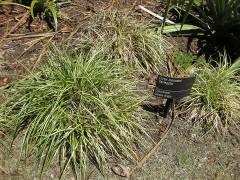
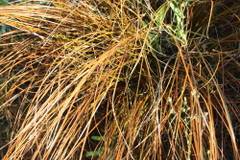
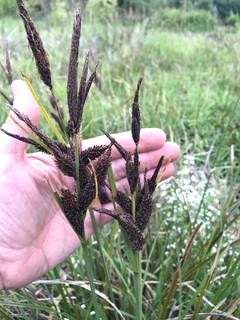
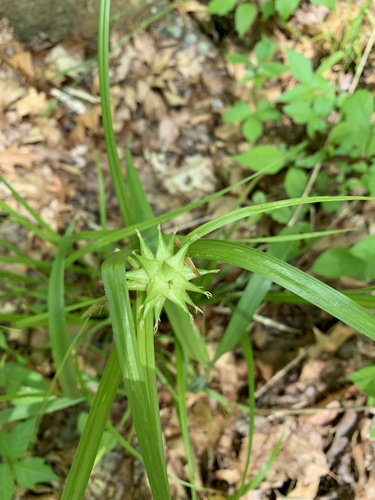
Carex grayi is Gray's sedge — a native eastern North American sedge in the family Cyperaceae carrying a highly recognizable seed head form, growing 18–30 inches (45–75 cm) tall and 12–18 inches (30–45 cm) wide in a clumping habit. The species was named in honor of Asa Gray (1810–1888), the central American botanist of the 19th century who served as Fisher Professor of Natural History at Harvard University and produced the foundational works of North American botanical taxonomy. The seed clusters separate the species visually from every other Carex: large 1–1.5 inch (2.5–4 cm) diameter spiky star-shaped or mace-like spheres covered with inflated perigynia (fruit-bearing scales) radiating outward in all directions, creating a spiky-ball form that resembles a medieval morning star weapon or a spiky Christmas ornament. The seed clusters emerge green in early summer (June–July) and age to golden-brown through fall and winter; the mace-shaped clusters persist on the plant for months and run as the principal ornamental feature. The mature seed clusters retain their structural form when cut and dried and run as a cut-and-dried-flower component in floral arrangements where the spiky-ball form contributes a structural element rare among native plant materials. Medium green wide arching foliage forms the basal mound below the seed cluster display. Wet to waterlogged soil — streambanks, wet woodlands, pond margins, and moist meadows — runs as the species's required habitat; the species fails in standard well-drained garden conditions and runs unsuited to typical perennial border use. Hardy to USDA zone 3. Deer avoid the foliage. Not known to be toxic to pets or humans.
Native Range
Carex grayi is native to eastern North America, from Quebec and Vermont south to Georgia and Mississippi and west to Iowa and eastern Texas, in wet woodlands, streambanks, pond margins, swamp edges, and moist bottomland forests at low to moderate elevations.Suggested Uses
Used in rain gardens, wet woodland plantings, streambank stabilization, pond margin borders, swamp-edge restoration projects, and harvested for cut-and-dried floral arrangements where the morning-star seed-cluster form contributes a structural element rare among native plant materials. The seed-cluster form gives the species visual prominence in mixed wet-soil plantings — the spiky-ball clusters read clearly across distance and contrast the more linear forms of typical wet-soil sedges and rushes. The species name commemorates Asa Gray, the central American botanist of the 19th century, and the morning-star common name references the medieval weapon resemblance — both naming associations give the species a conversational dimension in educational and naturalistic garden contexts. The wet-soil requirement runs as the species's principal cultural limitation — gardeners without consistent wet conditions should select alternative sedge species (Carex muskingumensis palm sedge, Carex pensylvanica Pennsylvania sedge) for similar foliage texture in drier soil contexts.How to Identify
Appearance
Size & Dimensions
Height1'6" - 2'6"
Width/Spread1' - 1'6"
Bloom Information
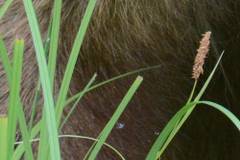
Spiky seed clusters emerge in June and July, then persist on the plant through fall and winter — the seed clusters run as the entire ornamental feature of the species rather than the small inconspicuous flowers that most Carex species rely on. The clusters age from green through golden-brown across the growing season and continue to hold their structural form into the following spring on undisturbed plants.
Detailed Descriptions
Flower Description
Green aging to golden-brown; large 1-1.5 inch spiky star-shaped or mace-like spherical seed clusters with inflated perigynia radiating outward in all directionsFoliage Description
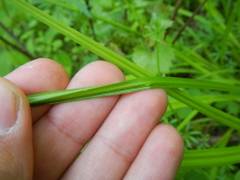
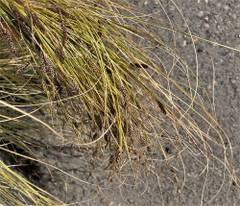
Medium green; wide arching leaf blades on triangular Cyperaceae stems forming basal moundGrowing Conditions
Sun Requirements
Requires 4-10 hours of direct sunlight daily
• Full Sun: 6+ hours of direct sunlight
• Partial Shade: 3-6 hours of direct sunlight
• Full Shade: Less than 3 hours of direct sunlight
Care & Maintenance
Care Guide
Plant in partial shade to full sun with 4–10 hours of light. Wet to waterlogged soil at pH 5.5–7.5 runs as the species's required cultural condition; the species tolerates standing water for extended periods and runs adapted to streambanks and pond margins where most ornamental sedges fail. The species runs unsuited to standard well-drained garden conditions and dry borders; gardeners selecting C. grayi for a non-wet site will see decline within 1–2 seasons. Hardy to USDA zone 3. Leave seed clusters standing through fall and winter — the structural seed-head display runs as the species's principal ornamental contribution. No fertilization needed in established plantings. Self-sows mildly in suitable wet conditions.Pruning
Cut all foliage to 4 inches (10 cm) above ground in early spring before new growth emerges. Leave the seed clusters standing through fall and winter; the structural seed-head display extends the ornamental window beyond the typical season. No other seasonal pruning is needed.Pruning Schedule
Prune: March
spring