Carex, Genus, appalachica, Species,
- Genus & species
Appalachian sedge
Eastern North America: Quebec and Ontario south through Appalachians to Georgia, Alabama, west to Missouri
Overview
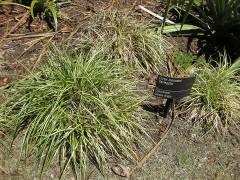
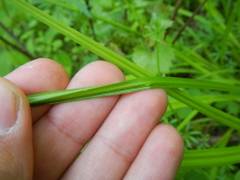
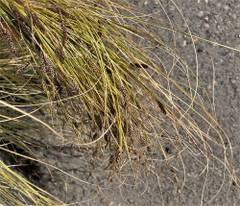
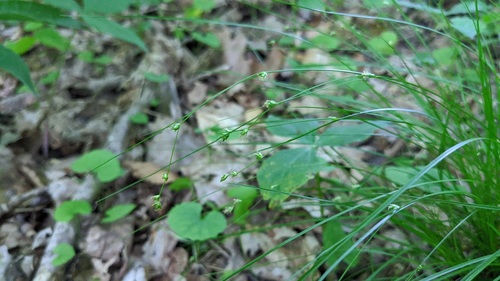
Carex appalachica is a thread-leaved clump-forming perennial sedge in the family Cyperaceae growing 6-12 inches (15-30 cm) tall and 8-12 inches (20-30 cm) wide in loose arching tufts. Leaves are very narrow, 0.5-1.5 mm wide, bright green, thread-like, creating a delicate hair-like texture. Stems are triangular, wiry, arching. The inflorescence is inconspicuous: a few short spikes near the stem tip in late spring. Native to the deciduous forests of the Appalachian region, where the species grows in dry to mesic upland woodland on rocky acidic humus-rich soils. Tolerates dry shade and persists beneath mature deciduous trees where soil dries out in summer, conditions that limit most native sedges. The narrow leaves and arching habit create a ground-covering effect comparable to a narrow-bladed grass but without mowing, increasingly used as a lawn alternative in shaded residential settings in eastern North America. Spreads slowly by short rhizomes, forming a loose colony over 3-5 years. Does not tolerate full sun, wet soil, or heavy foot traffic.
Native Range
Carex appalachica is native to eastern North America, from Quebec and Ontario south through the Appalachian Mountains to Georgia and Alabama, and west to Missouri. The species occurs in dry to mesic deciduous forests, rocky woodland slopes, and upland oak-hickory forests on acidic to neutral soils from 500-5,000 feet (150-1,500 m).Suggested Uses
Planted as a native groundcover and lawn alternative in shaded residential settings, spaced 8-10 inches (20-25 cm) apart. The narrow hair-like leaves create a soft flowing carpet under deciduous trees. Used in woodland gardens, shade gardens, and as a no-mow lawn substitute. Combines with woodland wildflowers such as Tiarella cordifolia, Polystichum acrostichoides, and Geranium maculatum. In the Pacific Northwest, suited to shaded sites with well-drained acidic soil. Not suited to sunny exposures or waterlogged sites.How to Identify
Appearance
Size & Dimensions
Height6" - 1'
Width/Spread8" - 1'
Bloom Information
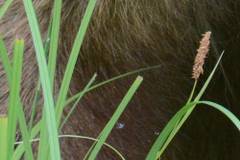
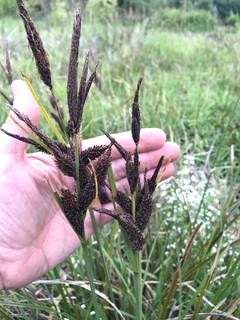
Inconspicuous spikes appear from April through May. A single terminal male spike and 1-2 small female spikes clustered near the stem tip. Wind-pollinated. Utricles ripen by June.
Detailed Descriptions
Flower Description
Brown (inconspicuous); single terminal male spike and 1-2 small female spikesFoliage Description
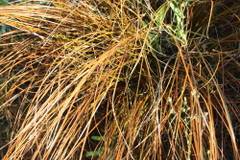
Bright green; very narrow thread-like 0.5-1.5 mm wide; arching; in loose tufts; semi-evergreenGrowing Conditions
Sun Requirements
Requires 1-4 hours of direct sunlight daily
• Full Sun: 6+ hours of direct sunlight
• Partial Shade: 3-6 hours of direct sunlight
• Full Shade: Less than 3 hours of direct sunlight
Care & Maintenance
Care Guide
Sited in partial to full shade in dry to mesic acidic humus-rich well-drained soil at pH 4.5-6.5. Spaced 8-10 inches (20-25 cm) apart for groundcover coverage in 2-3 years. Tolerates dry shade beneath mature oaks, beeches, and maples. Watered during the first growing season; once established, supplemental irrigation is rarely needed except during extended drought. Fertilizer is not used; the species is adapted to nutrient-poor woodland soils. Mulched with leaf litter; oak leaves are typical in native settings. Does not tolerate full sun or waterlogged conditions.Pruning
Mowed or cut back to 3-4 inches (8-10 cm) in late winter before new growth if a tidier appearance is desired. Otherwise, no pruning is needed; the thread-like foliage is self-maintaining.Pruning Schedule
Prune: February–March
early spring
Container Growing
Suitable for container growing
Minimum container size: 2 gallons