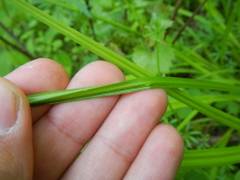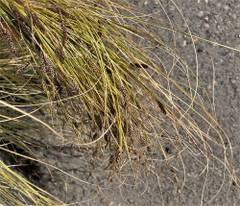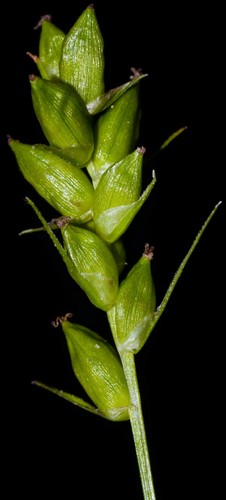
Carex, Genus, amphibola, Species,
- Genus & species
creek sedge
Native to eastern North America from New York and Ontario south to Florida and west to Texas; native habitats include moist to dry woodlands, stream margins, floodplains, and open meadows on a wide range of soil types
Overview
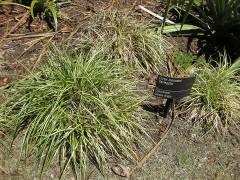
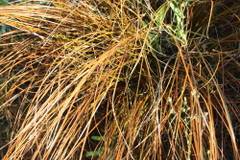
Carex amphibola is a clump-forming native sedge in the Cyperaceae family reaching 12–18 inches (30–45 cm) tall and wide, forming a graceful fountain of narrow arching medium green leaf blades. Sedges carry triangular stems (the mnemonic 'sedges have edges') that distinguish them from grasses, which carry round stems; sedges are not technically grasses despite functioning similarly in landscape design. The species tolerates a wide range of conditions from full sun to full shade and from dry upland sites to moist stream margins — the broad habitat tolerance makes the species a versatile native sedge for garden use across difficult sites where more specialized sedges fail. Inconspicuous greenish-brown flower spikes appear in April and May but carry no ornamental value; the plant is grown entirely for the narrow-leaved foliage. The semi-evergreen foliage remains green through mild winters and goes partially dormant in cold zones. Creek sedge does not spread aggressively; clumps expand slowly and self-sowing runs moderate. In moist shaded conditions, the foliage runs tallest and most arching; in dry sun, the foliage stays shorter and more compact. The species is increasingly used as a lawn alternative in shaded areas, planted at 8–12 inch (20–30 cm) centers to form a low-maintenance green carpet that requires no mowing. Deer avoid the foliage. Not known to be toxic to pets or humans.
Native Range
Carex amphibola is native to eastern North America, from New York and Ontario south to Florida and west to Texas. The species grows in moist to dry woodlands, stream margins, floodplains, and open meadows on a wide range of soil types.Suggested Uses
Used as a shade ground cover, lawn alternative under trees, and in rain gardens, stream-margin plantings, and native habitat restorations. The wide tolerance suits difficult sites from dry shade to moist sun where more specialized sedges fail. Container culture works in pots of 3 gallons (11 liters) or more. Mass plantings at 8–12 inch (20–30 cm) spacing create a low-maintenance green carpet under tree canopies where lawn grasses fail to establish. The species also functions as a wildlife habitat plant — the dense clumping foliage gives cover for ground-foraging birds, small mammals, and overwintering insects, while the spring seed heads feed ground-feeding birds.How to Identify
Appearance
Size & Dimensions
Height1' - 1'6"
Width/Spread1' - 1'6"
Bloom Information
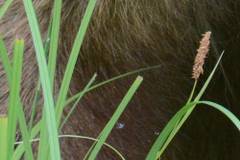
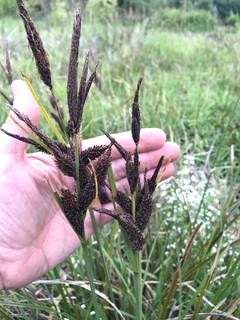
Flowering occurs in April and May. Inconspicuous greenish-brown flower spikes appear among the foliage for approximately 2 weeks. The flowers carry no ornamental value and the species is grown entirely for the foliage. Small seed heads develop and are consumed by ground-feeding birds (juncos, sparrows) across late spring and early summer.
Detailed Descriptions
Foliage Description
Medium green; narrow arching blades forming a fountain shapeGrowing Conditions
Sun Requirements
Requires 2-10 hours of direct sunlight daily
• Full Sun: 6+ hours of direct sunlight
• Partial Shade: 3-6 hours of direct sunlight
• Full Shade: Less than 3 hours of direct sunlight
Care & Maintenance
Care Guide
Plant in full sun to full shade with 2–10 hours of light. Average soil of any type suits the species, including clay, sand, and loam. Water during establishment; drought-tolerant once rooted, though moist conditions produce the fullest growth. No fertilization is needed in reasonably fertile soil. Comb out brown foliage in early spring before new growth emerges. When used as a lawn alternative, plant at 8–12 inch (20–30 cm) centers and allow the clumps to knit together over 1–2 years; no mowing is required for the lawn-alternative use.Pruning
Comb out or shear brown foliage in early spring before new growth emerges. In mild climates where the foliage remains semi-evergreen, no cutback may be needed. No other seasonal pruning is required.Pruning Schedule
Prune: February–March
winterspring
Container Growing
Suitable for container growing
Minimum container size: 3 gallons