Overview
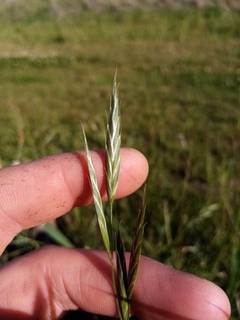
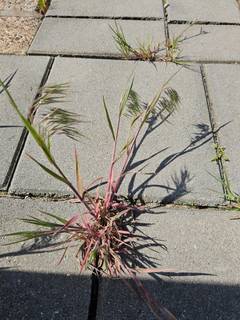
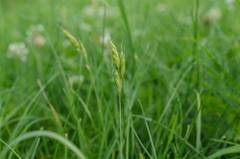
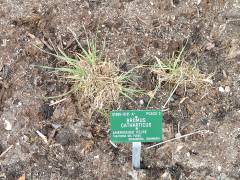
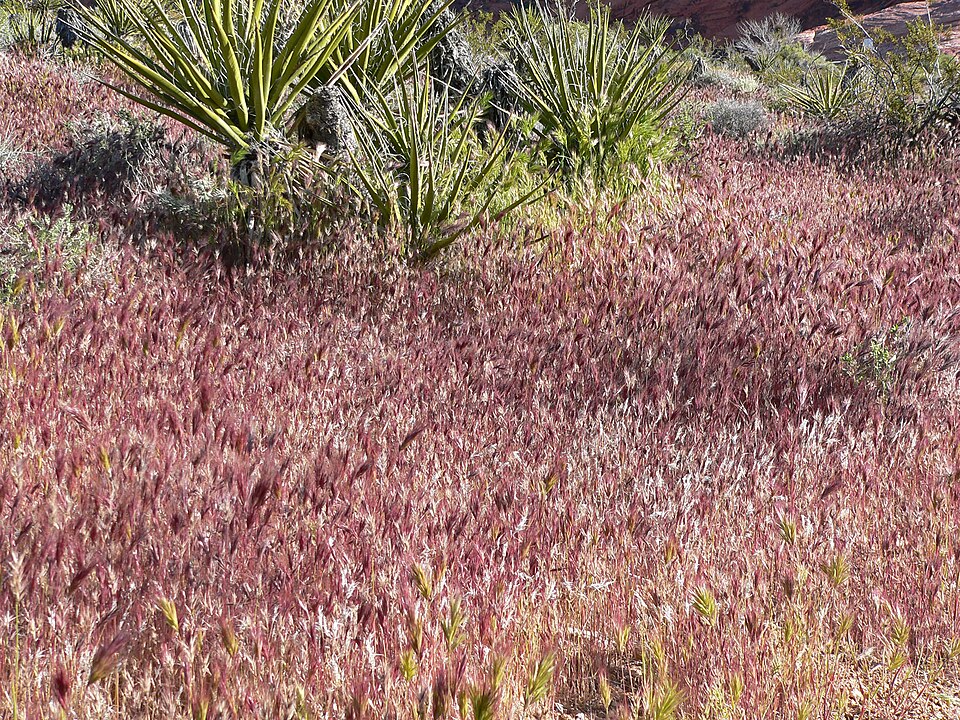
Bromus rubens is a winter annual grass reaching 4-16 inches (10-40 cm) tall, forming slender erect tufts from fibrous roots. The leaves and sheaths are softly hairy, green maturing to straw-brown. Flowering stems carry a dense, compact panicle 2-4 inches (5-10 cm) long that turns red to purple as the seeds ripen, with stiff awns 0.5-0.75 inch (12-18 mm) long radiating from each floret. The species germinates with autumn and winter rains, completes flowering in spring, and dies by early summer, leaving dry reddish seedheads. The sharp-pointed florets and barbed awns detach readily and can lodge in the mouths and eyes of grazing animals. In western North America B. rubens forms continuous stands across desert and semi-arid rangeland, where the cured summer growth carries fire between widely spaced shrubs and shortens natural fire intervals. It is closely related to B. madritensis, with which it is sometimes merged, and to B. diandrus, a taller relative with longer awns. One limitation is that the dense fibrous litter it leaves behind suppresses germination of slower native annuals. Populations fluctuate sharply between wet and dry years, expanding after high-rainfall winters.
Native Range
Bromus rubens is native to the Mediterranean Basin, including southern Europe, North Africa, and southwest Asia. It has naturalized widely in arid western North America, Australia, and South America, and is recorded as invasive across the deserts of California, Nevada, Arizona, and Utah.Suggested Uses
Bromus rubens is not grown ornamentally and has no horticultural use. It is encountered as a weed of disturbed sites, rangeland, and desert margins, where it is studied chiefly for its role in altering wildfire cycles. Land managers track it as an indicator of degraded arid habitat.How to Identify
Appearance
Size & Dimensions
Height4" - 1'4"
Width/Spread2" - 4"
Bloom Information
Flowering occurs in spring, from March to May in its naturalized western North American range, following autumn and winter germination. The greenish florets are wind-pollinated and quickly turn red to purple. Seed shatters by early summer, after which the plants dry to straw-brown.
Detailed Descriptions
Flower Description
green ripening to red-purpleFoliage Description
green maturing to straw-brownGrowing Conditions
Sun Requirements
Requires 6-12 hours of direct sunlight daily
• Full Sun: 6+ hours of direct sunlight
• Partial Shade: 3-6 hours of direct sunlight
• Full Shade: Less than 3 hours of direct sunlight
Water & Climate
Water Needs
Drought Tolerance
Drought tolerant when established