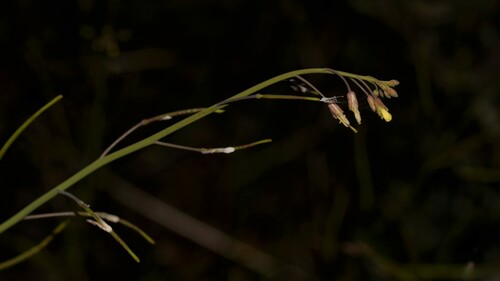
Brassica, Genus, tournefortii, Species,
- Genus & species
Saharan mustard
North Africa, Mediterranean, and southwestern Asia
Overview
Brassica tournefortii is a fast-growing winter annual in the mustard family (Brassicaceae). It germinates with autumn and winter rains, forms a flat basal rosette of bristly, deeply lobed leaves 4–12 inches (10–30 cm) long, then bolts into a branched flowering stem 8–40 inches (20–100 cm) tall. The flowers have four pale yellow petals about 0.2 inch (5 mm) long and open along elongating racemes. Slender seedpods 1.5–2.8 inches (4–7 cm) long follow, each holding many spherical seeds that become sticky when wet. As the plant dries, the rigid branched skeleton breaks off and tumbles in the wind, scattering seed over long distances. Native to North Africa, the Mediterranean, and southwestern Asia, it has become established across the deserts of the southwestern United States, where it germinates earlier and grows faster than many native annuals and can form dense stands on open sand. These stands carry fire through desert vegetation that historically rarely burned, which is its main drawback in wildland settings. Brassica tournefortii is listed as a noxious or invasive weed in California, Arizona, and Nevada.
Native Range
Brassica tournefortii is native to North Africa, the Mediterranean Basin, and southwestern and central Asia. It has naturalized widely in arid regions of Australia, South Africa, and North America, and is an established invader of the Sonoran and Mojave deserts.Suggested Uses
Brassica tournefortii has no horticultural use and is managed as an invasive weed across the southwestern deserts. Where it occurs, land managers remove it to reduce fire fuel and competition with native winter annuals. It is included in regional invasive-plant control programs.How to Identify
Appearance
Size & Dimensions
Height8" - 3'4"
Width/Spread10" - 2'
Bloom Information
Flowering runs from late winter into spring, often beginning in February in low desert and continuing through May. Plants flower within weeks of bolting and continue producing flowers and pods at the stem tips over roughly 6–8 weeks. A single plant can mature thousands of seeds before drying.
Detailed Descriptions
Foliage Description
greenGrowing Conditions
Sun Requirements
Requires 6-12 hours of direct sunlight daily
• Full Sun: 6+ hours of direct sunlight
• Partial Shade: 3-6 hours of direct sunlight
• Full Shade: Less than 3 hours of direct sunlight
Water & Climate
Water Needs
Drought Tolerance
Drought tolerant when established