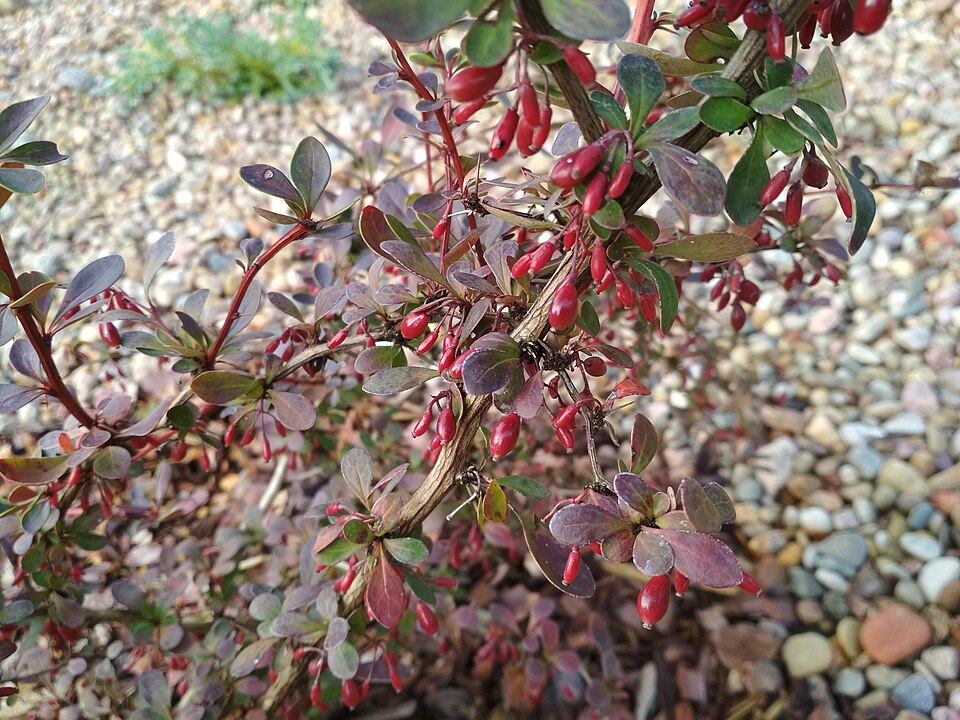
Berberis, Genus, thunbergii, Species, f., Form, atropurpurea, Form, 'Golden Ring', Cultivar,
- Genus & species
- Form
- Cultivar
golden ring barberry
Species native to Japan; cultivar selected in the Netherlands, 1950
Overview
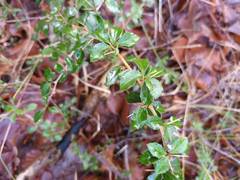
Berberis thunbergii f. atropurpurea 'Golden Ring' is a rounded, spreading deciduous shrub reaching 48–72 inches (120–180 cm) tall and 48–72 inches (120–180 cm) wide at maturity. The cultivar carries a bicolored leaf pattern: each blade has a deep reddish-purple center with a narrow bright gold-yellow margin 1–2 mm wide. Leaves are obovate, 0.8–1.2 inches (2–3 cm) long, slightly larger than most cultivars within the forma atropurpurea. The gold margin is most defined in full sun and fades toward green in shade. Stems are arching, densely branched, with single sharp spines at each leaf node. Pale yellow flowers tinged red on the exterior appear in clusters of 1–3 in April–May, lasting 2–3 weeks. Red oval berries 0.3 inch (8 mm) long ripen in September–October and persist into winter. Growth rate is moderate at 6–10 inches (15–25 cm) per year. Fall foliage turns bright red over 2–3 weeks. The arching habit opens and loses vigor in shade. B. thunbergii is listed as invasive in Massachusetts, Maine, New Hampshire, New York, Pennsylvania, Ohio, Wisconsin, and Minnesota; cultivars are restricted under those state regulations.
Native Range
The species Berberis thunbergii is native to Japan and possibly eastern China, occurring on mountain slopes, forest margins, and rocky areas. The forma atropurpurea describes purple-leaved seedling variants; 'Golden Ring' is a cultivar within this forma, selected in the Netherlands in 1950.Suggested Uses
Planted in mixed borders, informal hedging, and mass plantings at 36–48 inch (90–120 cm) spacing in zones 4–8. The bicolored foliage adds detail interest at close viewing distances. The thorny stems form a barrier. Grows in containers of at least 7 gallons (26 L). Not suited to states where B. thunbergii cultivars are restricted under invasive species regulations, including Massachusetts, Maine, New Hampshire, New York, Pennsylvania, Ohio, Wisconsin, and Minnesota.How to Identify
Appearance
Size & Dimensions
Height4' - 6'
Width/Spread4' - 6'
Bloom Information
Pale yellow flowers tinged red on the exterior appear in clusters of 1–3 along the stems in April–May. Individual flowers are 0.2–0.3 inch (5–8 mm) across. Bloom duration is 2–3 weeks. Bright red oval berries 0.3 inch (8 mm) long ripen in September–October and persist into winter.
Detailed Descriptions
Flower Description
pale yellow with red exterior tingeFoliage Description
deep reddish-purple with narrow bright gold-yellow marginGrowing Conditions
Sun Requirements
Requires 6-10 hours of direct sunlight daily
• Full Sun: 6+ hours of direct sunlight
• Partial Shade: 3-6 hours of direct sunlight
• Full Shade: Less than 3 hours of direct sunlight
Care & Maintenance
Care Guide
Plant in well-drained soil with a pH of 5.5–8.0 in full sun for the most defined gold margin and deepest purple center. In partial shade, the bicolored effect is reduced and the purple shifts toward greenish-purple. Tolerates clay, sand, chalk, and alkaline soils. Water weekly during the first growing season. Established plants tolerate drought intervals of 3–4 weeks. The full-sized rounded habit benefits from periodic stem thinning to maintain density in garden settings. B. thunbergii is listed as invasive in Massachusetts, Maine, New Hampshire, New York, Pennsylvania, Ohio, Wisconsin, and Minnesota; cultivars are restricted under those state regulations.Pruning
Shape pruning is carried out in late winter or early spring (February–March) before leaf-out. Removing one-third of the oldest stems at the base each year maintains vigor and density. Tolerates renovation pruning to 6–12 inches (15–30 cm) in late winter. Hedging requires 2–3 shearing passes per growing season. Single spines warrant protective handling during pruning.Pruning Schedule
Prune: February–March
winterearly spring
Container Growing
Suitable for container growing
Minimum container size: 7 gallons
Toxicity
Non-toxicRelated Berberis species
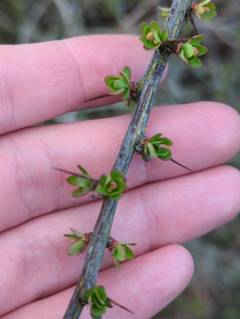 Japanese barberryBerberis thunbergii
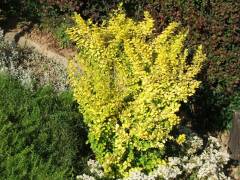 Golden Japanese barberryBerberis thunbergii 'Aurea'
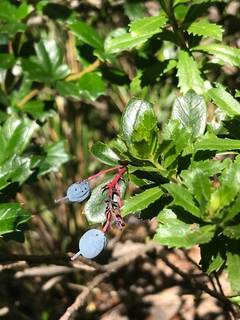 Darwin's barberryBerberis darwinii
 Warty barberryBerberis verruculosa
- Purpleleaf or redleaf Japanese barberryBerberis thunbergii f. atropurpurea
- Helmond Pillar Japanese barberryBerberis thunbergii f. atropurpurea 'Helmond Pillar'