Image 1 of 2
Plant Reference
1 / 2
Berberis, Genus, gladwynensis, Species, 'William Penn', Cultivar,
- Genus & species
- Cultivar
William Penn barberry
Hybrid of garden origin (Gladwyne, Pennsylvania)
Overview
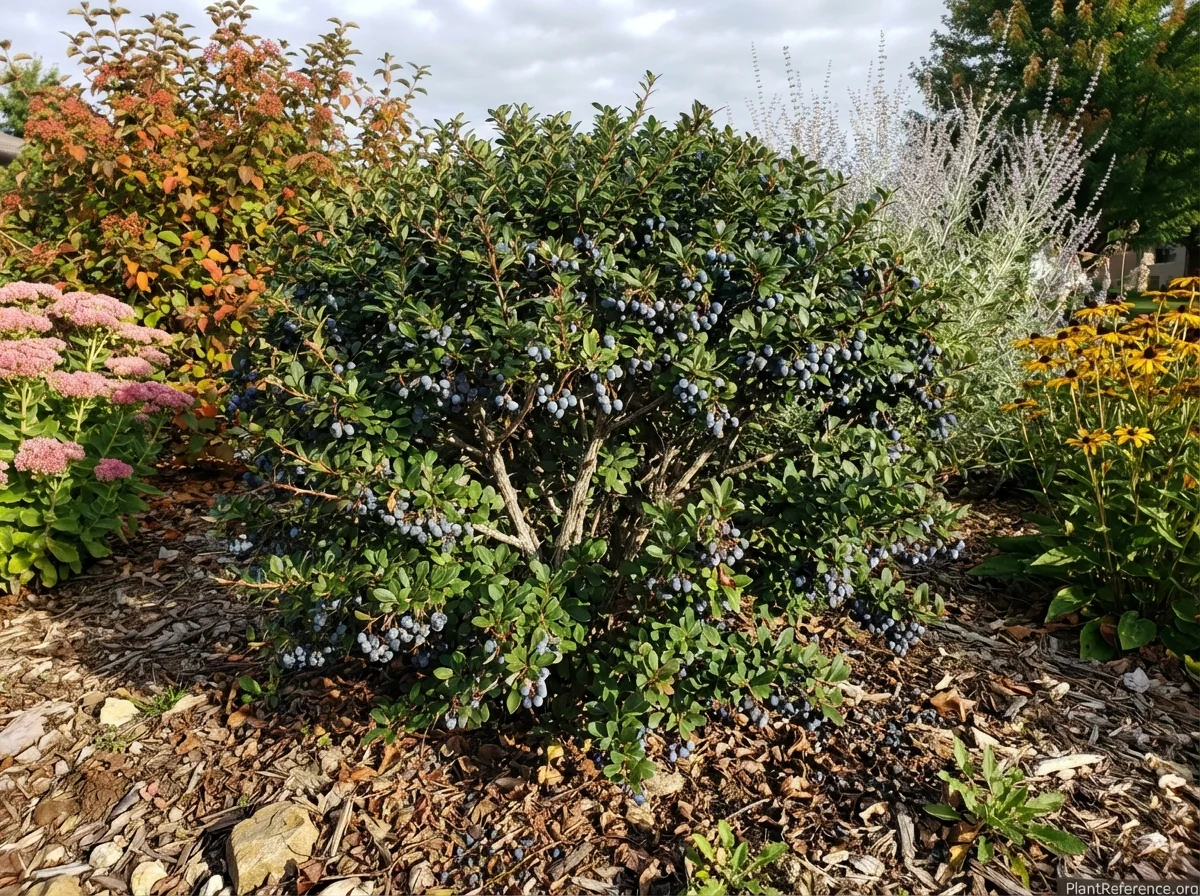
Berberis ×gladwynensis 'William Penn' is a compact evergreen shrub reaching 36–48 inches (90–120 cm) tall and 36–48 inches (90–120 cm) wide, forming a dense mound that is slightly wider than tall at maturity. Leaves are elliptic, leathery, 1–2 inches (2.5–5 cm) long, dark green and glossy on the upper surface. New spring growth emerges bronze-tinged before maturing to dark green; in cold winters the foliage may develop bronze or reddish-purple tints. Dense clusters of bright yellow flowers 0.3 inch (8 mm) across form along the stems in April–May, lasting 1–2 weeks. Dark blue-black berries ripen in September–October. Three-pronged thorns occur at each leaf node along arching stems. The hybrid was bred at the Henry Foundation for Botanical Research in Gladwyne, Pennsylvania; the hybrid name 'gladwynensis' references that location. Parentage is uncertain, likely involving B. julianae and other Chinese Berberis species. Growth rate is moderate at 4–8 inches (10–20 cm) per year. All Berberis species contain berberine alkaloid and are toxic to pets on ingestion. Berberis species are regulated in some US states as alternate hosts for wheat stem rust (Puccinia graminis).
Native Range
Hybrid of garden origin, bred at the Henry Foundation for Botanical Research in Gladwyne, Pennsylvania. The hybrid epithet 'gladwynensis' references that location. Parentage is uncertain but likely involves B. julianae and other Chinese Berberis species.Suggested Uses
Planted as a low evergreen hedge, foundation shrub, or specimen in mixed borders at 36–48 inch (90–120 cm) spacing in zones 5–8. The dense compact form and three-pronged thorns form a low barrier. Grows in containers of at least 5 gallons (19 L). Not suited to deep shade, waterlogged soils, or states with active Berberis import or planting restrictions.How to Identify
Appearance
Size & Dimensions
Height3' - 4'
Width/Spread3' - 4'
Bloom Information
Dense clusters of bright yellow flowers 0.3 inch (8 mm) across open along the stems in April–May, lasting 1–2 weeks. Individual flowers are borne in tight axillary clusters rather than singly or in pendant racemes. Dark blue-black berries 6–8 mm long ripen in September–October.
Detailed Descriptions
Flower Description
bright yellow in dense clusters along the stemsFoliage Description
dark green and glossy, elliptic, leathery, 1–2 inches (2.5–5 cm); bronze-tinged new growth in spring; bronze or reddish tints in cold wintersGrowing Conditions
Sun Requirements
Requires 4-8 hours of direct sunlight daily
• Full Sun: 6+ hours of direct sunlight
• Partial Shade: 3-6 hours of direct sunlight
• Full Shade: Less than 3 hours of direct sunlight
Care & Maintenance
Care Guide
Plant in well-drained soil with a pH of 6.0–7.5 in full sun to partial shade. Tolerates clay soil. Water weekly during the first growing season. Established plants tolerate drought intervals of 3–4 weeks. The compact mound form develops without shaping. Three-pronged thorns on the stems warrant protective handling during pruning. Berberine alkaloid throughout the plant is toxic to pets on ingestion. Berberis species are restricted in several US states as alternate hosts for wheat stem rust — Minnesota, North Dakota, Michigan, and parts of Montana have historical or active regulations on the genus.Pruning
Shape pruning is carried out after flowering in early summer (June). The compact mound form develops without routine intervention. Tolerates renovation pruning to 8–12 inches (20–30 cm) in early spring if the shrub becomes overgrown; regrowth is dense.Pruning Schedule
Prune: June
summer
Container Growing
Suitable for container growing
Minimum container size: 5 gallons
Toxicity Warning
Toxic to petsRelated Berberis species
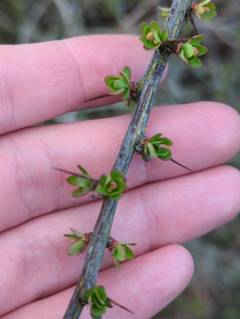 Japanese barberryBerberis thunbergii
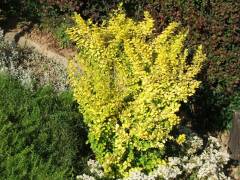 Golden Japanese barberryBerberis thunbergii 'Aurea'
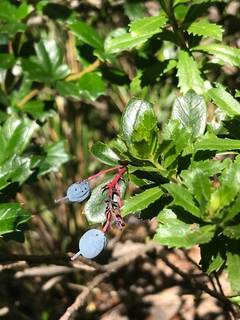 Darwin's barberryBerberis darwinii
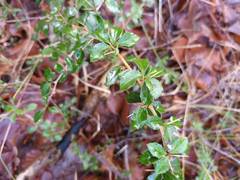 Warty barberryBerberis verruculosa
- Purpleleaf or redleaf Japanese barberryBerberis thunbergii f. atropurpurea
- Helmond Pillar Japanese barberryBerberis thunbergii f. atropurpurea 'Helmond Pillar'