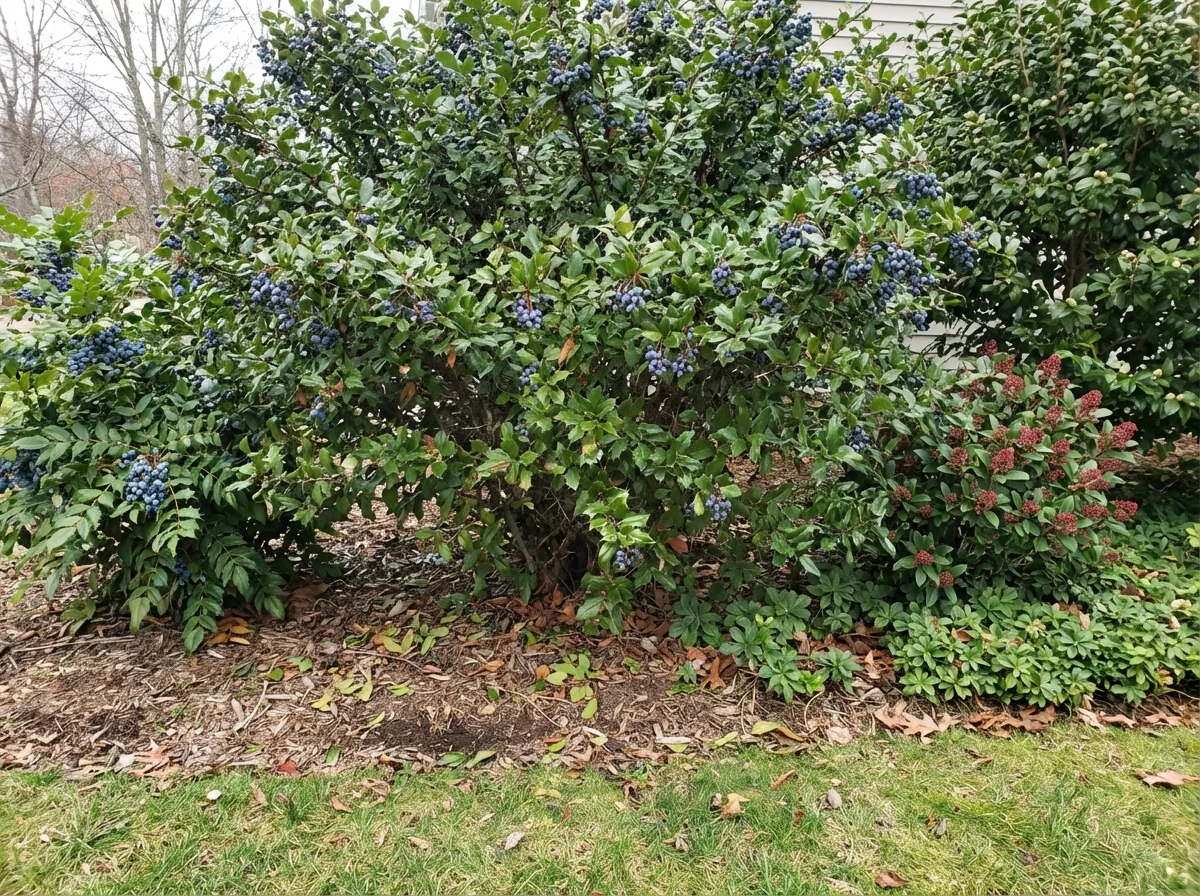
Image 1 of 7
Plant Reference
1 / 7
Berberis, Genus, ×, Hybrid, gladwynensis, Species,
- Genus & species
- Hybrid
Gladwyne barberry
Hybrid of garden origin; the cross was made at the Henry Foundation in Gladwyne, Pennsylvania, from two Chinese parent species — Berberis julianae (central China, Hubei province) and Berberis verruculosa (western China, Sichuan province)
Overview
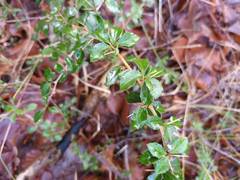
Berberis × gladwynensis is a dense mounding broadleaf evergreen hybrid shrub in the barberry family Berberidaceae growing 36–72 inches (90–180 cm) tall and 36–72 inches (90–180 cm) wide, resulting from a cross between Berberis julianae (wintergreen barberry, from central China) and Berberis verruculosa (warty barberry, from western China). The hybrid was created at the Henry Foundation in Gladwyne, Pennsylvania, and the epithet gladwynensis refers to this location. Leaves are dark green and glossy, leathery, small, oval, 0.75–1.5 inches (18–38 mm) long with a few spiny teeth along the margins, and the leaf size is intermediate between the larger-leaved B. julianae (2–3 inches / 5–7 cm) and the smaller-leaved B. verruculosa (0.5–1 inch / 12–25 mm). Bronze tints develop in the foliage during winter cold. Yellow small flowers open in clusters at the leaf axils and branch tips in April across a 1–2 week bloom period, and blue-black berries develop in fall and are consumed by birds. The hybrid combines the cold hardiness of B. julianae (zone 5) with the compact mounding growth form and the smaller leaf size of B. verruculosa, and the resulting dense mounding habit at 36–72 inches (90–180 cm) is more compact than B. julianae alone (72–120 inches / 180–300 cm) while retaining the zone 5 cold tolerance that limits B. verruculosa (zone 6–7). Triple spines at each leaf node create a thorny barrier, and thick leather gloves are warranted during pruning and maintenance work. The cultivar 'William Penn' is the selection with the widest commercial distribution and is treated as a separate entry in the PlantReference database. All parts of the plant contain berberine, a yellow isoquinoline alkaloid — mildly toxic to humans and animals if ingested. The species adapts to clay and a wide range of soil conditions. Drought-tolerant once established. Deer-resistant because of the thorny habit and the berberine content.
Native Range
Hybrid of garden origin — the cross was made at the Henry Foundation in Gladwyne, Pennsylvania, from two Chinese parent species: Berberis julianae (wintergreen barberry, native to central China, Hubei province) and Berberis verruculosa (warty barberry, native to western China, Sichuan province). The Henry Foundation was established by Mary Gibson Henry (1884–1967), an American botanist and plant explorer who collected plants across North America and supported plant breeding programs at the Gladwyne estate.Suggested Uses
Used as a barrier hedge, low screen, foundation shrub, and in mixed borders in USDA zones 5 through 9 at 36–72 inch (90–180 cm) spacing between plants. The dense mounding thorny habit creates an impenetrable barrier hedge at a compact size that is suited to positions where the taller B. julianae (72–120 inches / 180–300 cm) is too large, and the zone 5 cold hardiness extends the planting range into climates where many other evergreen barberries are not reliably hardy. The cultivar 'William Penn' is the widely grown selection and is treated as a separate entry. All parts are mildly toxic (berberine), and gardens where pet or child access to the foliage and berries is a concern should account for this toxicity.How to Identify
Appearance
Size & Dimensions
Height3' - 6'
Width/Spread3' - 6'
Bloom Information
Yellow small flowers open in clusters at the leaf axils and branch tips in April across a 1–2 week bloom period. Honeybees visit the flowers for nectar during the spring bloom window. Blue-black berries develop through summer and ripen in fall, and the berries are consumed by birds that disperse the seed. The dark green evergreen foliage with bronze winter tints is the year-round ornamental feature rather than the brief spring bloom.
Detailed Descriptions
Flower Description
yellow small flowers in clusters at the leaf axils and branch tips in mid-springFoliage Description
dark green and glossy; leathery small oval leaves 0.75-1.5 inches (18-38 mm) long with a few spiny teeth along the margins; the leaf size is intermediate between the larger-leaved parent B. julianae (2-3 inches / 5-7 cm) and the smaller-leaved parent B. verruculosa (0.5-1 inch / 12-25 mm); bronze tints develop in the foliage during winter coldGrowing Conditions
Sun Requirements
Requires 4-8 hours of direct sunlight daily
• Full Sun: 6+ hours of direct sunlight
• Partial Shade: 3-6 hours of direct sunlight
• Full Shade: Less than 3 hours of direct sunlight
Care & Maintenance
Care Guide
Site in full sun to partial shade with 4–8 hours of direct sun per day in well-drained soil with a pH of 5.5–7.5. The hybrid adapts to clay and a wide range of soil conditions and is drought-tolerant once the root system is established after the first or second growing season. The triple spines at each leaf node create a thorny barrier, and thick leather gloves are warranted during pruning and maintenance work. Pruning for shape is done after flowering in late spring (May), and the species tolerates clipping for formal and informal hedging. All parts contain berberine (isoquinoline alkaloid) — mildly toxic to humans and animals if ingested. Deer-resistant because of the thorny habit and the berberine content. Hardy in USDA zones 5–9.Pruning
Pruning for shape is done after flowering in late spring (May) by cutting back overlength stems to a bud or side branch. The dense mounding form is largely self-maintaining and calls for only light shaping cuts to hold the shrub at a designed size, and the species tolerates clipping for formal hedging. Thick leather gloves are warranted during pruning because the triple spines at each leaf node puncture unprotected skin. Hard renovation pruning (cutting the shrub to 12–18 inches / 30–45 cm from the ground) can be done in late spring if the shrub has become overgrown.Pruning Schedule
Prune: May
spring
Container Growing
Suitable for container growing
Minimum container size: 5 gallons
Toxicity Warning
Toxic to pets and humansRelated Berberis species
 Japanese barberryBerberis thunbergii
 Golden Japanese barberryBerberis thunbergii 'Aurea'
 Darwin's barberryBerberis darwinii
 Warty barberryBerberis verruculosa
- Purpleleaf or redleaf Japanese barberryBerberis thunbergii f. atropurpurea
- Helmond Pillar Japanese barberryBerberis thunbergii f. atropurpurea 'Helmond Pillar'