Image 1 of 5
1 / 5
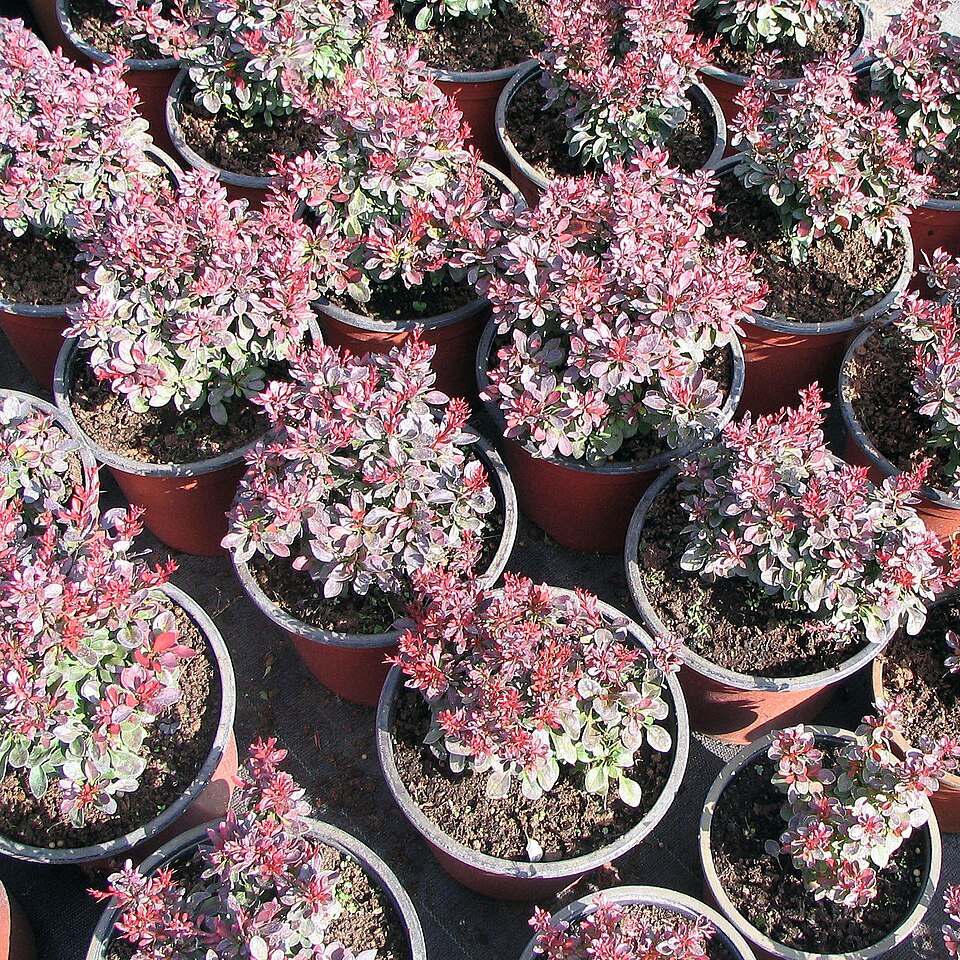
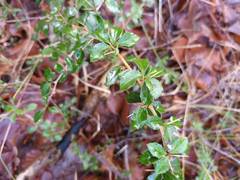
© Gmihail at Serbian Wikipedia, some rights reserved (CC-BY-SA) · Wikimedia Commons
Berberis, Genus, thunbergii, Species, f., Form, atropurpurea, Form, 'Bagatelle', Cultivar,
- Genus & species
- Form
- Cultivar
bagatelle barberry
Species native to Japan; cultivar selected in the Netherlands
Overview
Berberis thunbergii f. atropurpurea 'Bagatelle' is a compact, dense, rounded deciduous shrub reaching 10–15 inches (25–38 cm) tall with a spread of 12–18 inches (30–45 cm) — a dwarf selection within the purple-leaved forma atropurpurea. Leaves are small, obovate, 0.3–0.8 inch (8–20 mm) long, deep reddish-purple to maroon through the growing season. New spring growth emerges crimson-red before darkening to maroon. Single sharp spines occur at each leaf node, less conspicuous than on larger barberry cultivars due to the compact branching. Pale yellow flowers 0.2–0.3 inch (5–8 mm) across appear in April–May but are sparse and largely concealed within the dense foliage. Fruit set is minimal; few small red berries develop in September–October. Growth rate is slow at 1–3 inches (2.5–8 cm) per year; plants take 5–8 years to reach full size. Fall foliage turns bright orange-red and persists 2–3 weeks. The tight, rounded form develops naturally without pruning. In partial shade, the purple foliage becomes green-flushed. B. thunbergii is listed as invasive in Massachusetts, Maine, New Hampshire, New York, Pennsylvania, Ohio, Wisconsin, and Minnesota; cultivars are restricted under those state regulations.
Native Range
The species Berberis thunbergii is native to Japan and possibly eastern China, occurring on mountain slopes, forest margins, and rocky areas from near sea level to 5,000 feet (1,500 m) elevation. The forma atropurpurea describes purple-leaved seedling variants, and 'Bagatelle' is a cultivar within this forma, selected in the Netherlands.Suggested Uses
Planted in rock gardens, alpine beds, low border edging, and containers at 12–18 inch (30–45 cm) spacing in zones 4–8. The dwarf size suits small-scale plantings, troughs, and miniature compositions. Grows in containers of at least 2 gallons (8 L). Not suited to states where B. thunbergii cultivars are restricted under invasive species regulations, including Massachusetts, Maine, New Hampshire, New York, Pennsylvania, Ohio, Wisconsin, and Minnesota.How to Identify
Appearance
Size & Dimensions
Height10" - 1'3"
Width/Spread1' - 1'6"
Bloom Information
Sparse pale yellow flowers 0.2–0.3 inch (5–8 mm) across appear in April–May, largely concealed within the dense foliage. Fruit set is minimal; occasional small red berries ripen in September–October and do not form a visible fruit display.
Detailed Descriptions
Foliage Description
deep reddish-purple to maroon; crimson-red new growthGrowing Conditions
Sun Requirements
Requires 5-10 hours of direct sunlight daily
• Full Sun: 6+ hours of direct sunlight
• Partial Shade: 3-6 hours of direct sunlight
• Full Shade: Less than 3 hours of direct sunlight
Care & Maintenance
Care Guide
Plant in well-drained soil with a pH of 5.5–8.0 in full sun for the deepest purple foliage. In partial shade, leaves develop a greenish cast. Tolerates clay, sand, chalk, and alkaline soils. Water weekly during the first growing season. Established plants tolerate drought intervals of 3–4 weeks. The compact habit requires no shaping. Slow growth means recovery from damage or hard pruning takes 2–3 seasons. B. thunbergii is listed as invasive in Massachusetts, Maine, New Hampshire, New York, Pennsylvania, Ohio, Wisconsin, and Minnesota; cultivars are restricted under those state regulations.Pruning
Minimal to no pruning required; the globose habit is self-maintaining. Dead or damaged stems can be removed in early spring (March). Renovation by one-third in early spring is tolerated; recovery takes 2–3 seasons due to slow growth. Single spines warrant protective handling during pruning.Pruning Schedule
Prune: March
early spring
Container Growing
Suitable for container growing
Minimum container size: 2 gallons
Toxicity
Non-toxicRelated Berberis species
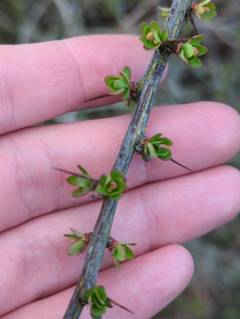 Japanese barberryBerberis thunbergii
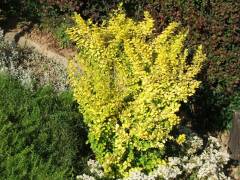 Golden Japanese barberryBerberis thunbergii 'Aurea'
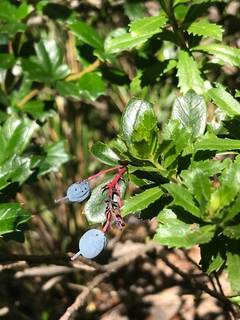 Darwin's barberryBerberis darwinii
 Warty barberryBerberis verruculosa
- Purpleleaf or redleaf Japanese barberryBerberis thunbergii f. atropurpurea
- Helmond Pillar Japanese barberryBerberis thunbergii f. atropurpurea 'Helmond Pillar'