Berberis, Genus, japonica, Species,
- Genus & species
Japanese mahonia
East Asia (Taiwan; long cultivated in China and Japan)
Overview
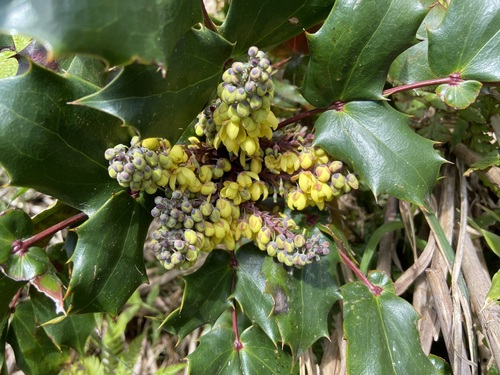
Berberis japonica (widely sold as Mahonia japonica) is an evergreen shrub in the barberry family, reaching 5–7 feet (1.5–2.1 m) tall and 5–10 feet (1.5–3 m) wide with a stiff, upright framework of sparsely branched stems. The leaves are pinnate, 12–18 inches (30–45 cm) long, with 9 to 19 leathery, holly-like leaflets edged in sharp spines and arranged along a rigid central stalk. Pale lemon-yellow flowers are carried in slender, spreading to arching racemes 4–10 inches (10–25 cm) long, clustered at the stem tips. Flowering runs through winter, from late autumn to early spring depending on climate, and the flowers carry a lily-of-the-valley scent. Powdery blue-black berries with a grey bloom follow in spring. The plant grows in sun to deep shade on most soils and tolerates dry shade once established, though it can scorch in cold drying wind and strong midday sun in hot regions. Its spiny foliage and open, leggy base limit where it sits near paths and seating. The roots and inner stems contain yellow berberine alkaloids.
Native Range
Berberis japonica is native to Taiwan and has a long history of cultivation in China and Japan, from which it was introduced to Western gardens. It is naturalized in parts of western Europe.Suggested Uses
Used in shaded and woodland borders, as a winter-flowering specimen, and in low-maintenance shrub plantings under trees. The spiny foliage is also used in informal barrier plantings.How to Identify
Appearance
Size & Dimensions
Height5' - 7'
Width/Spread5' - 10'
Bloom Information
Flowering runs through the winter months, typically from November to March, with the main flush in midwinter. The pale-yellow racemes open over several weeks and carry a sweet fragrance. Blue-black berries ripen in spring and are taken by birds.
Detailed Descriptions
Foliage Description
dark greenGrowing Conditions
Sun Requirements
Requires 1-6 hours of direct sunlight daily
• Full Sun: 6+ hours of direct sunlight
• Partial Shade: 3-6 hours of direct sunlight
• Full Shade: Less than 3 hours of direct sunlight
Care & Maintenance
Care Guide
Grows in part shade to deep shade and tolerates full sun in cool-summer climates, on moist but well-drained soils of most types, including clay and chalk. Established plants tolerate dry shade beneath trees. Cold drying winds and strong midday sun can brown the leaf margins. Watering is needed only while plants establish; mature shrubs are drought-tolerant. The shrub is hardy to about 5°F (-15°C) in zones 7 to 9. Suckering is limited, and the plant keeps a slow, steady rate of growth.Pruning
Pruning is generally minimal. Leggy or bare stems can be cut back to a lower leaf cluster or to ground level in spring after flowering, and the shrub regrows from the base. Removing the oldest stems every few years keeps growth lower and denser.Container Growing
Suitable for container growing
Toxicity Warning
Toxic to pets and humansRelated Berberis species
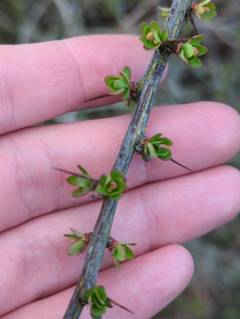 Japanese barberryBerberis thunbergii
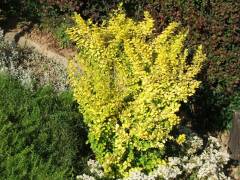 Golden Japanese barberryBerberis thunbergii 'Aurea'
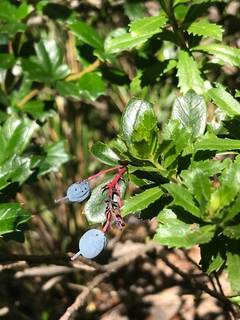 Darwin's barberryBerberis darwinii
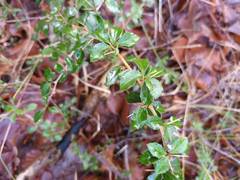 Warty barberryBerberis verruculosa
- Purpleleaf or redleaf Japanese barberryBerberis thunbergii f. atropurpurea
- Helmond Pillar Japanese barberryBerberis thunbergii f. atropurpurea 'Helmond Pillar'