Asclepias, Genus, latifolia, Species,
- Genus & species
broadleaf milkweed
Central and southern United States and northern Mexico
Overview
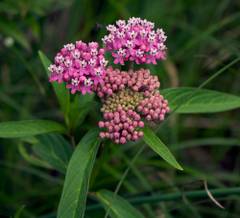
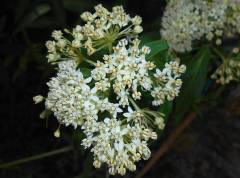
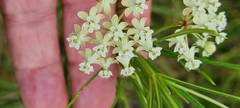
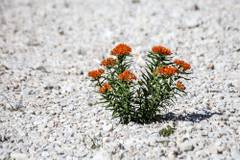
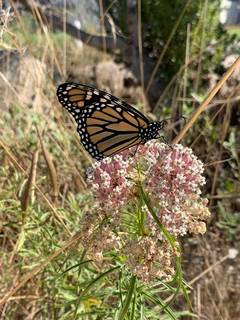
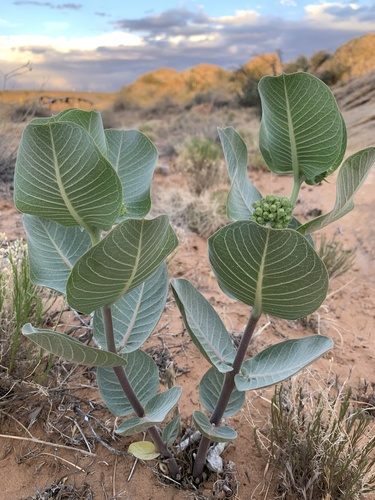
Asclepias latifolia is an erect herbaceous perennial reaching 12-36 inches (30-90 cm) tall, growing in clumps from a deep taproot. The stems are stout and usually unbranched, lined with broad, leathery leaves measuring 2-6 inches (5-15 cm) long and nearly as wide. Leaves are opposite, broadly ovate to nearly round, often overlapping and held close to the stem, with wavy margins and little or no petiole. Flowers appear in dense, rounded umbels seated in the upper leaf axils, each cluster holding 10-25 greenish-white to cream flowers about 0.3 inch (8 mm) across. All parts release a milky latex when cut. After flowering, the plant forms erect seed pods 2-4 inches (5-10 cm) long that split to release flat brown seeds carried on silky white hairs. The species grows on dry plains, sandy flats, and disturbed roadsides across the southern Great Plains and Southwest. It tolerates drought and high summer heat but establishes slowly and does not transplant well once the taproot forms. All parts contain cardiac glycosides toxic to livestock, pets, and humans if eaten. The foliage is a larval food source for monarch butterflies.
Native Range
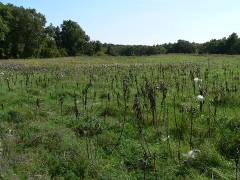
Asclepias latifolia is native to the central and southern United States and northern Mexico, ranging from Nebraska and Kansas south to Texas and west to Arizona. It grows on dry shortgrass prairie, sandy plains, and roadside flats.Suggested Uses
Used in native plant gardens, pollinator plantings, and dry meadow restorations within its range. The cardiac glycosides make it toxic to grazing livestock, so it is kept out of pasture plantings.How to Identify
Appearance
Size & Dimensions
Height1' - 3'
Width/Spread1' - 2'
Bloom Information
Flowering occurs from June through August. The greenish-white to cream umbels open over several weeks in the upper leaf axils. Seed pods follow in late summer and split open in autumn to release silk-tufted seeds.
Detailed Descriptions
Flower Description
greenish-white to creamFoliage Description
blue-green to gray-greenGrowing Conditions
Sun Requirements
Requires 6-12 hours of direct sunlight daily
• Full Sun: 6+ hours of direct sunlight
• Partial Shade: 3-6 hours of direct sunlight
• Full Shade: Less than 3 hours of direct sunlight
Care & Maintenance
Care Guide
Grows in full sun with six or more hours of direct light daily. Sandy, gravelly, or otherwise sharply drained soil suits it, while wet or heavy clay sites cause root rot. Once established, the deep taproot makes the plant drought-tolerant, and supplemental water is rarely needed. Seed germination is slow and improves after 30 days of cold-moist stratification. The taproot does not tolerate disturbance, so the plant is set in its permanent position while young. Native soils need no added fertilizer.Pruning
Pruning needs are minimal. Dead stems can be cut to the ground in late winter before new growth emerges. Spent seed pods may be removed before they split where self-seeding is not wanted.Pruning Schedule
Prune: February–March
winter