Image 1 of 2
Plant Reference
1 / 2
Acer, Genus, palmatum, Species, 'Shaina', Cultivar,
- Genus & species
- Cultivar
Shaina Japanese maple
Parent species {Acer palmatum} native to Japan, Korea, and China; 'Shaina' originated in cultivation
Overview
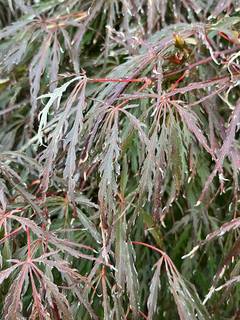
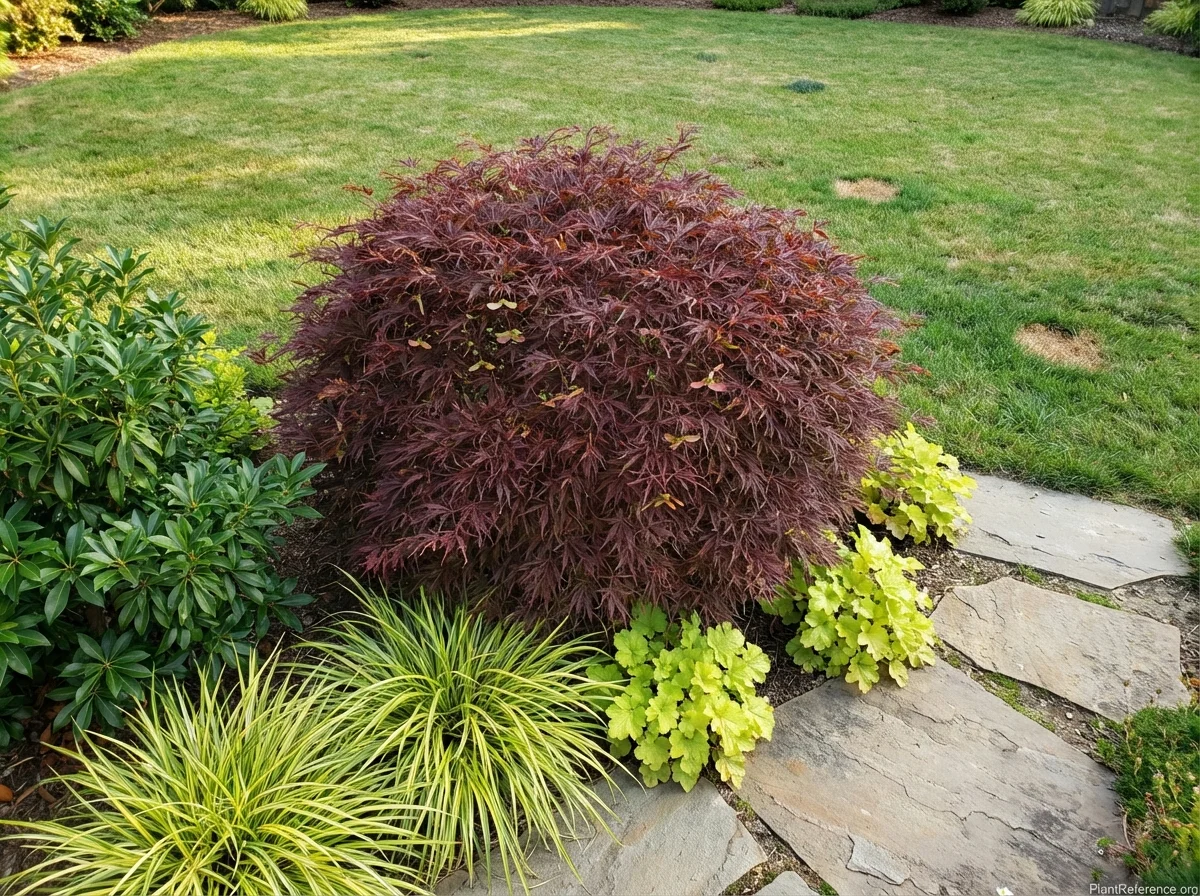
Acer palmatum 'Shaina' is a deciduous dwarf shrub cultivar reaching 4-6 feet (1.2-1.8 m) tall with an equal spread over 10-15 years, forming a dense compact globe-shaped mound. It originated as a witches'-broom sport of A. palmatum 'Bloodgood' and retains the deep red-purple foliage of its parent. Leaves are five-lobed, 1-2 inches (2.5-5 cm) wide — roughly half the size of 'Bloodgood' leaves — with narrow pointed lobes and serrated margins. Foliage is deep red-purple through spring and summer and turns scarlet in fall. The dense mounded form holds its outline without shaping. Growth averages 2-4 inches (5-10 cm) per year. As with other red-foliage A. palmatum cultivars, color intensity depends on light exposure: 4-6 hours of direct sun produces the deepest red-purple tones, and deep shade shifts color toward bronze-green. Sustained summer temperatures above 85°F (29°C) cause leaf margin scorch, which rules out hot-summer regions without afternoon shade.
Native Range
Acer palmatum is native to Japan, Korea, and China, occurring in mixed broadleaf forests at low to middle elevations. The cultivar 'Shaina' originated as a witches'-broom sport on A. palmatum 'Bloodgood' and does not occur in wild populations.Suggested Uses
Planted as a specimen, foundation planting accent, or container specimen at 5-6 foot (1.5-1.8 m) spacing. The compact globe form and red-purple summer foliage suit small residential gardens, raised beds, and courtyard positions where standard-size A. palmatum cultivars would outgrow the space within 5-8 years. Grown in containers of 10 gallons (38 L) or more. Not suited to hot-summer climates, alkaline soils above pH 7.0, or sites with afternoon sun in warm regions.How to Identify
Appearance
Size & Dimensions
Height4' - 6'
Width/Spread4' - 6'
Bloom Information
Pendant clusters of small dark red to purple flowers open in April and May as new leaves emerge. Individual flowers measure 0.3-0.4 inch (8-10 mm) across and are not a primary display feature. Samaras 0.75-1 inch (2-2.5 cm) long ripen to tan-brown in September and October.
Detailed Descriptions
Flower Description
dark red to purple; pendant clusters; individual flowers 0.3-0.4 inch (8-10 mm) acrossFoliage Description
deep red-purple through spring and summer; scarlet in fall; leaves 1-2 inches (2.5-5 cm) wide, five-lobed with narrow pointed serrated lobesGrowing Conditions
Sun Requirements
Requires 3-8 hours of direct sunlight daily
• Full Sun: 6+ hours of direct sunlight
• Partial Shade: 3-6 hours of direct sunlight
• Full Shade: Less than 3 hours of direct sunlight
Care & Maintenance
Care Guide
Plant in moist, well-drained, humus-rich soil with a pH of 5.5-7.0 in part shade to full sun in cool-summer climates; tolerated soil types include loam and sand. Water weekly during the first two growing seasons. Established plants tolerate dry intervals of 7-10 days but show leaf scorch under sustained drought or afternoon heat. Foliage color is most saturated at 4-6 hours of direct sun; deep shade shifts color toward bronze-green. Sustained summer temperatures above 85°F (29°C) cause leaf margin scorch, which rules out hot-summer regions without afternoon shade. Grown in containers of 10 gallons (38 L) or more with free-draining medium. No routine fertilization is required in humus-rich soils.Pruning
No routine pruning is required. The dense globe form is self-maintaining and the 2-4 inch (5-10 cm) annual growth rate holds the compact outline without intervention for many years. Dead or crossing branches are removed in late spring to early summer (May-June) after leaf-out. Late-summer and fall pruning is avoided because wounds close slowly at those times.Pruning Schedule
Prune: May–June
late spring
Container Growing
Suitable for container growing
Minimum container size: 10 gallons