When to Plant Carrots in Raleigh: Zone 7b Dates + Best Varieties
Pets & Toxicity
Recorded toxicity for plants linked in this guide. An unknown status is not a safety assessment.
No linked plant is recorded as toxicDetailsHide
Daucus carota ssp. sativus 'Rainbow' — Toxicity
Non-toxicView Daucus carota ssp. sativus 'Rainbow' plant profileDaucus carota ssp. sativus 'Nantes' — Toxicity
Non-toxicView Daucus carota ssp. sativus 'Nantes' plant profileDaucus carota ssp. sativus 'Imperator' — Toxicity
Non-toxicView Daucus carota ssp. sativus 'Imperator' plant profileDaucus carota ssp. sativus 'Chantenay' — Toxicity
Non-toxicView Daucus carota ssp. sativus 'Chantenay' plant profileDaucus carota ssp. sativus 'Danvers 126' — Toxicity
Non-toxicView Daucus carota ssp. sativus 'Danvers 126' plant profile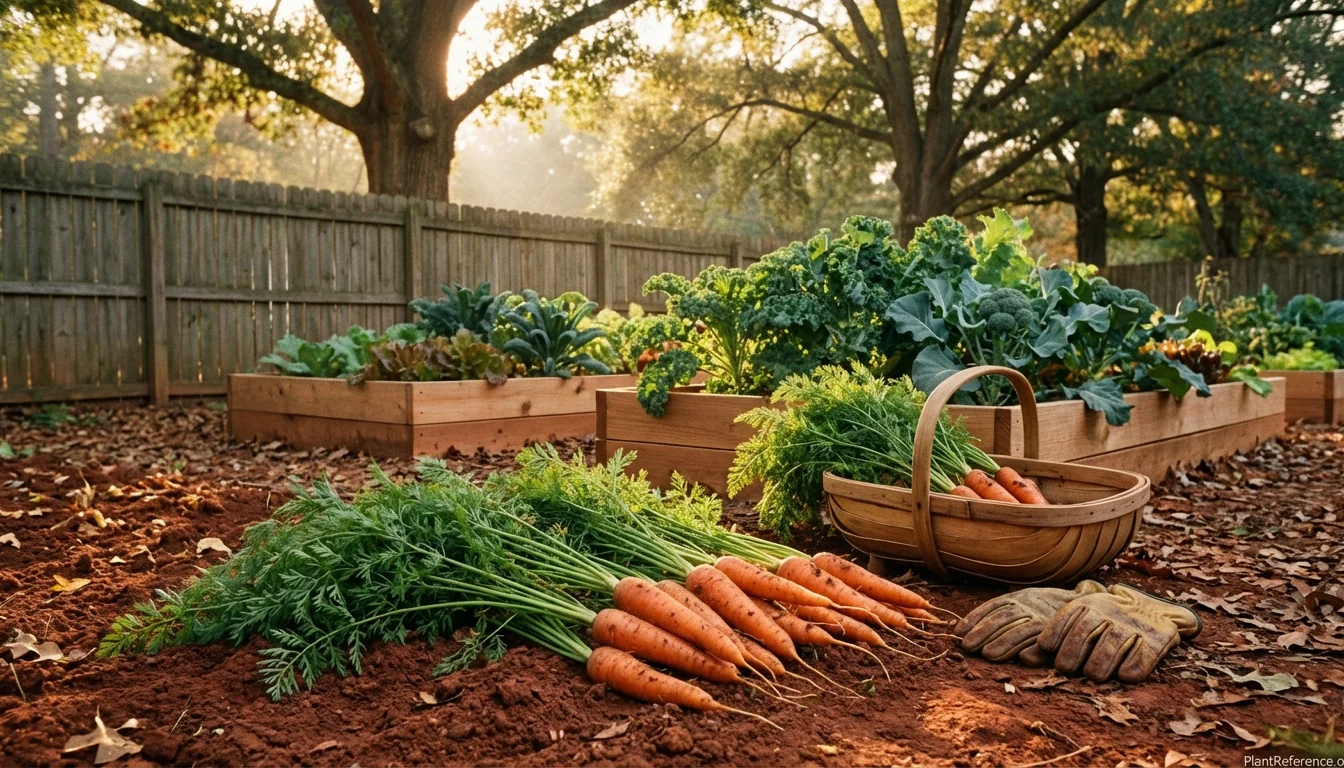
— Image © Plant Reference 2026
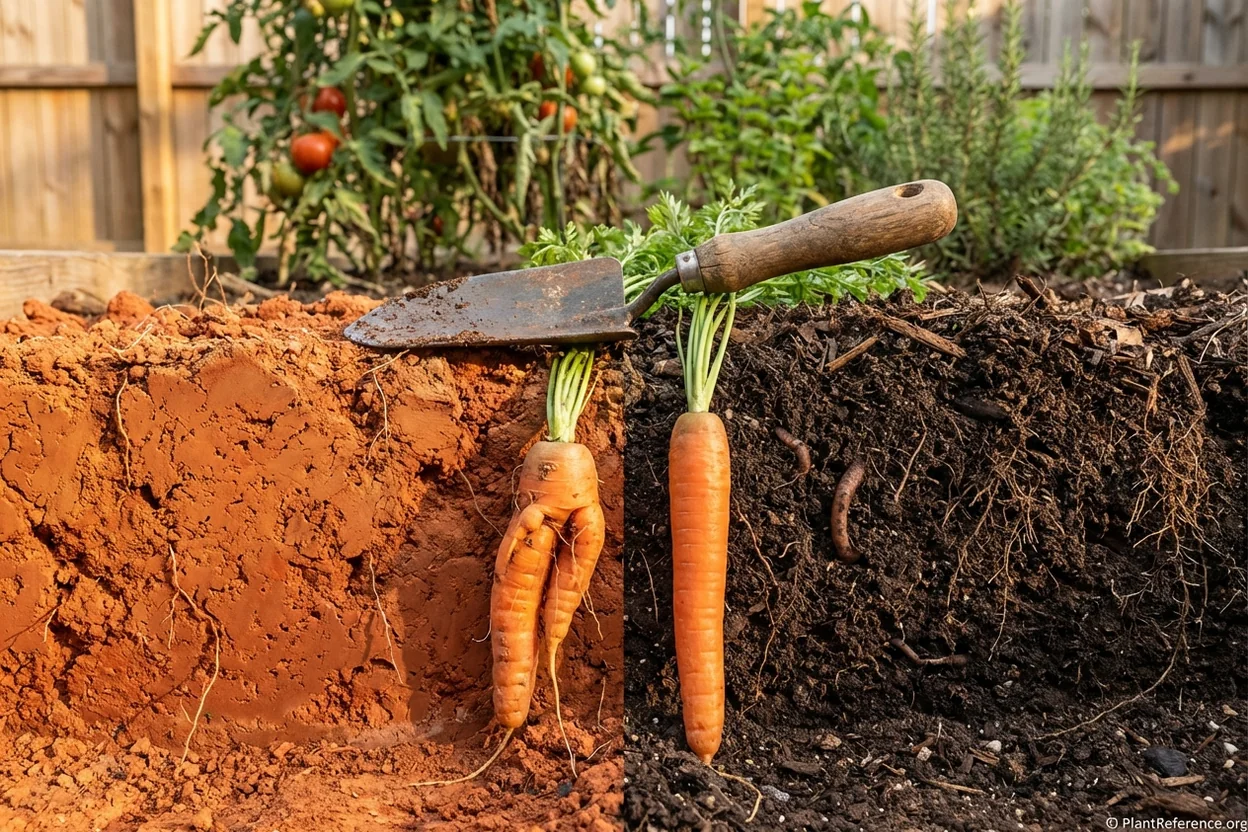
Raleigh sits in a carrot-growing sweet spot. We're far enough south for a long season and mild winters, but far enough north that summer heat doesn't last as long as it does in Atlanta or Dallas. The 214-day growing window gives you solid spring and fall crops with a manageable summer gap. The main challenge is the same one that defines gardening across the entire Piedmont region: red clay. It's mineral-rich and holds moisture well, but it compacts into something carrots can't penetrate without help. Get the soil right and everything else follows.
Best Carrot Varieties for Raleigh's Zone 7b Climate
The Piedmont red clay under most Raleigh neighborhoods is dense and acidic, typically running pH 5.5-6.5. It holds water and nutrients well—better than sand—but physically resists root penetration. Variety selection starts with matching root shape to your soil depth.
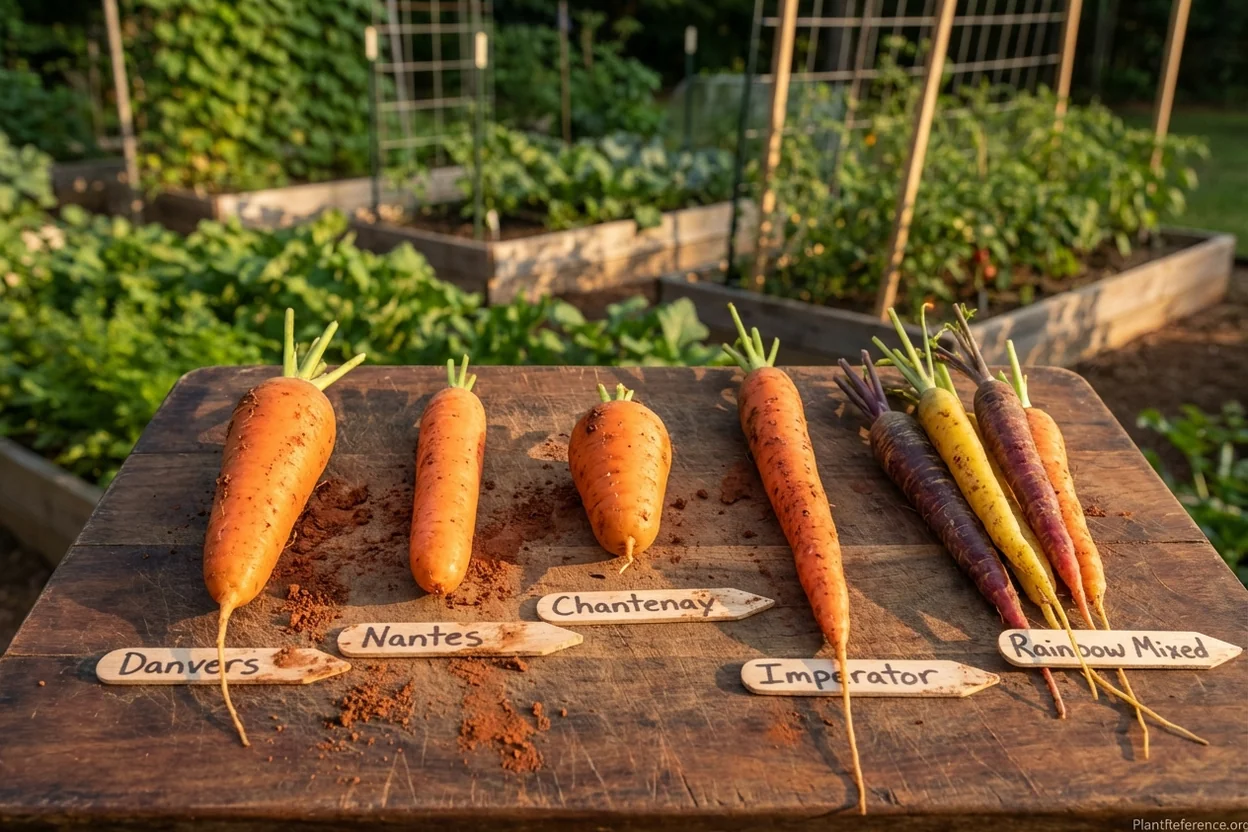
🌿Daucus carota ssp. sativus 'Danvers 126' (DAW-kus kuh-ROH-tuh) is the most reliable variety for Raleigh's native Piedmont clay. The conical root tapers as it grows, distributing mechanical force across a wider surface area than cylindrical types. At 70-80 days to maturity, 🌿Daucus carota ssp. sativus 'Danvers 126' fits comfortably in both planting windows. The firm flesh stores for months in cold conditions—useful for stretching the fall harvest through winter.
🌿Daucus carota ssp. sativus 'Nantes' produces the best-tasting carrot you'll grow—sweet, tender, nearly coreless—but it demands amended or raised bed soil. The cylindrical root doesn't handle clay resistance well. If you've invested the work to build good soil, 🌿Daucus carota ssp. sativus 'Nantes' makes that investment pay off. The cultivar 'Bolero' adds strong disease resistance that matters in Raleigh's humid shoulder seasons.
🌿Daucus carota ssp. sativus 'Chantenay' is the short, reliable option for challenging spots. At 4-5 inches (10-13 cm) long with broad shoulders, 🌿Daucus carota ssp. sativus 'Chantenay' stays within the amended topsoil and avoids the dense clay below. Works in containers, first-year garden beds, and community plots where soil improvement is still in progress. Harvest before 2 inches (5 cm) diameter to prevent a woody core.
🌿Daucus carota ssp. sativus 'Imperator' needs at least 12 inches (30 cm) of loose soil. In native Raleigh clay, that means purpose-built raised beds. The cultivar 'Sugarsnax 54' adds exceptional sweetness to the long, slender form. Worth the effort if you have the setup.
🌿Daucus carota ssp. sativus 'Rainbow' produces white, yellow, orange, and coral roots from one hybrid packet. At 70-75 days, it fits both windows and adds visual interest. Moderate depth requirements work in most amended Raleigh beds.
Variety | Days to Maturity | Best For | Notes for Raleigh |
|---|---|---|---|
70-80 days | Native clay and storage | Top pick for Piedmont red clay; conical root handles dense soil | |
65-75 days | Amended beds and fresh eating | Sweetest flavor; 'Bolero' resists humid-season diseases | |
65-75 days | Containers and shallow soil | Short roots avoid clay subsoil; reliable in challenging spots | |
75-85 days | Deep raised beds only | Needs 12+ inches loose soil; not for native Raleigh clay | |
70-75 days | Specialty and nutrition | Multiple colors; fits both spring and fall windows |
Specific Planting Dates for Raleigh
Raleigh averages an April 5 last frost and November 5 first frost, giving you 214 frost-free days. The Piedmont's moderate temperatures create two strong carrot windows with a shorter summer gap than cities farther south.
Spring Planting
Start sowing in early March, about four weeks before the April 5 last frost. Carrots tolerate light frost without damage, so early planting is safe. Continue succession sowings every two to three weeks through mid-April. Spring carrots need to reach harvestable size before sustained soil temperatures exceed 75°F (24°C)—typically by mid-June in Raleigh. That gives spring crops a generous growing window compared to cities like Atlanta and Dallas.
Fall Planting
Fall is Raleigh's strongest carrot season. Begin sowing in late August while soil is still warm enough for fast germination (5-7 days), and continue through late September. The timing puts roots in their prime development phase during October and November's cooling temperatures. As soil drops below 50°F (10°C), starch-to-sugar conversion produces the sweetest carrots of the year. Raleigh's first frost around November 5 doesn't end the harvest—it enhances it.
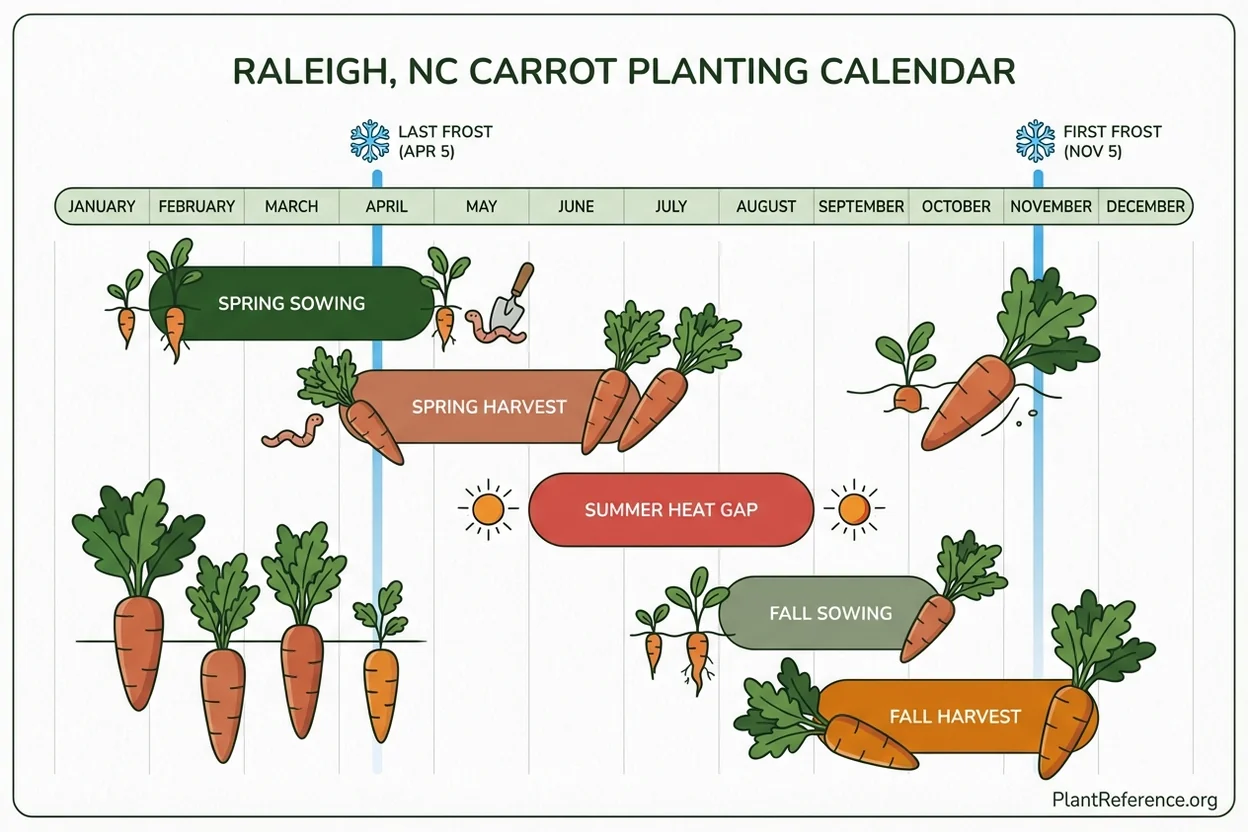
Spring sowing window: March 1 - April 15
Spring harvest: May through mid-June (before sustained heat)
Summer heat gap: Late June through mid-August
Fall sowing window: August 25 - September 25
Fall harvest: November through January (with mulch protection)
Best flavor: Fall harvest after cooling triggers sugar conversion
Complete Growing Guide for Raleigh
Soil Preparation
Piedmont red clay is dense, acidic, and compacts after rain—three qualities that work against straight carrot roots. But that same clay is mineral-rich and holds moisture and nutrients far better than sandy soil. The goal is to open up the structure without replacing what's already there.
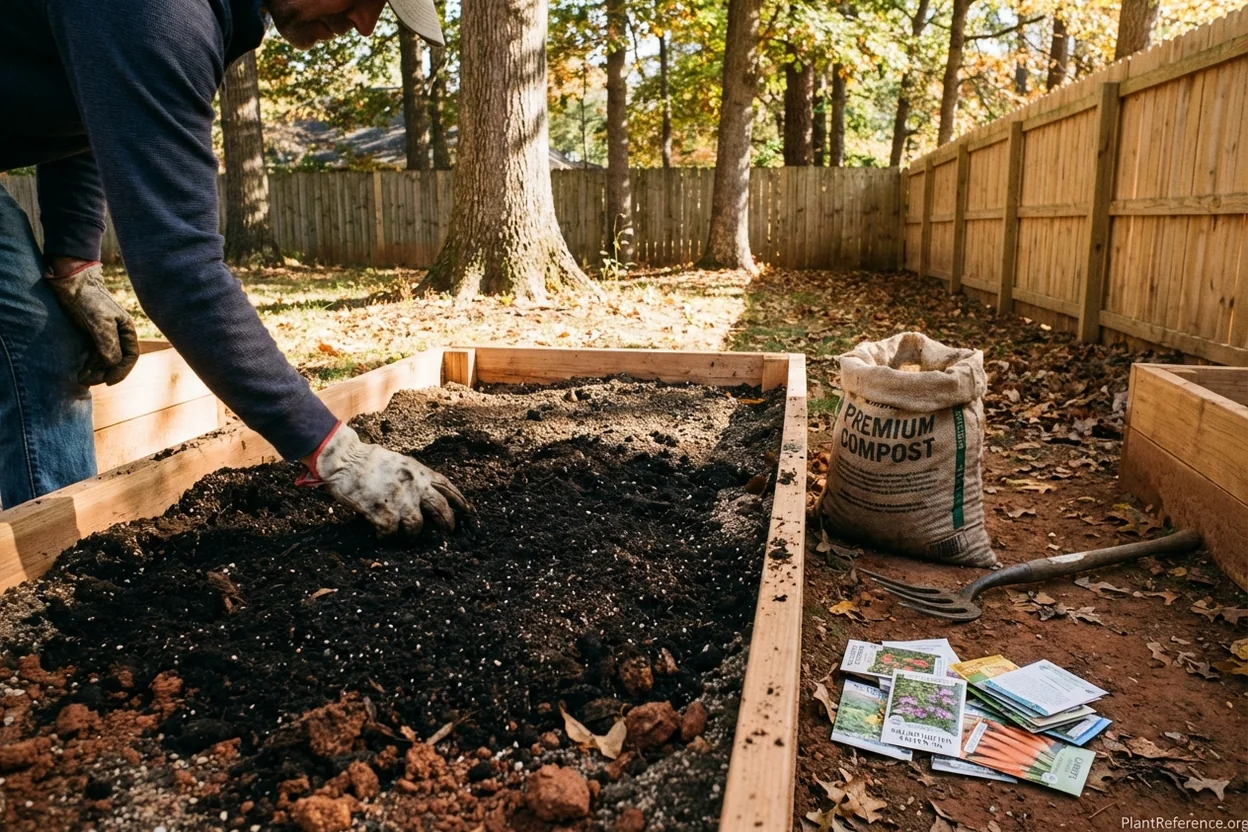
For in-ground beds, work the top 10-12 inches (25-30 cm) with a garden fork when moisture allows crumbling. Incorporate 3-4 inches (8-10 cm) of finished compost and 1-2 inches (2.5-5 cm) of coarse sand. The compost adds organic matter and biological activity that gradually improves clay structure from the inside. Test pH through the NC Cooperative Extension—Raleigh clay typically runs 5.5-6.5, and carrots prefer 6.0-6.8. Add lime if needed. Best Soil Mix for Raised Beds: Creating the Perfect Growing Medium
For raised beds, build to at least 12 inches (30 cm) deep with 60% topsoil, 30% compost, and 10% coarse sand or perlite. Cedar resists rot in Raleigh's humid climate and lasts 8-10 years without treatment. How to Build a Raised Garden Bed: Step-by-Step Construction Guide
Seeding
Sow seeds 1/4 inch (0.6 cm) deep in rows 12 inches (30 cm) apart. Cover with vermiculite or fine compost rather than native clay—Piedmont soil crusts after rain, and carrot seedlings don't have the strength to push through a hardened surface. This crusting problem is the single biggest germination failure in Raleigh gardens. Best Soil for Raised Beds: 6 Commercial Mixes Tested and Compared
Spring sowings take 14-21 days to germinate in cool soil. Lay burlap or a board over the row to maintain surface moisture. Check daily from day 5 and remove the cover at the first sign of emerging loops. Fall sowings germinate in 5-7 days because warm August-September soil speeds the process. Keep the surface consistently moist with light daily watering.
Thinning
Thin in two stages: first to 1 inch (2.5 cm) when seedlings reach 2 inches (5 cm) tall, then to 2-3 inches (5-8 cm) at 4-5 inches (10-13 cm). Cut at the soil line with scissors to avoid disturbing neighboring roots in clay soil. Raised Bed Vegetable Garden Layout: Planning for Maximum Production
Watering
Carrots need 1 inch (2.5 cm) of water weekly during early growth, increasing to 1.5-2 inches (4-5 cm) as roots develop. Raleigh averages about 46 inches of rainfall annually, distributed fairly evenly—more consistent than many Southern cities. During the occasional dry spell, supplement with drip irrigation or soaker hoses to maintain steady moisture.
Inconsistent watering causes root splitting as cells expand faster than walls can form. Clay soil holds moisture longer than sand, so check at 2-inch depth before irrigating—overwatering in clay creates the waterlogged conditions that promote root rot. Raised Bed Irrigation Systems: Watering Solutions for Consistent Growth
Mulching
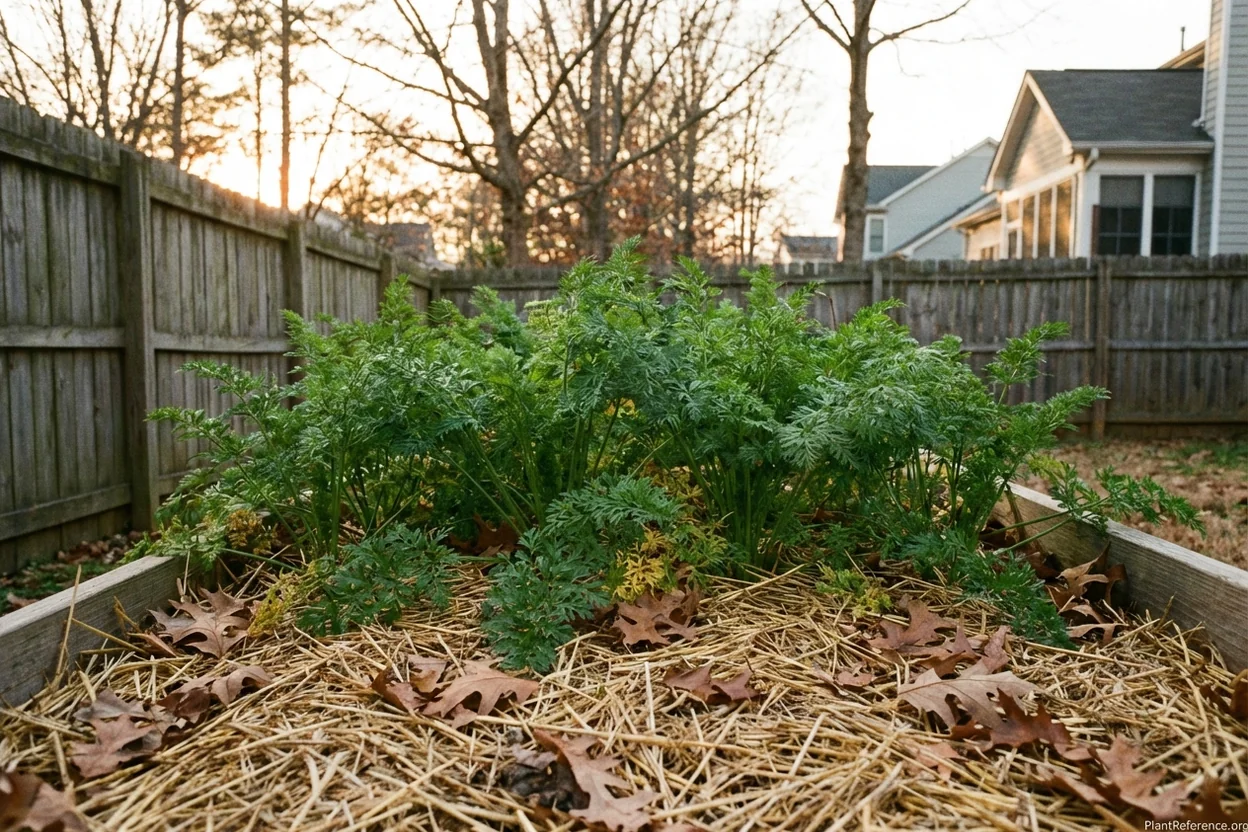
Apply 2-3 inches (5-8 cm) of straw or shredded leaves after seedlings are established. In spring, mulch keeps roots cool as temperatures rise through May. In fall, mulch insulates the bed after the November 5 first frost, extending the harvest window into December and January. Shredded hardwood leaves from Raleigh's abundant oaks make excellent free mulch—run them through a mower before applying to prevent matting. Raised Bed Soil Settling and Compaction: Prevention and Solutions
Troubleshooting Raleigh-Specific Problems
Summer Heat Gap
Raleigh's summer temperatures push soil above 75°F (24°C) from late June through mid-August, triggering bitter terpenoid compounds in carrot roots. The gap is shorter than Atlanta's or Dallas's—typically 6-8 weeks rather than 3-4 months—which means you can plant fall crops earlier and squeeze more from the spring window. Harvest spring carrots by mid-June and start fall sowings by late August. When to Plant Peppers in Raleigh: Complete Guide + Best Varieties for Zone 7b
Leaf Blight in Humid Conditions
Raleigh's humidity peaks during summer and early fall, promoting Alternaria and Cercospora leaf blight on carrot foliage. Infected leaves develop brown lesions that reduce photosynthesis and slow root development. Space rows 12 inches (30 cm) apart for airflow, water at the soil surface rather than overhead, and remove infected foliage promptly. The Nantes cultivar 'Bolero' offers above-average resistance. When to Plant Tomatoes in Raleigh: Complete Guide + Best Varieties for Zone 7b
Clay Crusting After Spring Rain
Piedmont spring rains compact the soil surface into a crust that blocks carrot emergence. Cover seeds with vermiculite rather than native soil, and protect seeded beds with floating row cover during the first two weeks to buffer rain impact. Once seedlings push through, they're strong enough to handle normal conditions. When to Plant Kale in Raleigh: Complete Guide + Best Varieties for Zone 7b
Voles and Root Damage
Voles tunnel through Raleigh gardens and gnaw on carrot roots underground, leaving irregular channels and bite marks. Hardware cloth lining on raised bed bottoms excludes voles from below. For in-ground beds, keep mulch pulled 2-3 inches back from plant stems to reduce cover for vole runways. When to Plant Squash in Raleigh: Complete Guide + Best Varieties for Zone 7b
Harvest & Storage
Spring carrots reach harvest size when shoulders measure 3/4-1 inch (2-2.5 cm) in diameter, typically 65-85 days after sowing. Raleigh's moderate spring gives you until mid-June before heat degrades quality—a larger window than gardeners get in the Deep South. Loosen soil alongside the row with a garden fork before pulling. Piedmont clay grips roots firmly, and pulling straight up snaps off tips. When to Plant Green Beans in Raleigh: Complete Guide + Best Varieties for Zone 7b
Fall carrots are the highlight. Roots that mature through October and November develop peak sweetness as cooling soil triggers starch-to-sugar conversion. Raleigh's first frost around November 5 improves flavor rather than ending the season. Apply 3-4 inches (8-10 cm) of straw mulch after the first frost and continue harvesting through December and into January. Most Raleigh winters stay mild enough that mulched carrots survive without additional protection.
For long-term storage, remove foliage immediately—leaves pull moisture from the root through transpiration. Store unwashed carrots in perforated plastic bags at 32-38°F (0-3°C). 🌿Daucus carota ssp. sativus 'Danvers 126' and the Nantes cultivar 'Bolero' store for four to five months under proper conditions. When to Plant Onions in Raleigh: Complete Guide + Best Varieties for Zone 7b
Frequently Asked Questions
Reading about plants and recognising them are different skills. These three build the second.
- Daily PlantIdentify the day’s mystery plant from a close-up photograph.
- Keyed OutWork a dichotomous key, lead by lead, to name a hidden specimen.
- Name That PlantName a specimen from botanical clues dealt hardest first.
Free to play, no account needed
Rachel is a garden writer and photographer based in Raleigh who covers the Piedmont region of North Carolina. She has a journalism background and got into gardening after buying her first house and realizing she had no idea what any of the plants in her yard were. That curiosity led to a Master Gardener certification and eventually a garden writing career. Rachel is especially interested in native plants of the Southeast, seasonal color, and the challenge of gardening in red clay soil. Her photography background means she pays attention to how gardens look through the seasons—she thinks about visual composition as much as plant health. She writes clearly and directly, without the breathless enthusiasm that makes a lot of garden writing hard to trust.