When to Plant Carrots in Portland: Zone 8b Dates + Best Varieties
Pets & Toxicity
Recorded toxicity for plants linked in this guide. An unknown status is not a safety assessment.
No linked plant is recorded as toxicDetailsHide
Daucus carota ssp. sativus 'Nantes' — Toxicity
Non-toxicView Daucus carota ssp. sativus 'Nantes' plant profileDaucus carota ssp. sativus 'Chantenay' — Toxicity
Non-toxicView Daucus carota ssp. sativus 'Chantenay' plant profileDaucus carota ssp. sativus 'Imperator' — Toxicity
Non-toxicView Daucus carota ssp. sativus 'Imperator' plant profileDaucus carota ssp. sativus 'Rainbow' — Toxicity
Non-toxicView Daucus carota ssp. sativus 'Rainbow' plant profileDaucus carota ssp. sativus 'Danvers 126' — Toxicity
Non-toxicView Daucus carota ssp. sativus 'Danvers 126' plant profile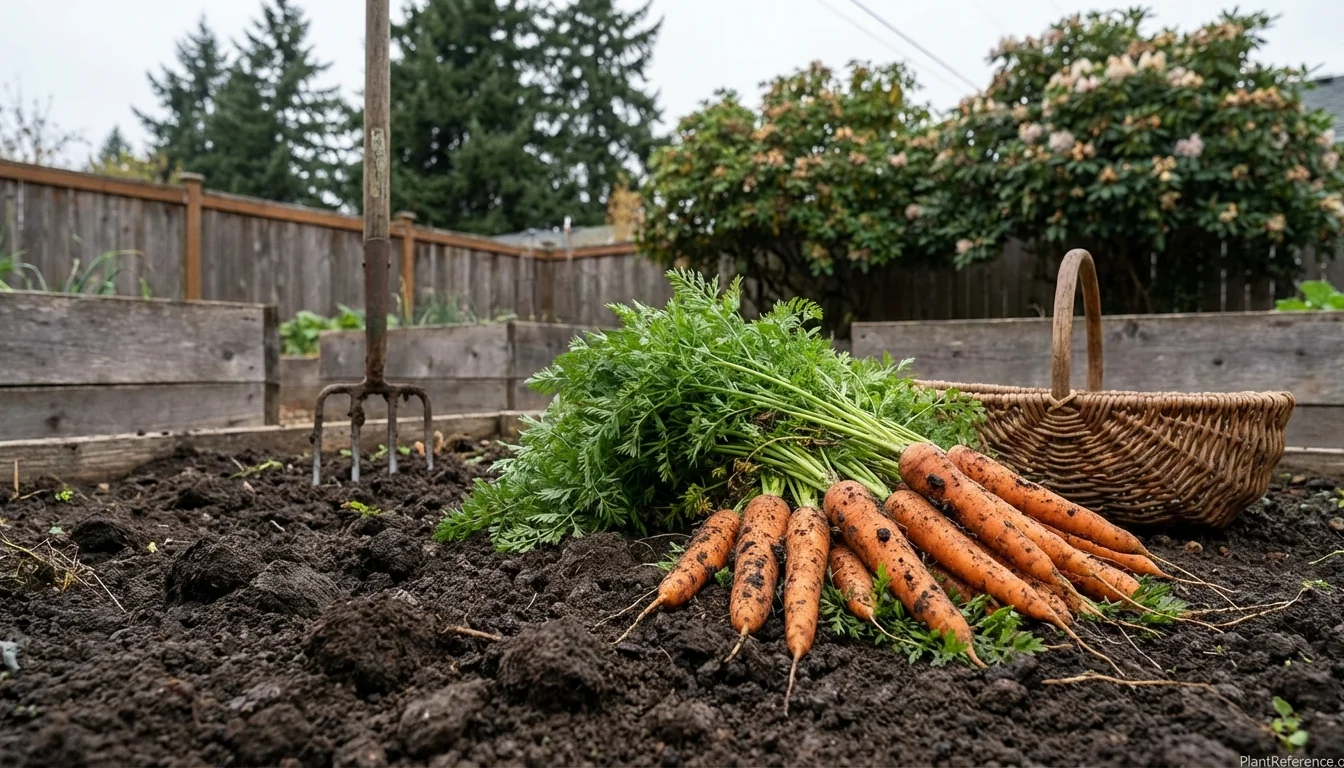
— Image © Plant Reference 2026
Understanding why carrots behave the way they do in Portland starts with what's underground. The Willamette Valley's alluvial soils—deposited over millennia by the Willamette River and its tributaries—create a distinctive growing environment: a fertile silty clay-loam topsoil layer sitting over heavier clay subsoil. That upper layer is rich in organic matter and holds moisture well, which is excellent for carrot germination. But the clay beneath it resists root penetration, which explains why Portland gardeners sometimes harvest carrots that start straight and then abruptly fork 6 inches down. With the right variety selection and soil management, Portland's 235-day season and mild winters make it one of the best carrot-growing climates in the country.
Best Carrot Varieties for Portland's Zone 8b Climate
Portland's Willamette Valley soils vary by neighborhood, but most gardeners are working with some combination of silty clay-loam. The key variable is how deep the workable layer extends before you hit dense clay. That depth determines which carrot varieties will thrive and which will fork.
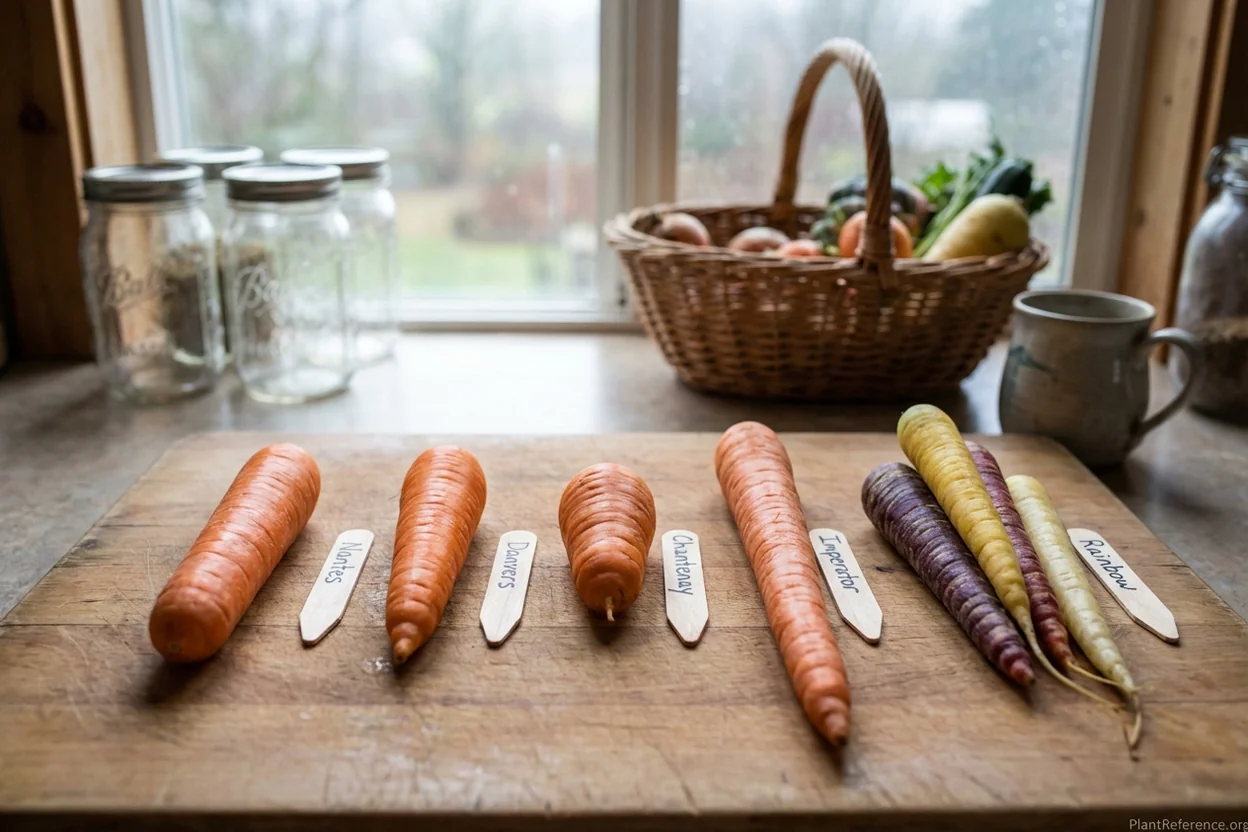
🌿Daucus carota ssp. sativus 'Nantes' (DAW-kus kuh-ROH-tuh) is my top recommendation for Portland. The cylindrical root produces sweet, nearly coreless flesh with a satisfying snap. At 6-7 inches (15-18 cm) long, 🌿Daucus carota ssp. sativus 'Nantes' needs moderate depth—achievable in most Portland garden beds with basic amendment. The cultivar 'Bolero' adds exceptional disease resistance and storage ability, while 'Napoli' is bred specifically for overwintering and holds in the ground through our mild winters without deteriorating.
🌿Daucus carota ssp. sativus 'Danvers 126' is the variety that handles Portland's heavier clay pockets without complaint. The conical, wedge-shaped root generates lateral force as it grows, displacing soil particles rather than trying to push straight through resistance. From a plant physiology perspective, the root's shape distributes mechanical stress across a broader surface area—the physics work in its favor. At 70-80 days to maturity, 🌿Daucus carota ssp. sativus 'Danvers 126' fits comfortably in both planting windows.
🌿Daucus carota ssp. sativus 'Chantenay' is the insurance policy for the most challenging soil. At just 4-5 inches (10-13 cm) long with stout shoulders, 🌿Daucus carota ssp. sativus 'Chantenay' produces a usable root even where depth is severely limited. Container gardens, shallow beds, and rocky sites all work. Harvest before the diameter exceeds 2 inches (5 cm)—beyond that point, the ratio of cortex tissue to phloem shifts and the core becomes woody.
🌿Daucus carota ssp. sativus 'Imperator' needs 12 inches (30 cm) or more of loose, obstruction-free soil. In Portland's native ground, that rarely exists without significant amendment or purpose-built raised beds. The long, slender roots are what you see at the grocery store, and 'Sugarsnax 54' adds high sugar content to the Imperator form. Reserve this variety for deep raised beds with a custom soil blend.
🌿Daucus carota ssp. sativus 'Rainbow' produces white, yellow, orange, and coral roots from one F1 hybrid packet. The different pigments—beta-carotene, xanthophylls, lycopene, anthocyanins—represent distinct classes of phytochemicals with different antioxidant activity. Maturity runs 70-75 days with intermediate depth requirements.
Variety | Days to Maturity | Best For | Notes for Portland |
|---|---|---|---|
65-75 days | Fresh eating and overwintering | Top performer in Willamette Valley silty loam; 'Napoli' for winter harvest | |
70-80 days | Heavy clay and storage | Conical shape handles Portland's clay subsoil layer | |
65-75 days | Containers and shallow soil | Short roots avoid clay subsoil entirely; harvest before 2-inch diameter | |
75-85 days | Deep raised beds only | Needs 12+ inches loose soil; not for native Portland clay | |
70-75 days | Specialty and nutrition | Multiple phytochemical classes; moderate depth requirement |
Specific Planting Dates for Portland
Portland averages a March 20 last frost and November 10 first frost, giving you 235 frost-free days. Combined with mild winters that rarely freeze the ground below the surface, you can grow carrots across three distinct seasons.
Spring Planting
Begin sowing in late February once the soil is workable and has reached at least 40°F (4°C). At that temperature, germination takes 14-21 days—the radicle emerges slowly because enzymatic activity in the seed increases linearly with soil temperature up to about 75°F (24°C). Continue succession sowings every two to three weeks through late March for staggered harvests from May through July.
Fall and Overwintering
Sow your fall crop in early to mid-September, roughly 8-10 weeks before the November 10 first frost. The roots size up during October's cooling temperatures, then undergo cold-induced metabolic changes through winter. Below 40°F (4°C), amylase enzymes break down stored starch into soluble sugars—glucose, fructose, and sucrose—which function as cryoprotectants to prevent ice crystal formation in cell vacuoles. This is the biochemical reason overwintered carrots taste sweeter than anything from the spring crop. Harvest from December through early March.
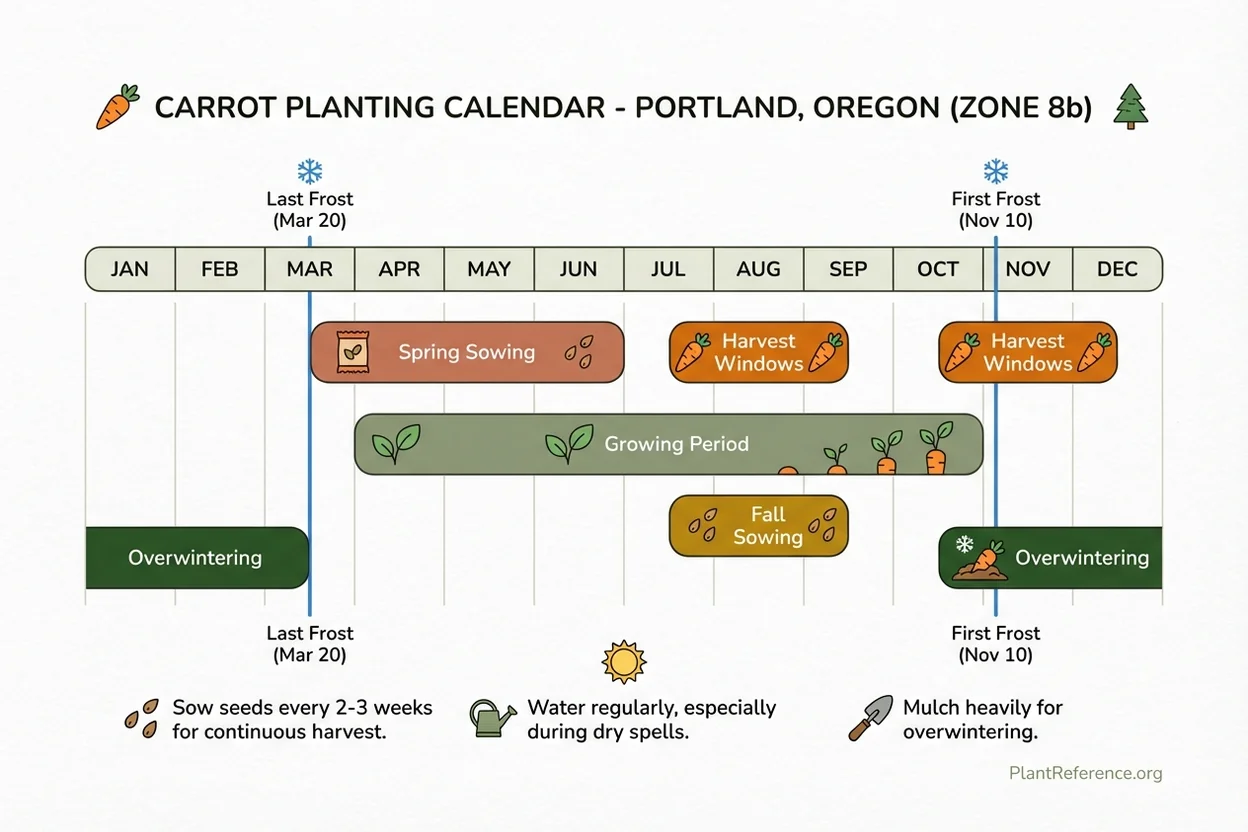
Spring sowing window: February 20 - March 30
Succession sowing interval: Every 2-3 weeks
Spring harvest: May through July
Fall sowing window: September 1 - September 20
Fall/winter harvest: December through March (overwintered in ground)
Season ends: November 10 first frost (but carrots overwinter with mulch protection)
Complete Growing Guide for Portland
Soil Preparation
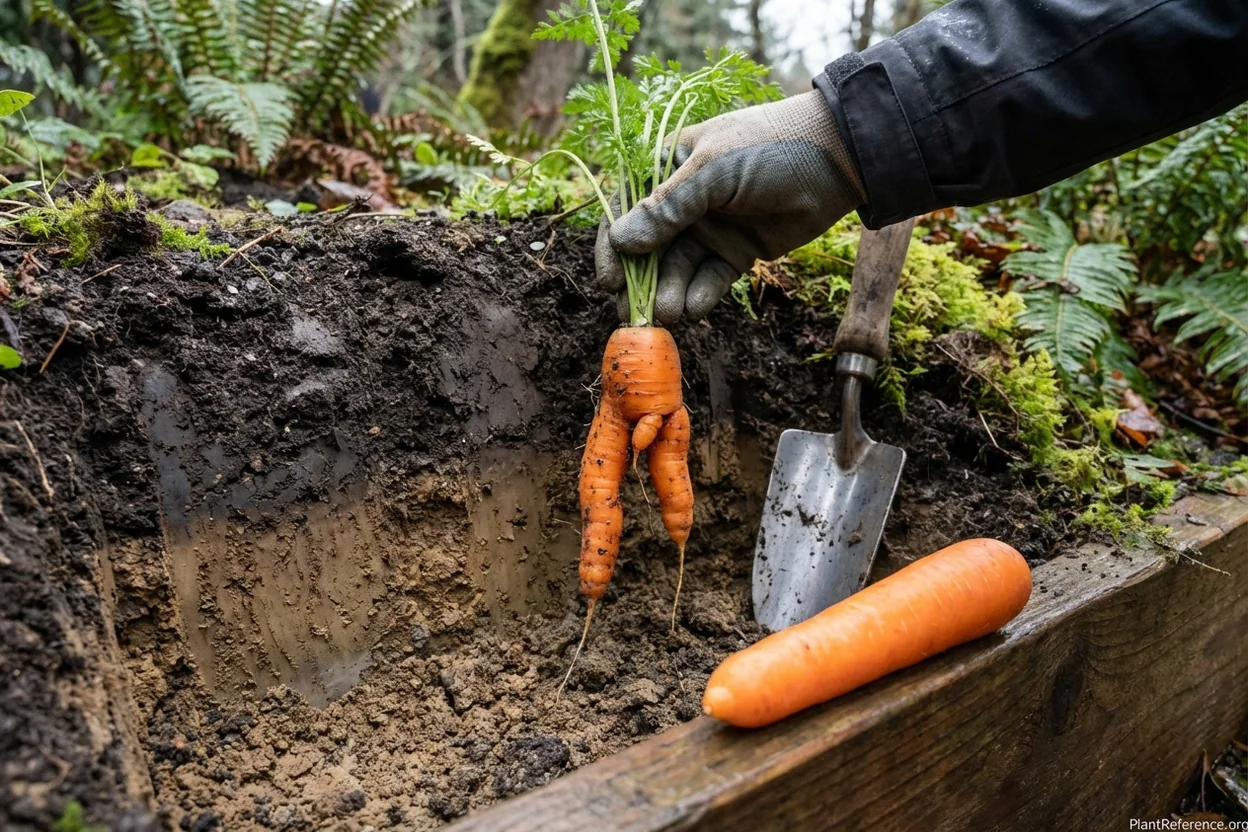
The Willamette Valley's alluvial soil profile typically shows 6-10 inches (15-25 cm) of workable silty clay-loam over a denser clay horizon. Carrots grow well in that upper layer, but roots that hit the clay transition zone fork or stop growing. Your preparation strategy depends on which varieties you're planting.
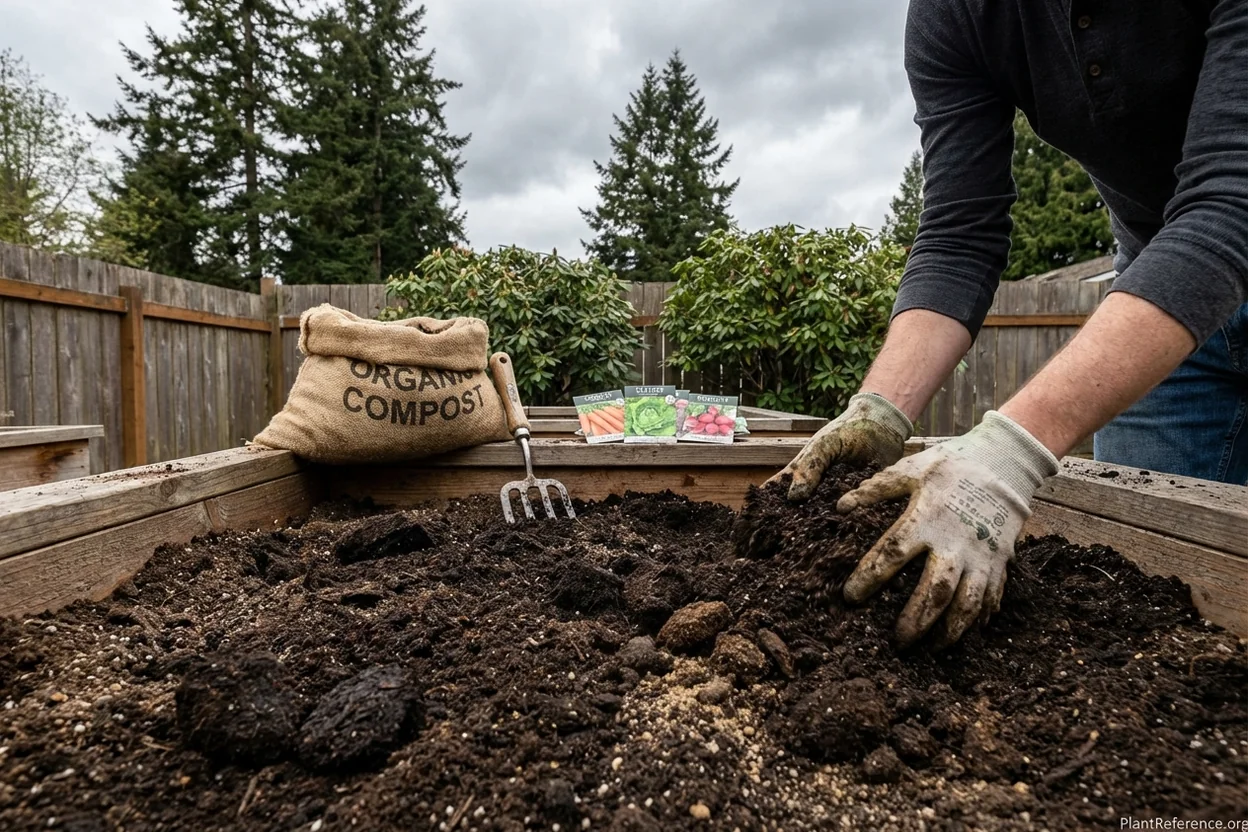
For in-ground beds growing 🌿Daucus carota ssp. sativus 'Nantes' or 🌿Daucus carota ssp. sativus 'Danvers 126', work the soil to 10-12 inches (25-30 cm) deep when it crumbles in your hand. Portland's wet winters mean the soil often stays too moist for spring preparation until mid-February—working waterlogged clay destroys aggregate structure and creates compaction that persists all season. Incorporate 2-3 inches (5-8 cm) of finished compost and coarse sand to improve drainage and reduce mechanical resistance. Best Soil Mix for Raised Beds: Creating the Perfect Growing Medium
Skip fresh manure entirely. The excess nitrogen stimulates lateral root branching through auxin-mediated signaling—you'll get hairy, forked taproots instead of smooth ones. Portland's native soil is already moderately fertile; a basic soil test from the OSU Extension Service tells you exactly what amendments are needed. Raised Bed Soil pH Problems: Testing, Adjusting, and Maintaining Balance
For raised beds, fill to at least 12 inches (30 cm) with 60% topsoil, 30% compost, and 10% coarse sand. Use untreated cedar or redwood for construction—both species contain natural thujaplicins that resist fungal decay in Portland's wet climate. How to Build a Raised Garden Bed: Step-by-Step Construction Guide
Seeding and Germination
Carrot seeds need uninterrupted moisture for 14-21 days to germinate. The seed coat must fully imbibe water to activate gibberellic acid production, which triggers the embryo to break dormancy. If the seed dries after imbibition but before radicle emergence, the embryo dies.
Sow seeds 1/4 inch (0.6 cm) deep in rows 12 inches (30 cm) apart. Cover with vermiculite or fine compost—not native soil. Portland's silty clay-loam forms a hard surface crust after rain that carrot seedlings lack the mechanical strength to penetrate. That crust is the primary cause of poor germination stands in our area. Best Soil for Raised Beds: 6 Commercial Mixes Tested and Compared
Lay burlap or a board directly over the seeded row to maintain surface moisture. Check daily from day 5 onward. Remove the cover immediately when you spot the first emerging seedling loops—even one additional day under the board produces etiolated hypocotyls that collapse in direct light.
Thinning
Thin in two stages: first to 1 inch (2.5 cm) when seedlings reach 2 inches (5 cm) tall, then to 2-3 inches (5-8 cm) at the 4-5 inch (10-13 cm) stage. Use scissors to snip at the soil line rather than pulling, which disrupts the taproots of neighboring plants through root-zone disturbance. Raised Bed Vegetable Garden Layout: Planning for Maximum Production
Watering
Carrots require approximately 1 inch (2.5 cm) of water weekly during early growth, increasing to 2 inches (5 cm) as roots bulk up. Portland's rainfall provides adequate moisture from October through June, but our dry summers—July through September—require supplemental irrigation. The Willamette Valley's Mediterranean-influenced precipitation pattern means you'll transition from no watering needed to regular irrigation almost overnight in late June.
Use drip irrigation or soaker hoses at the soil surface. Inconsistent watering causes cell expansion in the root to outpace cell wall synthesis, resulting in longitudinal splitting. Overhead irrigation wets foliage and promotes the fungal diseases that thrive in Portland's already humid shoulder seasons. Raised Bed Irrigation Systems: Watering Solutions for Consistent Growth
Overwintering Technique
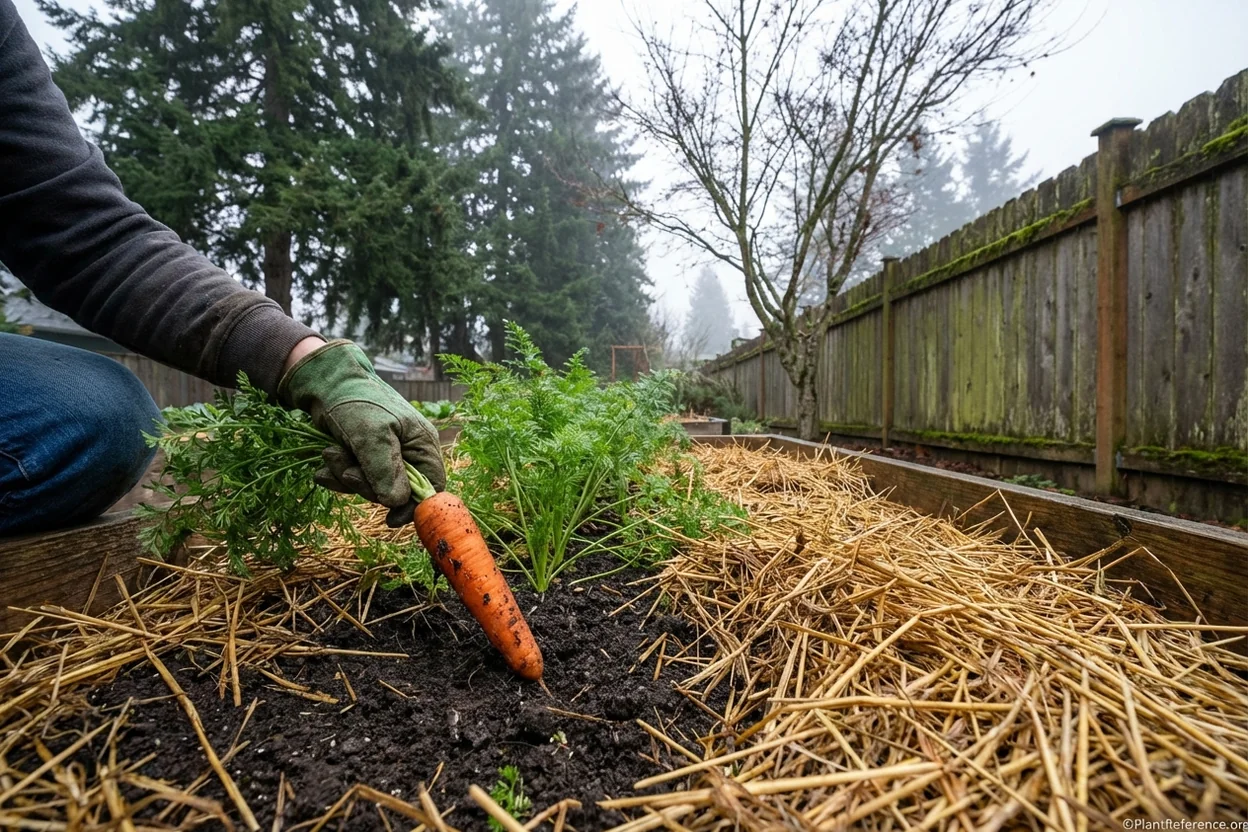
Portland's mild Zone 8b winters make overwintering straightforward. After your September sowing, let roots grow through fall. When soil temperatures drop below 40°F (4°C)—typically late November—the biochemical conversion from starch to sugar begins. Apply 3-4 inches (8-10 cm) of straw or leaf mulch over the row before the first hard freeze.
Portland rarely sees extended periods below 20°F (-7°C), so heavy mulch provides sufficient insulation. Dig roots as needed through winter. Harvest everything by early March before lengthening photoperiods trigger the vernalization response and the plant bolts to flower.
Troubleshooting Portland-Specific Problems
Carrot Rust Fly
The carrot rust fly is Portland's most damaging carrot pest. Adults emerge in two distinct flights—May and August—and lay eggs at the soil surface near the crown. Larvae tunnel into the root, leaving rust-brown channels filled with frass. The damage is both cosmetic and structural, creating entry points for secondary bacterial infection.
Floating row covers installed at seeding are the most reliable organic control. Seal the edges with soil to prevent adult access. If you've experienced rust fly damage in previous seasons, delay spring sowing until early June to avoid the first generation entirely. Crop rotation provides modest benefit since adult flies can travel several hundred meters. When to Plant Peppers in Portland: Complete Guide + Best Varieties for Zone 8b
Slugs and Snails
Portland's wet climate supports large slug populations that devastate carrot seedlings during the first three weeks after emergence. Iron phosphate bait applied at planting and reapplied after rain provides effective control that's safe for pets and beneficial organisms. Copper tape along raised bed edges creates a physical barrier—the copper ions interact with slug mucus to produce a mild electrical charge that deters crossing. When to Plant Kale in Portland: Complete Guide + Best Varieties for Zone 8b
Willamette Valley Clay Forking
Forked carrots in Portland almost always result from the root tip hitting the clay subsoil transition zone. The Willamette Valley's typical soil profile has 6-10 inches of workable silty clay-loam over dense clay. When the root tip encounters that abrupt density change, it branches laterally rather than continuing downward. The solution is either choosing shorter varieties like 🌿Daucus carota ssp. sativus 'Chantenay' and 🌿Daucus carota ssp. sativus 'Danvers 126' that stay within the workable topsoil, or building raised beds deep enough to eliminate the clay interface entirely. Raised Bed Soil Settling and Compaction: Prevention and Solutions
Summer Bitterness
When soil temperatures exceed 75-80°F (24-27°C), carrots synthesize terpenoid compounds—specifically falcarinol and falcarindiol—that produce bitter flavor. Portland's July and August temperatures regularly trigger this response. Harvest spring carrots before mid-July, and time your fall sowing so roots bulk up during the cooling temperatures of September and October. When to Plant Squash in Portland: Complete Guide + Best Varieties for Zone 8b
Harvest & Storage
Spring carrots reach harvest size when shoulders measure 3/4-1 inch (2-2.5 cm) in diameter, typically 65-85 days after sowing. Portland's cool spring temperatures allow roots to develop steadily without heat-induced bitterness. Loosen soil alongside the row with a garden fork before pulling—the Willamette Valley's silty clay grips roots firmly and will snap off tips if you pull straight up. When to Plant Tomatoes in Portland: Complete Guide + Best Varieties for Zone 8b
Overwintered carrots deliver peak flavor by January after months of cold-induced sugar accumulation. The cultivar Daucus carota ssp. sativus 'Napoli' holds particularly well through Portland winters without splitting or turning pithy. Harvest all overwintered roots before mid-March to avoid bolting—once the plant detects lengthening photoperiods after vernalization, it redirects carbohydrate reserves from the root to the developing flower stalk, and flavor deteriorates rapidly.
For long-term storage, remove foliage immediately after harvest. The leaves continue transpiring and pull water from the root through xylem tension. Store unwashed roots in perforated plastic bags at 32-38°F (0-3°C). Keep carrots away from apples, pears, and other climacteric fruits that release ethylene gas—ethylene triggers isocoumarin synthesis in carrot tissue, producing bitter off-flavors. 🌿Daucus carota ssp. sativus 'Danvers 126' and the Nantes cultivar 'Bolero' store for four to five months under proper conditions. When to Plant Onions in Portland: Complete Guide + Best Varieties for Zone 8b
Frequently Asked Questions
Reading about plants and recognising them are different skills. These three build the second.
- Daily PlantIdentify the day’s mystery plant from a close-up photograph.
- Keyed OutWork a dichotomous key, lead by lead, to name a hidden specimen.
- Name That PlantName a specimen from botanical clues dealt hardest first.
Free to play, no account needed
Aisha manages a small tropical nursery on the east side of Houston, specializing in plants that can handle the Gulf Coast's humidity, heat, and unpredictable flooding. She studied horticulture in college and worked at a wholesale grower before opening her own operation. Growing up, her parents kept a kitchen garden with okra, bitter gourd, and curry leaf plants—a tradition she's continued. Houston's subtropical climate lets her grow things most of the country can't, but it also means dealing with fungal issues, standing water, and summers where it's too hot for even tomatoes. Aisha writes about tropical and subtropical plant care, humidity management, and working with heavy clay soils.