When to Plant Carrots in Pittsburgh: Zone 6b Dates + Best Varieties
Pets & Toxicity
Recorded toxicity for plants linked in this guide. An unknown status is not a safety assessment.
No linked plant is recorded as toxicDetailsHide
Daucus carota ssp. sativus 'Nantes' — Toxicity
Non-toxicView Daucus carota ssp. sativus 'Nantes' plant profileDaucus carota ssp. sativus 'Chantenay' — Toxicity
Non-toxicView Daucus carota ssp. sativus 'Chantenay' plant profileDaucus carota ssp. sativus 'Imperator' — Toxicity
Non-toxicView Daucus carota ssp. sativus 'Imperator' plant profileDaucus carota ssp. sativus 'Rainbow' — Toxicity
Non-toxicView Daucus carota ssp. sativus 'Rainbow' plant profileDaucus carota ssp. sativus 'Danvers 126' — Toxicity
Non-toxicView Daucus carota ssp. sativus 'Danvers 126' plant profile
— Image © Plant Reference 2026
Growing carrots in Pittsburgh means dealing with Zone 6b's clay-heavy soils, variable spring weather, and a 178-day frost-free window that keeps you on a tighter schedule than gardeners further south. I track everything I grow in a spreadsheet, and after years of testing carrot varieties in both raised beds and native ground, I can tell you exactly which ones produce here and which ones are a waste of your seed money. The short version: match your variety to your soil, time your plantings around Pittsburgh's April 25 last frost, and plan a fall crop—those frost-sweetened roots are the best carrots you'll ever eat.
Best Carrot Varieties for Pittsburgh's Zone 6b Climate
Pittsburgh's biggest challenge for carrots isn't the temperature—it's the soil. Most of western Pennsylvania sits on heavy clay-loam that compacts easily and resists the downward growth that carrots need. I've watched perfectly good Imperator seeds produce nothing but twisted, forked roots in my neighbor's unimproved clay plot. The variety you pick matters more here than in almost any other city.
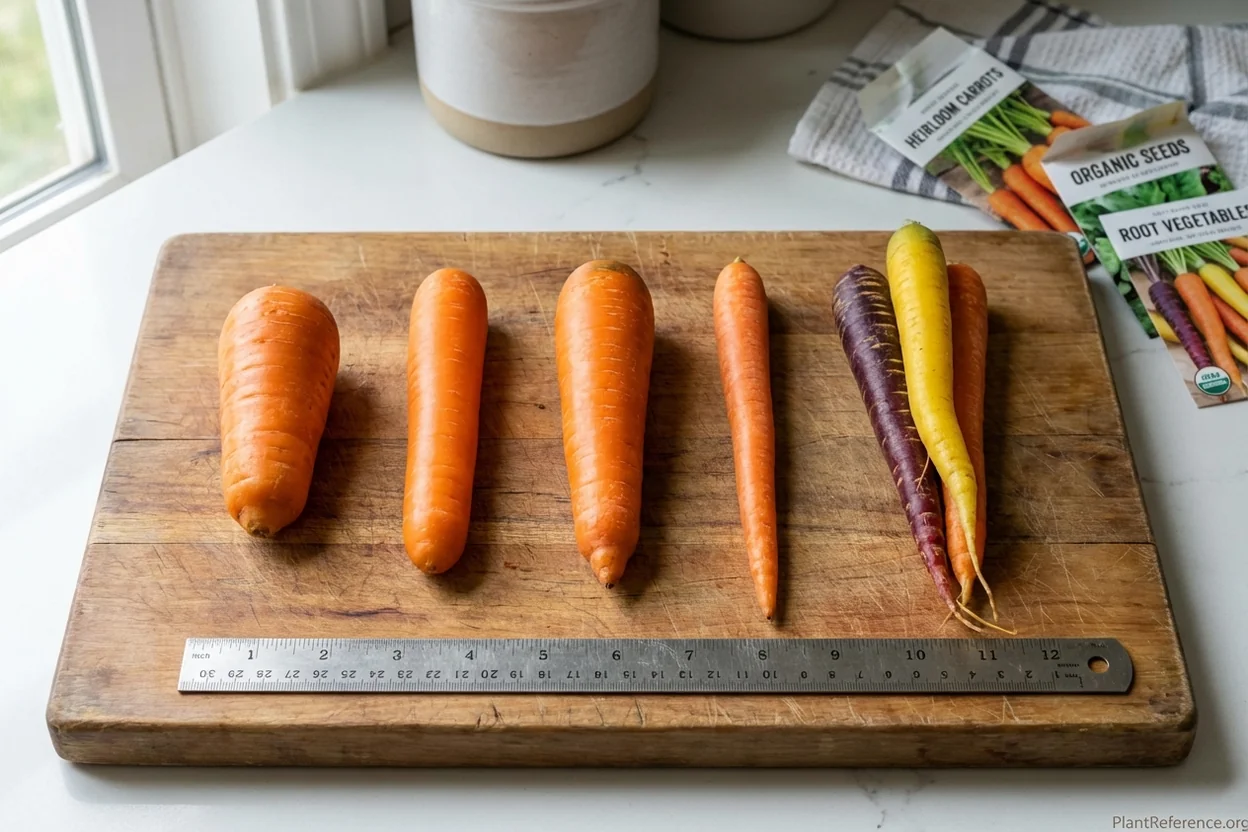
🌿Daucus carota ssp. sativus 'Nantes' (DAW-kus kah-ROH-tah) varieties break down into groups based on root shape, and that shape determines how well they'll handle Pittsburgh's ground conditions. Tapered varieties push through heavy soil better than cylindrical ones, and short varieties sidestep the problem entirely.
🌿Daucus carota ssp. sativus 'Danvers 126' is my top recommendation for Pittsburgh gardens. Its wedge-shaped root was specifically bred for heavier soils—the tapered shape exerts lateral force that opens up clay-loam where blunt-tipped varieties stall out. It matures in 70-80 days, stores well for months, and handles the variable conditions of western Pennsylvania without complaint. This is the variety I plant most and the one I recommend to every beginner at my container workshops.
🌿Daucus carota ssp. sativus 'Nantes' produces the sweetest, crispest roots for fresh eating—almost coreless, with a snap when you bite into one. The catch is that cylindrical, blunt-tipped shape. It needs loose, friable soil, which means raised beds or deeply amended ground for most Pittsburgh properties. At 65-75 days to maturity, it fits both spring and fall windows with room to spare. Daucus carota ssp. sativus 'Bolero' is a Nantes type with strong disease resistance, and it's my go-to for the fall planting where it handles the cooler, wetter conditions of a Pittsburgh autumn.
🌿Daucus carota ssp. sativus 'Chantenay' is the solution for the worst soil situations. At just 4-5 inches (10-13 cm) long and 2-3 inches (5-8 cm) wide, this stubby carrot doesn't need to penetrate deep. It grows in shallow beds, rocky ground, and heavy clay that would ruin longer varieties. Daucus carota ssp. sativus 'Red Core Chantenay' is the standard strain—very sweet when harvested at proper size, but it turns coarse and woody if you leave it too long.
🌿Daucus carota ssp. sativus 'Imperator' is the long, slender supermarket carrot at 8-11 inches (20-28 cm). It demands deep, sandy, obstruction-free soil—at least 12 inches (30 cm) of loose growing medium. In Pittsburgh, that means dedicated raised beds. Daucus carota ssp. sativus 'Sugarsnax 54' is an Imperator type with excellent sweetness that makes a great snacking carrot if you've got the bed depth to support it.
🌿Daucus carota ssp. sativus 'Rainbow' mixes add visual variety with purple, yellow, white, and orange roots. The F1 hybrids mature together, while seed blends produce roots at different rates. Fun for the garden, though I find the individual named varieties more reliable for consistent results.
Variety | Days to Maturity | Best For | Notes for Pittsburgh |
|---|---|---|---|
70-80 days | Storage, heavy soil | Best performer in native Pittsburgh clay | |
65-75 days | Fresh eating | Needs raised bed or deep soil amendment | |
65-75 days | Shallow/rocky soil | Shortest root handles worst soil conditions | |
75-85 days | Deep raised beds | Requires 12+ inches loose soil minimum | |
70-75 days | Specialty/variety | Mixed maturity in blends; hybrids more uniform |
Specific Planting Dates for Pittsburgh
Pittsburgh's April 25 average last frost and October 20 first frost create a 178-day growing season—shorter than Philadelphia's 209 days, but still plenty for two carrot crops if you time them right. Carrots grow best between 60°F and 70°F (16-21°C), and they actually tolerate light frost, so you can push the edges of the season in both directions.
Spring Planting
Start direct sowing as early as mid-March when the ground thaws and soil temperature reaches 40°F (4°C). Carrots handle frost, so there's no need to wait until after April 25. The ideal spring window runs from March 15 through April 30. Seeds germinate slowly in cool soil—14 to 21 days is typical—but that early start means harvest before the worst of summer heat arrives.
Fall/Winter Planting
The fall crop is where Pittsburgh's climate really rewards you. Sow from August 1 through August 20. Seeds germinate quickly in warm August soil, then roots bulk up during the cooling days of September and October. After the October 20 first frost, the cold converts stored starch into sugars, producing carrots that taste remarkably sweeter than anything from the spring harvest. With mulch protection, you can dig fall carrots well into December.
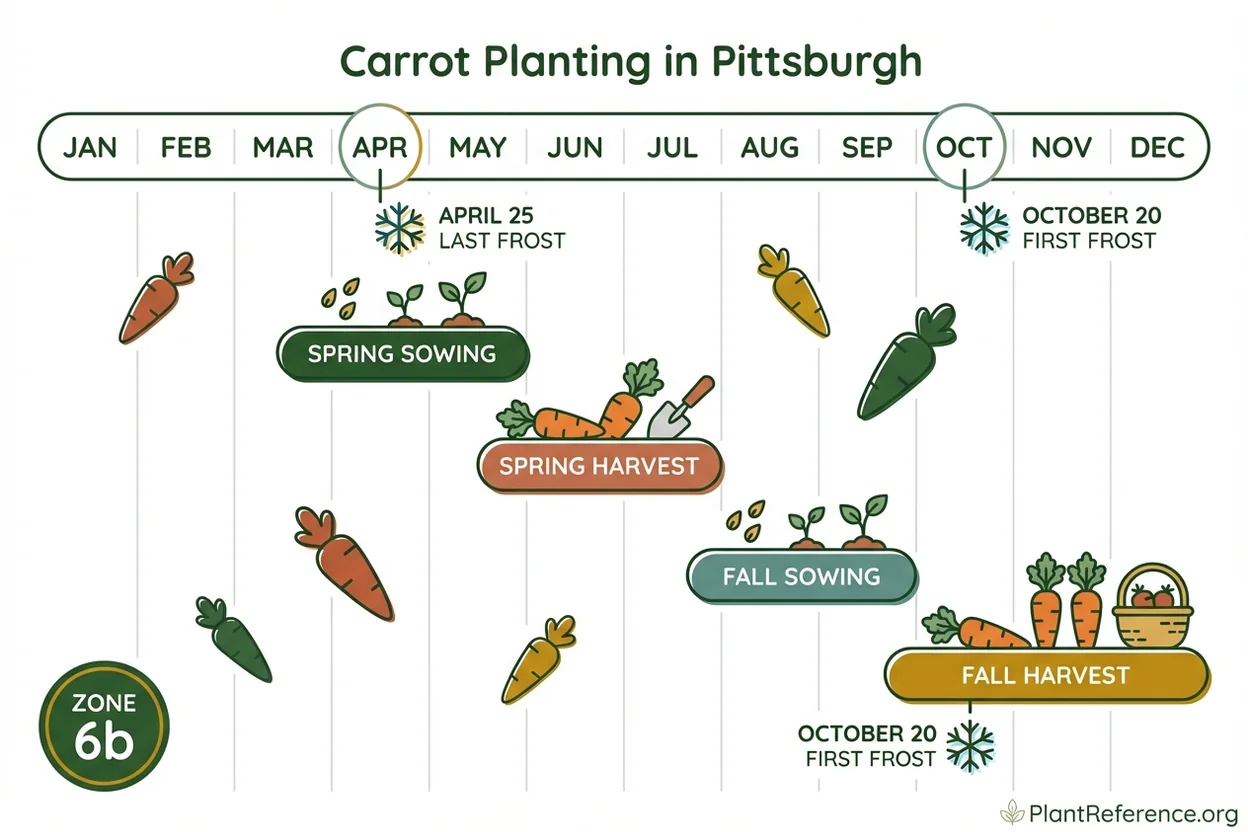
Spring direct sow: March 15 – April 30
Spring harvest: June 15 – July 31
Fall direct sow: August 1 – August 20
Fall harvest: November 1 – January 31 (with mulch)
Last frost date: April 25
First frost date: October 20
Growing season: 178 frost-free days
Succession Sowing
For a continuous spring harvest, sow a new short row every two weeks from mid-March through late April. This stretches your harvest window rather than dumping everything at once. Skip May and June plantings—roots maturing in July and August's heat turn tough and bitter. Pick back up with the August fall sowing.
Complete Growing Guide for Pittsburgh
Site Selection and Soil Preparation
Carrots need loose, well-drained soil free of rocks and debris to a depth of at least 8-12 inches (20-30 cm). That's a tall order in Pittsburgh, where most residential soil is compacted clay-loam with shale fragments from the region's geology. If you're planting in native ground, stick with 🌿Daucus carota ssp. sativus 'Danvers 126' or 🌿Daucus carota ssp. sativus 'Chantenay'—they're bred to handle exactly these conditions. For 🌿Daucus carota ssp. sativus 'Nantes' or 🌿Daucus carota ssp. sativus 'Imperator' types, Best Soil Mix for Raised Beds: Creating the Perfect Growing Medium raised beds with imported mix are the practical solution.
Work the soil only when it's dry enough to crumble in your hand. Tilling wet Pittsburgh clay destroys soil structure and creates a hardpan layer that blocks root growth entirely. Incorporate 2-3 inches (5-8 cm) of finished compost into the top 12 inches (30 cm). Do not use fresh manure—excess nitrogen causes excessive foliage, hairy roots, and forking. Raised Bed Soil Settling and Compaction: Prevention and Solutions
Test soil pH before planting. Carrots prefer 6.0-6.8, and Pittsburgh soils tend to run slightly acidic due to the region's geology. Raised Bed Soil pH Problems: Testing, Adjusting, and Maintaining Balance Apply garden lime if your reading falls below 6.0.
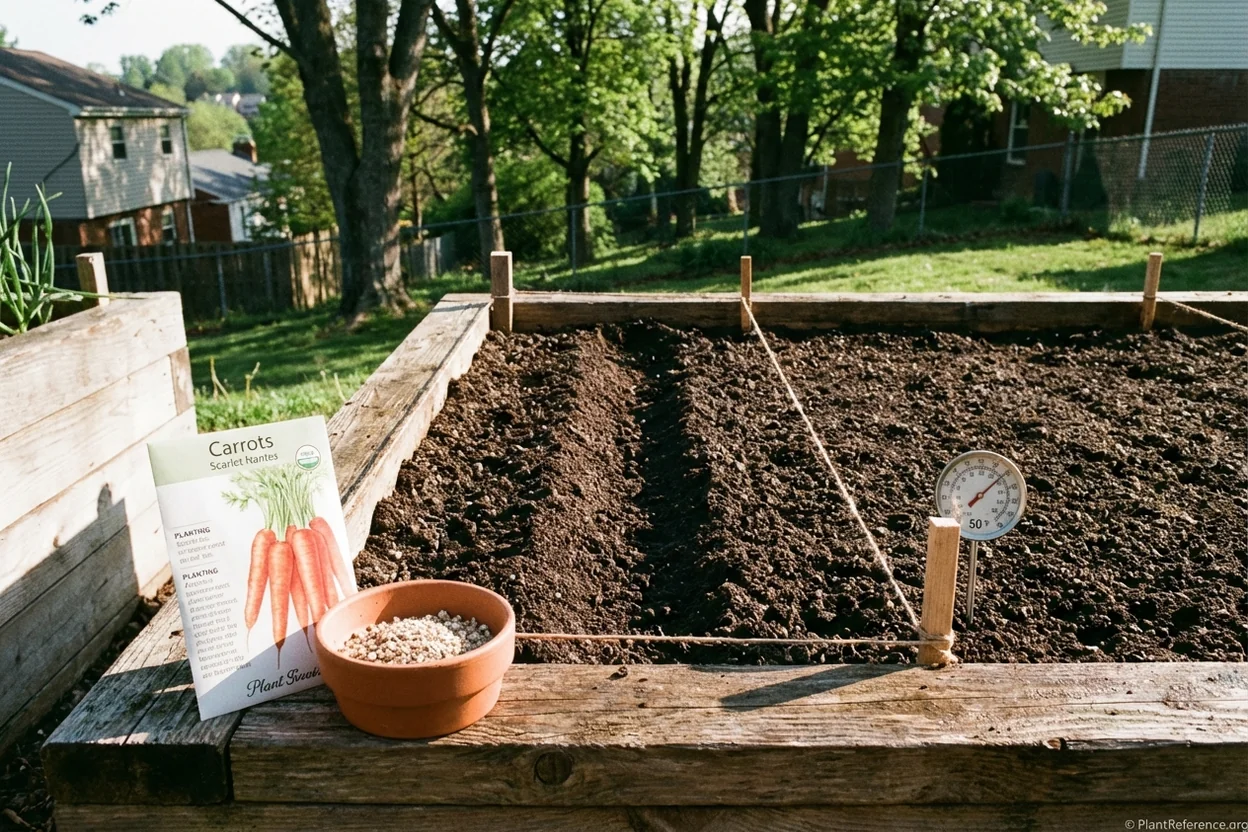
Sowing Technique
Carrot seeds are tiny and require 14-21 days of consistent moisture to germinate. Sow 1/4 inch (6 mm) deep in rows spaced 12 inches (30 cm) apart. Cover with sand, vermiculite, or finished compost instead of garden soil—Pittsburgh's clay forms a crust when it dries that carrot seedlings can't break through.
To maintain moisture during germination, lay burlap or a thin board over the seeded row. Check daily starting around day 5. Remove the cover immediately when you see white seedling loops emerging—even one extra day under a board produces weak, stretched seedlings that won't recover.
Thinning
This is the step most people skip, and it shows at harvest. Thin in two passes. First, when seedlings are 1-2 inches (2.5-5 cm) tall, snip extras at the soil line with scissors to 1 inch (2.5 cm) spacing. Use scissors, not your fingers—pulling seedlings disturbs the roots of neighboring plants. Second, when tops reach 4-5 inches (10-13 cm), thin to final spacing:
🌿Daucus carota ssp. sativus 'Nantes' and 🌿Daucus carota ssp. sativus 'Danvers 126': 2-3 inches (5-8 cm) apart
🌿Daucus carota ssp. sativus 'Imperator': 3-4 inches (8-10 cm) apart
🌿Daucus carota ssp. sativus 'Chantenay': 2 inches (5 cm) apart
The thinnings from the second pass are true baby carrots—finger-sized and tender. Raised Bed Vegetable Garden Layout: Planning for Maximum Production
Watering
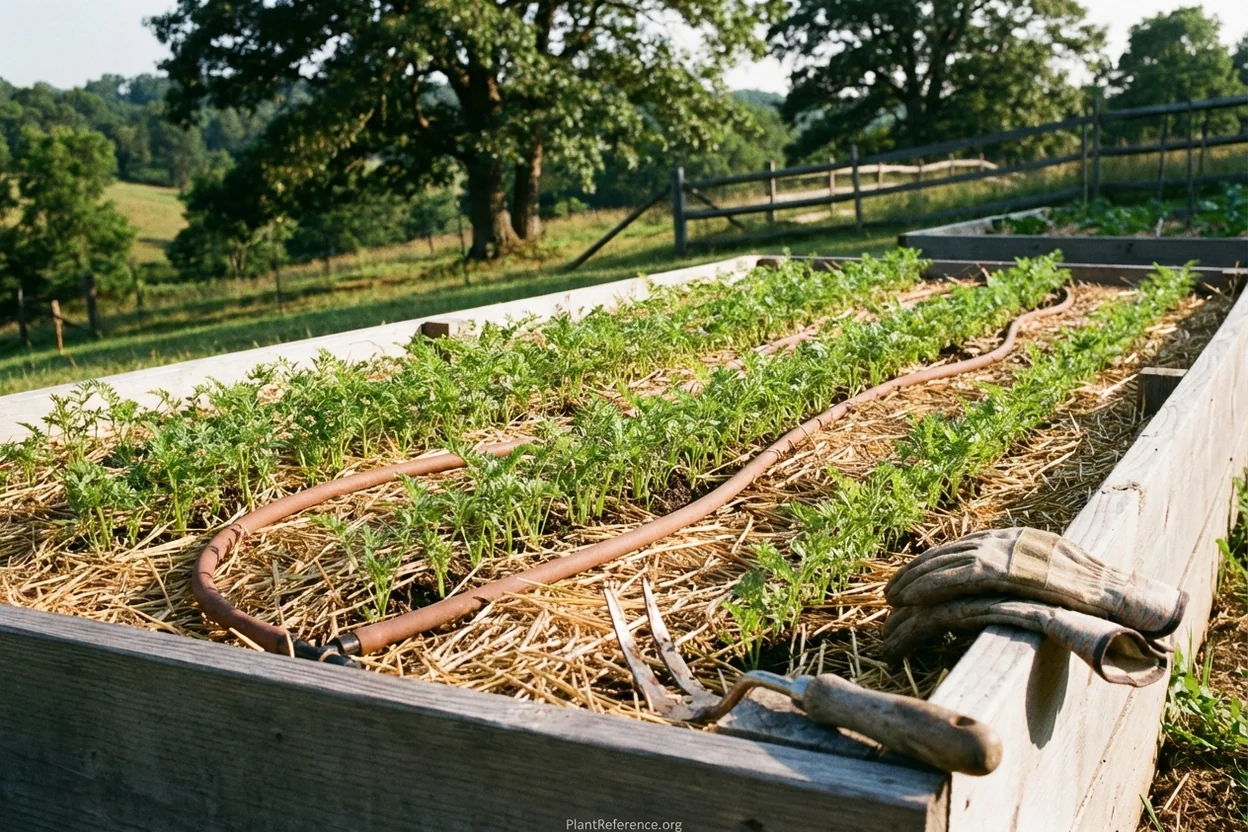
Carrots need 1 inch (2.5 cm) of water per week, increasing to 2 inches (5 cm) during root sizing. Consistency is everything—a dry period followed by heavy rain causes roots to split as cells expand too fast. Pittsburgh gets plenty of rain, but it arrives in unpredictable bursts. 5 Best Drip Irrigation Kits for Raised Beds (Tested for Easy Installation) Drip irrigation or soaker hoses deliver steady moisture without wetting foliage, which helps prevent the fungal diseases that Pittsburgh's humidity encourages.
Mulching and Weed Control
After thinning to final spacing, mulch between rows with 2-3 inches (5-8 cm) of straw or shredded leaves. This holds moisture, suppresses weeds, and moderates soil temperature during Pittsburgh's hot July and August days. Raised Bed Weeds: Prevention Strategies and Control Methods The critical weed-free period for carrots is the first 4-6 weeks. Seedlings grow slowly and get smothered fast. Hand-weed close to the row and keep cultivation shallow—under 1 inch (2.5 cm)—to avoid cutting feeder roots.
Fertilizing
Carrots are light feeders. Too much nitrogen sends energy to the foliage instead of the root and promotes hairy, forked growth. If you planted after a heavy feeder like tomatoes, the residual fertility is usually enough. Otherwise, work a balanced organic fertilizer (5-5-5) into the bed at planting. Side-dress with greensand or wood ash when tops reach 6 inches (15 cm). Potassium supports sugar production and helps the taproot push through denser soil.
Troubleshooting Pittsburgh-Specific Problems
Carrot Weevil
The carrot weevil (Listronotus oregonensis) is prevalent in the Great Lakes and Ohio Valley region, which includes Pittsburgh. Unlike the carrot rust fly, the weevil is a snout beetle whose larvae tunnel into the upper third of the root near the crown. The adults don't fly much—they walk—so rotating your carrot bed at least 200 feet (60 m) from last year's location reduces infestation. Raised Bed Pest Problems: Identification and Organic Control Methods Floating row covers installed at planting provide additional protection.
Aster Yellows
Aster leafhoppers migrate north from the Gulf Coast each spring, carrying a phytoplasma that causes yellowing leaves, bushy growth, and hairy, bitter roots. Once a plant is infected, it's done—pull and destroy it. Row covers block the leafhoppers, and keeping the garden free of plantain and wild carrot weeds removes the pathogen reservoirs they feed on.
Heavy Clay and Shale
Forking is the most common complaint from Pittsburgh carrot growers. The root tip hits a compacted clay layer or shale fragment and splits into two or more legs. Prevention starts with variety selection—🌿Daucus carota ssp. sativus 'Chantenay' and 🌿Daucus carota ssp. sativus 'Danvers 126' tolerate heavy soil far better than 🌿Daucus carota ssp. sativus 'Nantes' or 🌿Daucus carota ssp. sativus 'Imperator'. For in-ground planting, double dig or broadfork to 12-15 inches (30-38 cm) and remove any stones larger than 1 inch (2.5 cm).
Green shoulders develop when soil settles and exposes the root crown to sunlight. Hill soil over the crowns as they size up, or maintain mulch coverage to block light. When to Plant Carrots in Chicago: Zone 6a Dates + Best Varieties
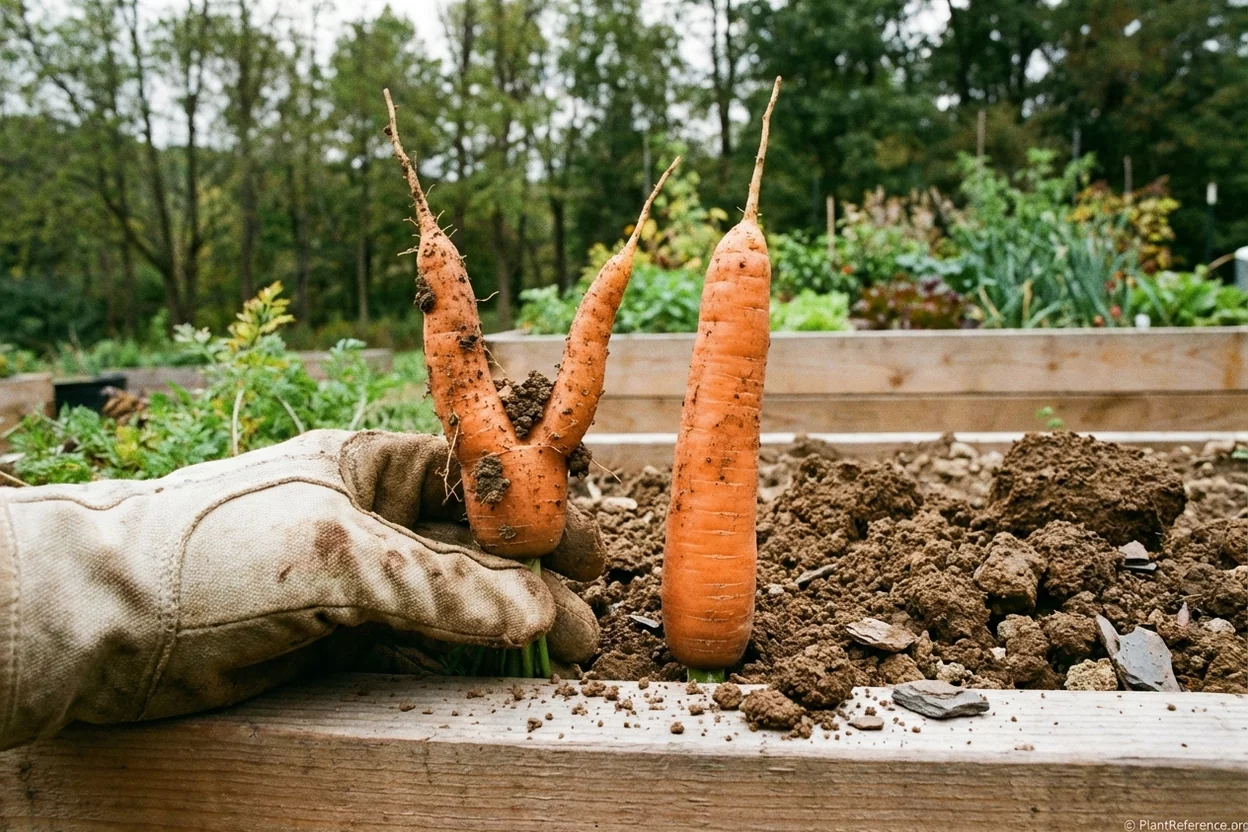
Splitting
Longitudinal cracks in roots result from inconsistent moisture—dry soil followed by a sudden heavy rain. Pittsburgh's summer thunderstorms make this common in July. Consistent irrigation through drip lines and heavy mulch are your best prevention. Raised Bed Irrigation Systems: Watering Solutions for Consistent Growth This is another reason to skip summer plantings and focus on the spring and fall windows.
Harvest & Storage
When to Harvest
Check root diameter at the soil line to gauge readiness. 🌿Daucus carota ssp. sativus 'Nantes' is ready when shoulders reach 1-1.5 inches (2.5-4 cm) across. Pull 🌿Daucus carota ssp. sativus 'Chantenay' before it exceeds 2 inches (5 cm) in diameter—left longer, the center turns woody and fibrous. 🌿Daucus carota ssp. sativus 'Danvers 126' can stay in the ground longer without losing quality, which makes it the best candidate for winter storage.
Spring carrots should come out by late July before Pittsburgh's worst summer heat degrades root quality. Fall-planted carrots are the real prize. After the October 20 first frost, cold soil triggers the conversion of stored starch into sugars, producing noticeably sweeter roots. Spread 6-8 inches (15-20 cm) of straw mulch over the bed once the ground starts freezing at the surface, and you can dig fresh carrots through November, December, and into January. Best Raised Bed Vegetables for Beginners: Top 10 Easy-Growing Crops
Storage
Cut foliage immediately after harvest—leaves continue pulling moisture from the root. Don't wash carrots until you're ready to eat them; the thin layer of soil actually slows microbial growth. Store in perforated plastic bags in the refrigerator at 32-38°F (0-3°C) for 4-5 months. Keep them away from apples, pears, and potatoes—these produce ethylene gas that makes carrots bitter. The Complete Guide to Raised Bed Gardening for Beginners (2025)
Frequently Asked Questions
Reading about plants and recognising them are different skills. These three build the second.
- Daily PlantIdentify the day’s mystery plant from a close-up photograph.
- Keyed OutWork a dichotomous key, lead by lead, to name a hidden specimen.
- Name That PlantName a specimen from botanical clues dealt hardest first.
Free to play, no account needed
Linda's been growing tomatoes in containers on her suburban Pittsburgh balcony—ever since her kids grew up and she finally had time for hobbies again. She's a medical billing specialist by day and a tomato enthusiast by night and weekend. Linda started documenting her container growing experiments on a simple blog and discovered other renters and condo dwellers were desperate for practical advice. She tests different varieties every season, tracking yields, disease resistance, and flavor in a detailed spreadsheet. Linda's approach is practical and budget-conscious—she saves seeds, reuses containers, and makes her own fertilizer from kitchen scraps. Her specialty is maximizing production in small spaces, and she's perfected the art of growing full-size tomatoes in 5-gallon buckets. She's a Pennsylvania Master Gardener and teaches container growing workshops at her local library.