When to Plant Carrots in Oklahoma City: Zone 7a Dates + Best Varieties
Pets & Toxicity
Recorded toxicity for plants linked in this guide. An unknown status is not a safety assessment.
No linked plant is recorded as toxicDetailsHide
Daucus carota ssp. sativus 'Imperator' — Toxicity
Non-toxicView Daucus carota ssp. sativus 'Imperator' plant profileDaucus carota ssp. sativus 'Rainbow' — Toxicity
Non-toxicView Daucus carota ssp. sativus 'Rainbow' plant profileDaucus carota ssp. sativus 'Nantes' — Toxicity
Non-toxicView Daucus carota ssp. sativus 'Nantes' plant profileDaucus carota ssp. sativus 'Chantenay' — Toxicity
Non-toxicView Daucus carota ssp. sativus 'Chantenay' plant profileDaucus carota ssp. sativus 'Danvers 126' — Toxicity
Non-toxicView Daucus carota ssp. sativus 'Danvers 126' plant profile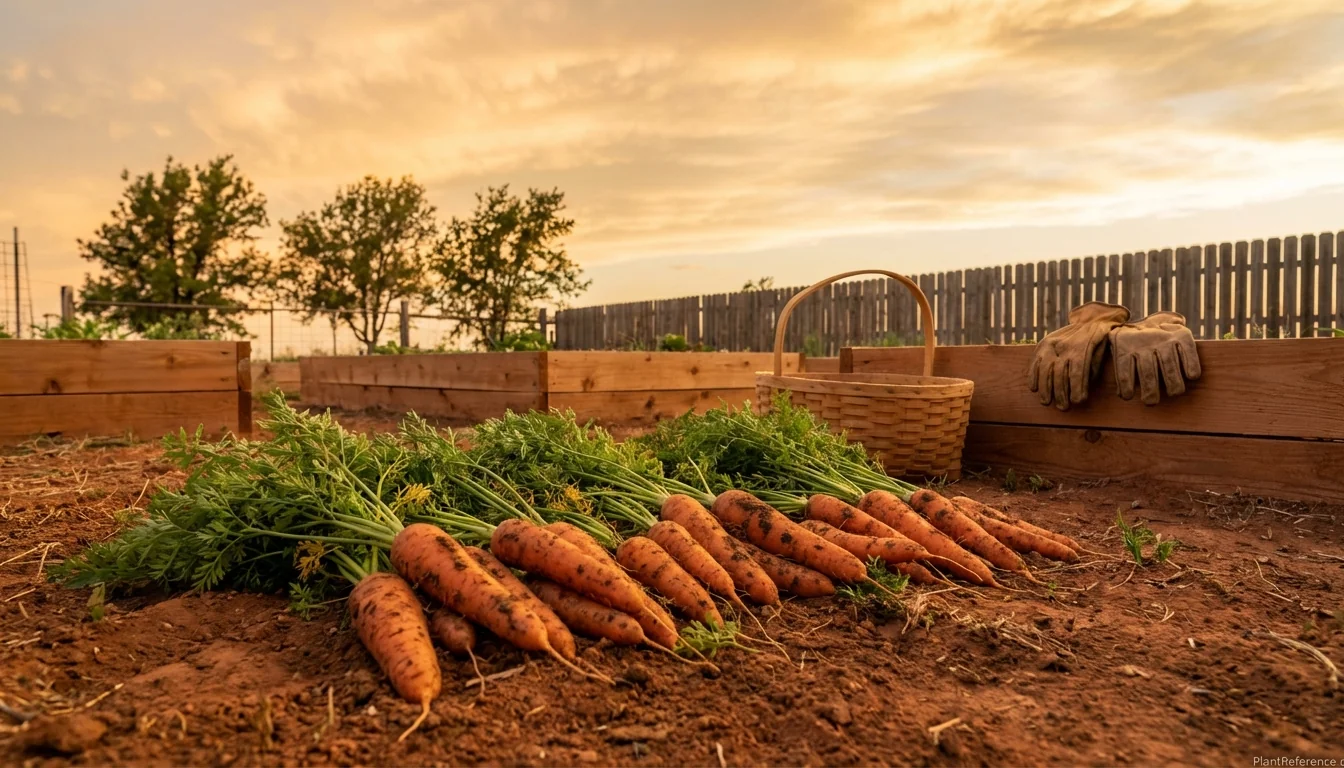
— Image © Plant Reference 2026
I spent 30 years tracking Oklahoma weather, and the one thing I can tell you with certainty is that averages don't mean much here. The April 1 last frost date is an average—I've recorded freezes as late as April 20 and as early as March 10 in consecutive years. The 218-day growing season looks generous on paper, but the weather within that window is the most variable of any place I've gardened. Carrots handle this variability better than most crops because they tolerate frost, withstand wind, and don't panic during the temperature swings that define Oklahoma spring. The key is understanding that our real challenge isn't frost dates—it's the combination of wind, erratic rainfall, and summer heat that requires specific management.
Best Carrot Varieties for Oklahoma City's Zone 7a Climate
Oklahoma City's native soil is red prairie clay—a heavy, slightly alkaline material (pH 6.5-7.5) with good mineral content but poor structure for root crops. It compacts under traffic, crusts hard after rain, and bakes to concrete hardness during summer drought. Wind compounds every moisture problem by desiccating the surface faster than you'd expect.
🌿Daucus carota ssp. sativus 'Danvers 126' (DAW-kus kuh-ROH-tuh) is the most reliable variety for Oklahoma conditions. The conical root tapers as it grows, generating enough mechanical force to push through heavy prairie clay. At 70-80 days to maturity, 🌿Daucus carota ssp. sativus 'Danvers 126' fits both planting windows. The firm flesh stores well for months—a practical advantage when you're stretching the fall harvest through winter.
🌿Daucus carota ssp. sativus 'Nantes' produces the sweetest, most tender roots you'll grow. The cylindrical shape delivers outstanding eating quality, but 🌿Daucus carota ssp. sativus 'Nantes' demands loose, well-drained soil. In Oklahoma City, that means raised beds protected from wind. The cultivar 'Bolero' adds disease resistance, though Oklahoma's lower humidity makes blight less of a concern than in the Southeast.
🌿Daucus carota ssp. sativus 'Chantenay' is the short, reliable option for native soil. At 4-5 inches (10-13 cm) long with broad shoulders, 🌿Daucus carota ssp. sativus 'Chantenay' stays within the amended topsoil and avoids the dense clay below. Works in containers and first-year garden beds. Harvest before 2 inches (5 cm) diameter to prevent a woody core.
🌿Daucus carota ssp. sativus 'Imperator' needs 12 inches (30 cm) of loose, obstruction-free soil. In Oklahoma's prairie clay, that requires purpose-built raised beds. The cultivar 'Sugarsnax 54' adds high sugar content to the long form.
🌿Daucus carota ssp. sativus 'Rainbow' produces white, yellow, orange, and coral roots from one hybrid packet. At 70-75 days, it fits both windows. Moderate depth requirements work in most amended Oklahoma City beds.
Variety | Days to Maturity | Best For | Notes for Oklahoma City |
|---|---|---|---|
70-80 days | Native clay and storage | Top pick for red prairie clay; conical root handles heavy alkaline soil | |
65-75 days | Protected raised beds | Sweetest flavor; needs wind protection; lower disease pressure than Southeast | |
65-75 days | Native soil and containers | Short roots avoid dense clay subsoil; handles Oklahoma wind well | |
75-85 days | Deep raised beds only | Needs 12+ inches loose soil; not for native Oklahoma prairie clay | |
70-75 days | Specialty and nutrition | Multiple colors; fits both windows in amended beds |

Specific Planting Dates for Oklahoma City
Oklahoma City averages an April 1 last frost and November 5 first frost, giving you 218 frost-free days. That's a long season—longer than Nashville, comparable to Raleigh—but the weather within that window is among the most variable in the country.
Spring Planting
Start sowing in early March, about four weeks before the April 1 last frost. Carrots tolerate light frost and even brief hard freezes without significant damage, so early planting is safe despite Oklahoma's unpredictable spring. Continue succession sowings every two weeks through mid-April. Spring carrots need to reach harvestable size before sustained soil temperatures exceed 75°F (24°C)—typically by early to mid-June. Oklahoma heats up faster than the calendar suggests; I've recorded 90°F soil temperatures in late May during drought years.
Fall Planting
Fall is Oklahoma City's strongest carrot season. Begin sowing in late August while soil is still warm enough for fast germination (5-7 days), and continue through mid-September. The timing gives roots 50-70 days of development before the November 5 first frost, with the critical growth phase happening during October's cooling temperatures. Starch-to-sugar conversion as soil drops below 50°F (10°C) produces the sweetest carrots of the year.

Spring sowing window: March 1 - April 15
Spring harvest: May through early June (before sustained heat)
Summer heat gap: Mid-June through mid-August
Fall sowing window: August 25 - September 15
Fall harvest: October through December (with mulch protection)
Best flavor: Fall harvest after cooling triggers sugar conversion
Complete Growing Guide for Oklahoma City
Soil Preparation
Oklahoma City's red prairie clay is heavy, slightly alkaline, and compacts into a surface crust that resists both water infiltration and seedling emergence. It holds nutrients well but drains poorly and bakes hard during the dry spells that punctuate Oklahoma summers. Wind accelerates surface drying and can remove light amendments before they incorporate.
For in-ground beds, work the top 10-12 inches (25-30 cm) with a garden fork and incorporate 3-4 inches (8-10 cm) of finished compost plus 1-2 inches (2.5-5 cm) of coarse sand. Test pH through the OSU Extension Service—Oklahoma prairie soil runs 6.5-7.5. Carrots prefer 6.0-6.8, so sulfur amendment may be needed if pH exceeds 7.0. Skip lime entirely—Oklahoma soil has plenty of calcium from the native prairie minerals. Best Soil Mix for Raised Beds: Creating the Perfect Growing Medium
For raised beds, build to at least 12 inches (30 cm) deep with 60% topsoil, 30% compost, and 10% coarse sand or perlite. Position beds perpendicular to prevailing south winds to reduce wind desiccation. Composite or cedar materials withstand Oklahoma's UV exposure and temperature swings better than pine. How to Build a Raised Garden Bed: Step-by-Step Construction Guide
Seeding
Sow seeds 1/4 inch (0.6 cm) deep in rows 12 inches (30 cm) apart. Cover with vermiculite or fine compost—never native prairie clay. Oklahoma soil crusts hard and fast after rain or irrigation, and wind-driven evaporation makes the crust worse by pulling surface moisture before seedlings can push through. This crusting-plus-wind combination is the single biggest germination failure in Oklahoma gardens. Best Soil for Raised Beds: 6 Commercial Mixes Tested and Compared
Spring sowings germinate in 14-21 days in cool soil. Cover the row with burlap weighted at the edges—Oklahoma wind will remove lightweight covers overnight. Fall sowings germinate in 5-7 days in warm August soil. Water lightly twice daily to counteract wind desiccation at the soil surface.
Thinning
Thin in two stages: first to 1 inch (2.5 cm) at 2 inches (5 cm) tall, then to 2-3 inches (5-8 cm) at 4-5 inches (10-13 cm). Cut at the soil line with scissors. Oklahoma's clay grips seedling roots tightly, and pulling disturbs neighboring plants. Raised Bed Vegetable Garden Layout: Planning for Maximum Production

Watering
Carrots need 1 inch (2.5 cm) of water weekly during early growth, increasing to 1.5-2 inches (4-5 cm) as roots develop. Oklahoma City averages about 36 inches of rainfall annually, but distribution is wildly erratic—I've recorded months with zero measurable precipitation followed by 8-inch deluges. You cannot rely on rainfall for consistent carrot irrigation.
Drip irrigation on a timer is essential in Oklahoma. Overhead watering wastes water to wind evaporation—on a 20 mph spring day, a significant percentage of sprinkler output never reaches the soil. Run drip lines alongside rows and maintain steady moisture. Inconsistent watering causes root splitting, and Oklahoma's cycle of drought followed by heavy rain creates exactly the conditions that produce it. Raised Bed Irrigation Systems: Watering Solutions for Consistent Growth
Mulching
Apply 2-3 inches (5-8 cm) of straw or shredded leaves after seedlings establish. Mulch serves triple duty in Oklahoma: it reduces wind desiccation at the soil surface, prevents rain-splash crusting on prairie clay, and moderates the extreme temperature swings that stress roots. In fall, 3-4 inches of straw after the November 5 frost extends harvest into December and sometimes January. Weight or pin mulch down—Oklahoma wind removes loose material. Raised Bed Soil Settling and Compaction: Prevention and Solutions

Troubleshooting Oklahoma City-Specific Problems
Summer Heat Gap
Oklahoma City's summer heat is intense—soil temperatures routinely exceed 85°F (29°C) from mid-June through mid-August, well above the 75°F bitterness threshold. The gap runs 8-10 weeks in most years, longer during drought. There's no practical way to extend spring carrots through this period. Harvest by early June and redirect attention to fall preparation. When to Plant Peppers in Oklahoma City: Complete Guide + Best Varieties for Zone 7a
Wind Desiccation on Seedlings
Sustained 15-25 mph winds are normal spring conditions in Oklahoma City. Wind pulls moisture from the soil surface faster than most irrigation systems can replace it, creating a dry crust that blocks carrot emergence. Floating row cover anchored with soil staples or rocks protects seedbeds during the critical first two weeks. Drip irrigation underneath the cover maintains moisture without the losses overhead systems suffer. When to Plant Kale in Oklahoma City: Complete Guide + Best Varieties for Zone 7a
Hail Damage
Oklahoma's severe storm season (April-June) occasionally delivers hail that shreds carrot foliage. Small hail causes cosmetic damage that plants recover from within two weeks. Large hail can destroy foliage entirely, significantly setting back root development. Floating row cover provides some protection against pea-sized hail. For larger events, there's no practical garden-scale protection—replant if the damage occurs early enough in the window. When to Plant Tomatoes in Oklahoma City: Complete Guide + Best Varieties for Zone 7a
Erratic Rainfall and Drought
Oklahoma City's 36 inches of annual rain arrives unpredictably—extended dry spells followed by intense thunderstorms. This cycle produces the worst possible conditions for carrots: drought stress followed by rapid cell expansion causes splitting. A rain gauge and drip irrigation system are not optional equipment in Oklahoma. Monitor soil moisture at 2-inch depth and irrigate to maintain steady conditions regardless of rainfall patterns. When to Plant Squash in Oklahoma City: Complete Guide + Best Varieties for Zone 7a

Harvest & Storage
Spring carrots reach harvest size when shoulders measure 3/4-1 inch (2-2.5 cm) in diameter, typically 65-85 days after sowing. Oklahoma's rapid spring warming means monitoring soil temperature matters more than counting days—harvest before sustained 75°F soil readings regardless of calendar date. Loosen soil alongside the row with a garden fork. Prairie clay grips roots firmly when dry, so water the bed the day before harvest. When to Plant Onions in Oklahoma City: Complete Guide + Best Varieties for Zone 7a
Fall carrots are Oklahoma City's strongest production. Roots that develop through October's cooling temperatures reach peak sweetness as starch converts to sugar. The November 5 first frost enhances flavor. Apply 3-4 inches (8-10 cm) of straw mulch after frost—pinned down against wind—and continue harvesting through December. Oklahoma winters occasionally deliver ice storms and sudden temperature drops into single digits°F, so harvest before severe weather events rather than relying on mulch alone.
For long-term storage, remove foliage immediately. Store unwashed carrots in perforated plastic bags at 32-38°F (0-3°C). 🌿Daucus carota ssp. sativus 'Danvers 126' stores four to five months under proper conditions. Poor Drainage in Raised Beds: Causes and Fixes for Waterlogged Soil
Frequently Asked Questions
Reading about plants and recognising them are different skills. These three build the second.
- Daily PlantIdentify the day’s mystery plant from a close-up photograph.
- Keyed OutWork a dichotomous key, lead by lead, to name a hidden specimen.
- Name That PlantName a specimen from botanical clues dealt hardest first.
Free to play, no account needed
Tagged with
Robert is a retired meteorologist who turned his lifelong hobby of gardening into a second career writing about weather-climate interactions and their effects on plants. Living in Oklahoma, he's seen it all—ice storms, tornadoes, 110°F heat, and drought, sometimes in the same month. Robert brings a data-driven approach to gardening, tracking weather patterns and correlating them with plant performance in his own large garden. He's particularly knowledgeable about wind-resistant plantings, storm damage recovery, and the challenge of gardening in a climate where extremes are the norm rather than the exception. Robert is a calm, measured writer who presents information without drama.