When to Plant Carrots in Indianapolis: Zone 5b Dates + Best Varieties
Pets & Toxicity
Recorded toxicity for plants linked in this guide. An unknown status is not a safety assessment.
No linked plant is recorded as toxicDetailsHide
Daucus carota ssp. sativus 'Chantenay' — Toxicity
Non-toxicView Daucus carota ssp. sativus 'Chantenay' plant profileDaucus carota ssp. sativus 'Nantes' — Toxicity
Non-toxicView Daucus carota ssp. sativus 'Nantes' plant profileDaucus carota ssp. sativus 'Imperator' — Toxicity
Non-toxicView Daucus carota ssp. sativus 'Imperator' plant profileDaucus carota ssp. sativus 'Rainbow' — Toxicity
Non-toxicView Daucus carota ssp. sativus 'Rainbow' plant profileDaucus carota ssp. sativus 'Danvers 126' — Toxicity
Non-toxicView Daucus carota ssp. sativus 'Danvers 126' plant profile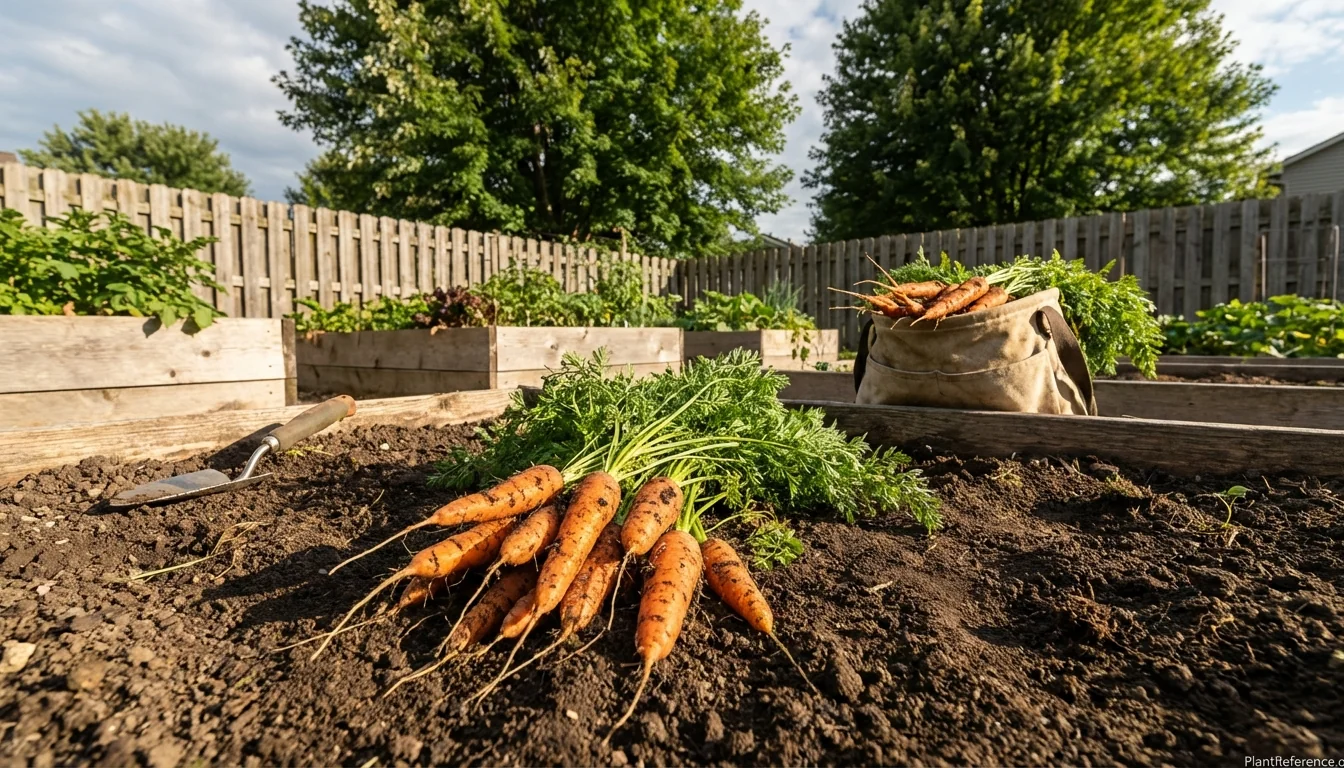
— Image © Plant Reference 2026
Growing carrots in Indianapolis comes down to understanding what's happening beneath the surface. As a soil scientist, that's where I start with every crop—and carrots make the case better than anything else in the garden. Your harvest quality is a direct product of your soil structure. Indianapolis sits on glacial till clay-loam that holds moisture and nutrients exceptionally well, but fights back against any root trying to push through it. Pair smart variety selection with proper soil preparation and a planting calendar built around our May 5 last frost date, and you'll harvest crisp, sweet carrots from late June through December.
Best Carrot Varieties for Indianapolis's Zone 5b Climate
The soil under your Indianapolis garden was deposited by glaciers thousands of years ago, and it shows. Most of us are working with dense clay-loam that compacts easily, crusts after rain, and contains enough rocks to stop a long carrot in its tracks. Choosing a variety that matches your soil condition—not just your taste preference—is the first decision that matters.
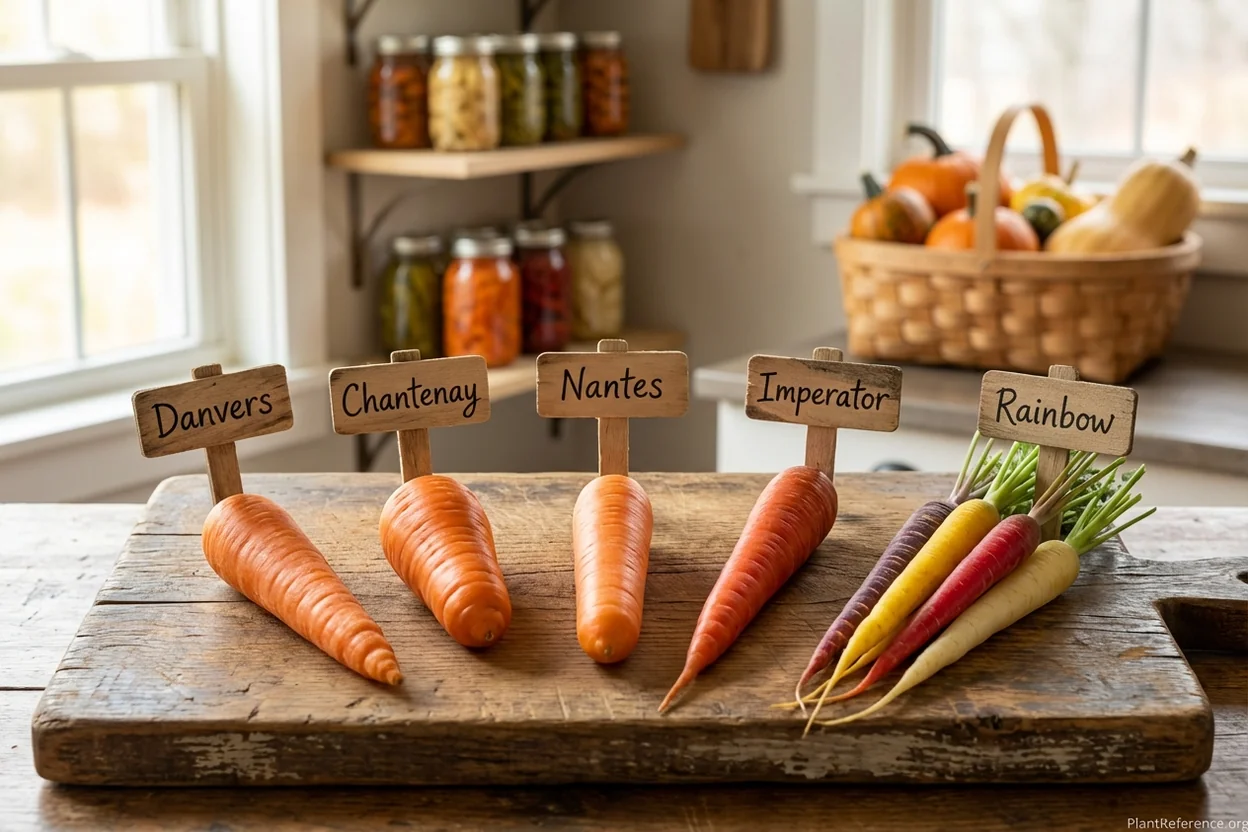
🌿Daucus carota ssp. sativus 'Danvers 126' (DAW-kus kuh-ROH-tuh) is my top recommendation for Indianapolis gardens growing in native soil. Its conical, wedge-shaped root was literally bred to push through heavy ground. The broad shoulders generate lateral force that displaces clay particles instead of trying to drill through them. At 70-80 days to maturity, 🌿Daucus carota ssp. sativus 'Danvers 126' fits comfortably in both spring and fall windows, and its higher fiber content makes it a strong candidate for winter root cellar storage.
🌿Daucus carota ssp. sativus 'Chantenay' is the variety I hand to gardeners who tell me their soil is "impossible." At just 4-5 inches (10-13 cm) long with stout, powerful shoulders, 🌿Daucus carota ssp. sativus 'Chantenay' doesn't need depth to produce a usable root. It handles shallow hardpan, rocky patches, and even container growing where depth is limited. Pull it before it exceeds 2 inches (5 cm) in diameter—past that point the core turns woody and loses sweetness.
🌿Daucus carota ssp. sativus 'Nantes' produces the sweetest, crispest roots of any type. The cylindrical shape snaps clean with almost no fibrous core. The trade-off is that 🌿Daucus carota ssp. sativus 'Nantes' requires loose, friable soil to develop straight roots. In Indianapolis, that means raised beds amended with compost and coarse sand. The cultivar 'Bolero' adds disease resistance and outstanding storage ability to the Nantes profile—it's my pick for fall planting.
🌿Daucus carota ssp. sativus 'Imperator' is the long, slender grocery store carrot. It needs 12 inches (30 cm) or more of obstruction-free, sandy soil and 75-85 days to mature. I only recommend 🌿Daucus carota ssp. sativus 'Imperator' for deep raised beds filled with a purpose-built mix. In native Indianapolis ground, the roots twist and fork every time.
🌿Daucus carota ssp. sativus 'Rainbow' brings nutritional variety with white, yellow, orange, and coral roots from a single F1 hybrid packet. Maturity runs 70-75 days with intermediate soil requirements similar to 🌿Daucus carota ssp. sativus 'Nantes'. The different pigments—carotenoids, anthocyanins, lycopene—each offer distinct antioxidant benefits.
Variety | Days to Maturity | Best For | Notes for Indianapolis |
|---|---|---|---|
70-80 days | All-around main crop | Best performer in native Indiana glacial clay-loam | |
65-75 days | Heavy clay and containers | Short roots handle worst soil without forking | |
65-75 days | Fresh eating quality | Requires amended raised beds for straight roots | |
75-85 days | Deep raised beds only | Needs 12+ inches loose soil; not for native clay | |
70-75 days | Specialty and nutrition | Multiple colors and phytochemicals; needs loose soil |
Specific Planting Dates for Indianapolis
Indianapolis averages a May 5 last frost and October 10 first frost, giving you 158 frost-free days. Carrots are cool-season crops that grow best between 60-70°F (16-21°C), so you have two productive windows: spring and late summer into fall.
Spring Planting
Carrots tolerate light frost and germinate in soil as cool as 40°F (4°C). You can start sowing roughly four weeks before the last frost date. Get seeds into the ground in early April once the soil has thawed and is workable. Continue succession sowings every two to three weeks through mid-May for staggered harvests that keep fresh carrots coming through summer.
Fall Planting
The fall crop produces the best-tasting carrots of the year. Sow in late July to early August, roughly 10-12 weeks before the October 10 first frost. The roots bulk up during September's cooling temperatures, and exposure to frost converts stored starch into sugars. From a soil science perspective, the fall planting also benefits from warmer soil at sowing—germination is faster and more uniform in August soil than in cold April ground.
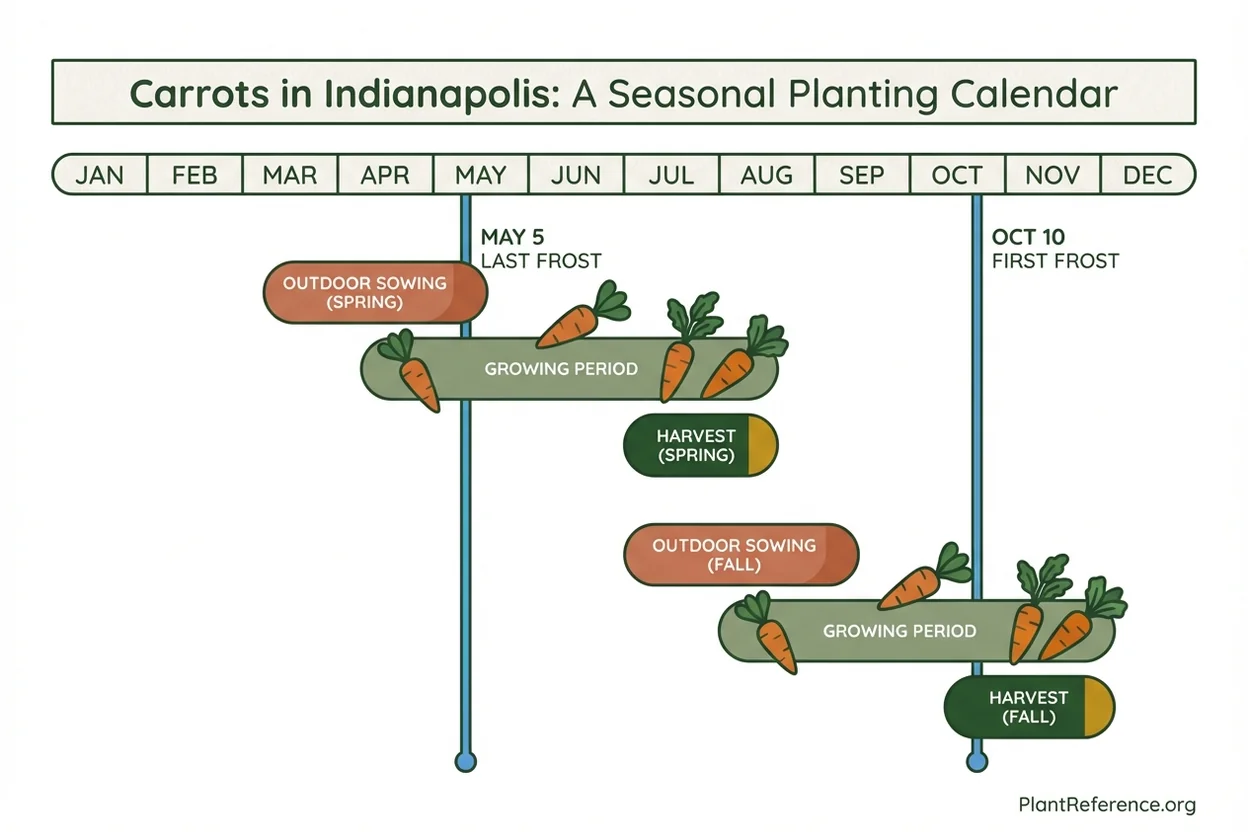
Spring sowing window: April 1 - May 15
Succession sowing interval: Every 2-3 weeks
Spring harvest: Late June through July
Fall sowing window: July 25 - August 10
Fall harvest: October through December (with mulch protection)
Season ends: October 10 first frost (extend with heavy mulch)
Complete Growing Guide for Indianapolis
Soil Preparation
This is where most Indianapolis carrot crops succeed or fail, and I say that as someone who looks at soil profiles for a living. Our glacial clay-loam compacts to the consistency of modeling clay when wet and dries into something closer to concrete. Carrots cannot push through that.
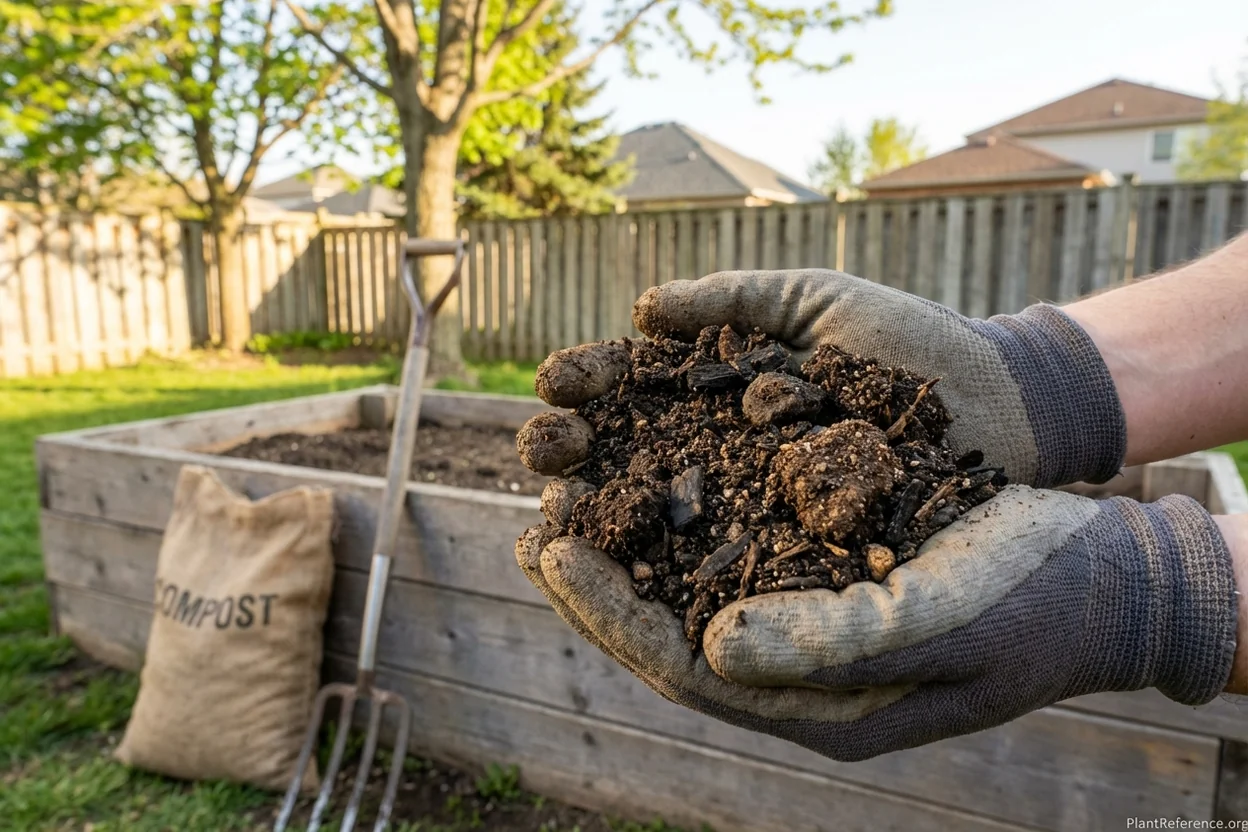
Start preparing beds at least two weeks before planting. For in-ground beds, work the soil to 10-12 inches (25-30 cm) deep only when it crumbles in your hand—never when it sticks together in a ball. That wet-working mistake destroys soil aggregates and creates season-long compaction that no amount of later work will fix. Incorporate 2-3 inches (5-8 cm) of finished compost and a generous addition of coarse sand or perlite to open up pore space and reduce mechanical resistance against the taproot. Best Soil Mix for Raised Beds: Creating the Perfect Growing Medium
Do not add fresh manure. The excess nitrogen causes carrots to produce hairy lateral roots and forked taproots instead of smooth, straight ones. The nitrogen-to-potassium ratio matters here—carrots are heavy potassium feeders, and potassium drives sugar translocation to the root and maintains the cell turgor that helps the tip penetrate soil. A basic soil test from your local extension office tells you exactly what to add and what to skip. Raised Bed Soil pH Problems: Testing, Adjusting, and Maintaining Balance
For raised beds, fill to at least 12 inches (30 cm) deep with roughly 60% topsoil, 30% compost, and 10% coarse sand. This gives 🌿Daucus carota ssp. sativus 'Nantes' and 🌿Daucus carota ssp. sativus 'Imperator' the obstruction-free profile they require. How to Build a Raised Garden Bed: Step-by-Step Construction Guide
Seeding and Germination
Carrot seeds need continuous moisture for 14-21 days to germinate. If the seed imbibes water and then dries before the radicle emerges, the embryo dies. This is the highest-risk phase of the entire crop.
Sow seeds 1/4 inch (0.6 cm) deep in rows 12 inches (30 cm) apart. Cover with vermiculite or fine compost—not garden soil. Indianapolis clay crusts over after any rainfall, forming a physical seal that weak carrot seedlings cannot break through. That crust is the number one cause of poor stands in our area. Best Soil for Raised Beds: 6 Commercial Mixes Tested and Compared
To maintain surface moisture, lay a board or strip of damp burlap directly over the seeded row. Check daily starting around day 5. The moment you see the first white seedling loops pushing up, remove the cover immediately. Even one extra day under the board produces etiolated stems that collapse on exposure to sunlight.
Thinning
Unthinned carrots produce pencil-thin, twisted roots with no value. Thin in two passes: first to 1 inch (2.5 cm) spacing when seedlings are 2 inches (5 cm) tall, then to final spacing of 2-3 inches (5-8 cm) when tops reach 4-5 inches (10-13 cm). Use small scissors to snip extras at the soil line—pulling them disturbs the fragile taproots of the plants you want to keep. Raised Bed Vegetable Garden Layout: Planning for Maximum Production
Watering
Carrots need approximately 1 inch (2.5 cm) of water per week during early growth, increasing to 2 inches (5 cm) as roots bulk up in their final weeks. Consistency is non-negotiable. A dry period followed by heavy irrigation causes cells in the root to expand faster than the cell wall can accommodate, producing longitudinal splitting that ruins the harvest.
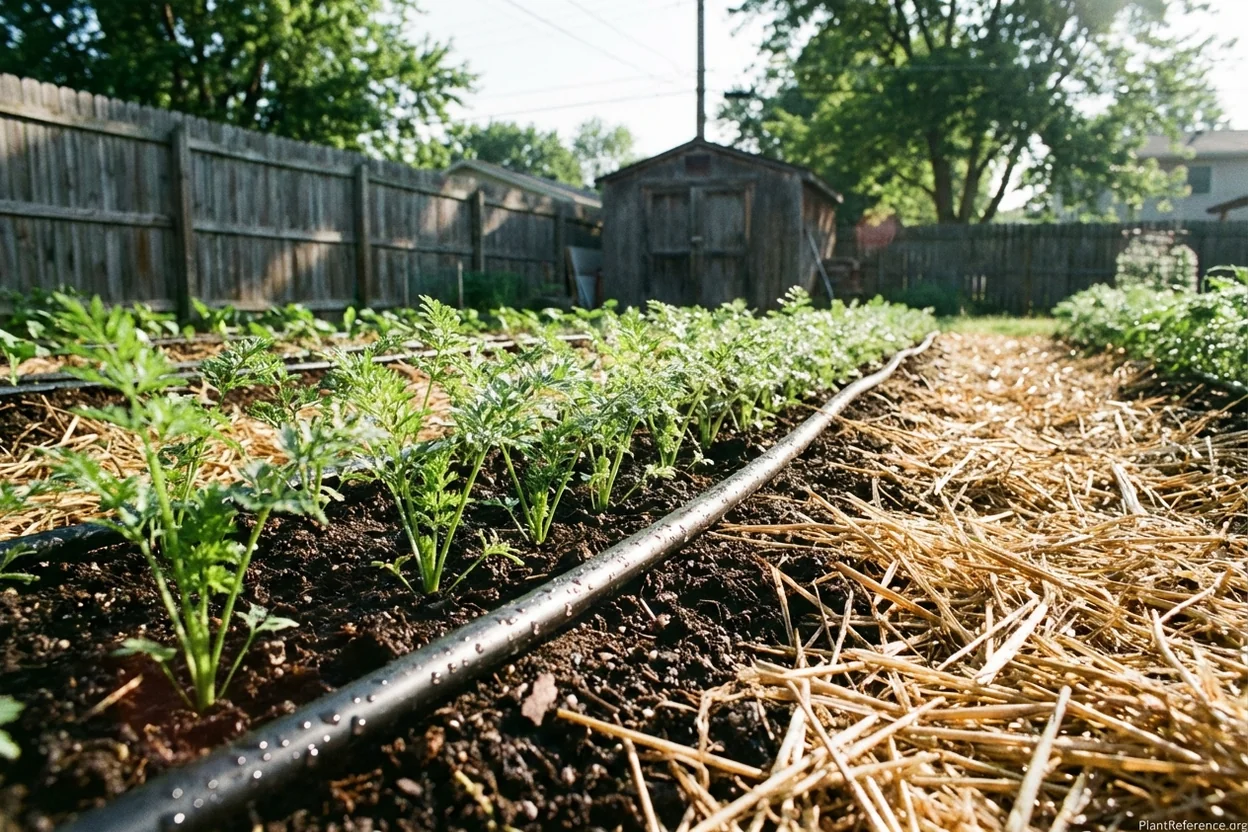
Use drip irrigation or soaker hoses positioned at the soil surface. Overhead watering wets the foliage and promotes fungal disease—a real concern during Indianapolis's humid July and August. Raised Bed Irrigation Systems: Watering Solutions for Consistent Growth
Mulching
Once seedlings are thinned to final spacing, apply 2-3 inches (5-8 cm) of straw or shredded leaf mulch between rows. Mulch stabilizes soil temperature during Indianapolis's spring temperature swings—a 40°F (22°C) day-to-night range in April is normal here. It also conserves the surface moisture that carrot seedlings depend on and suppresses weeds during the critical first six weeks when the tiny seedlings can't compete for light. Raised Bed Weeds: Prevention Strategies and Control Methods
Troubleshooting Indianapolis-Specific Problems
Clay Soil Forking
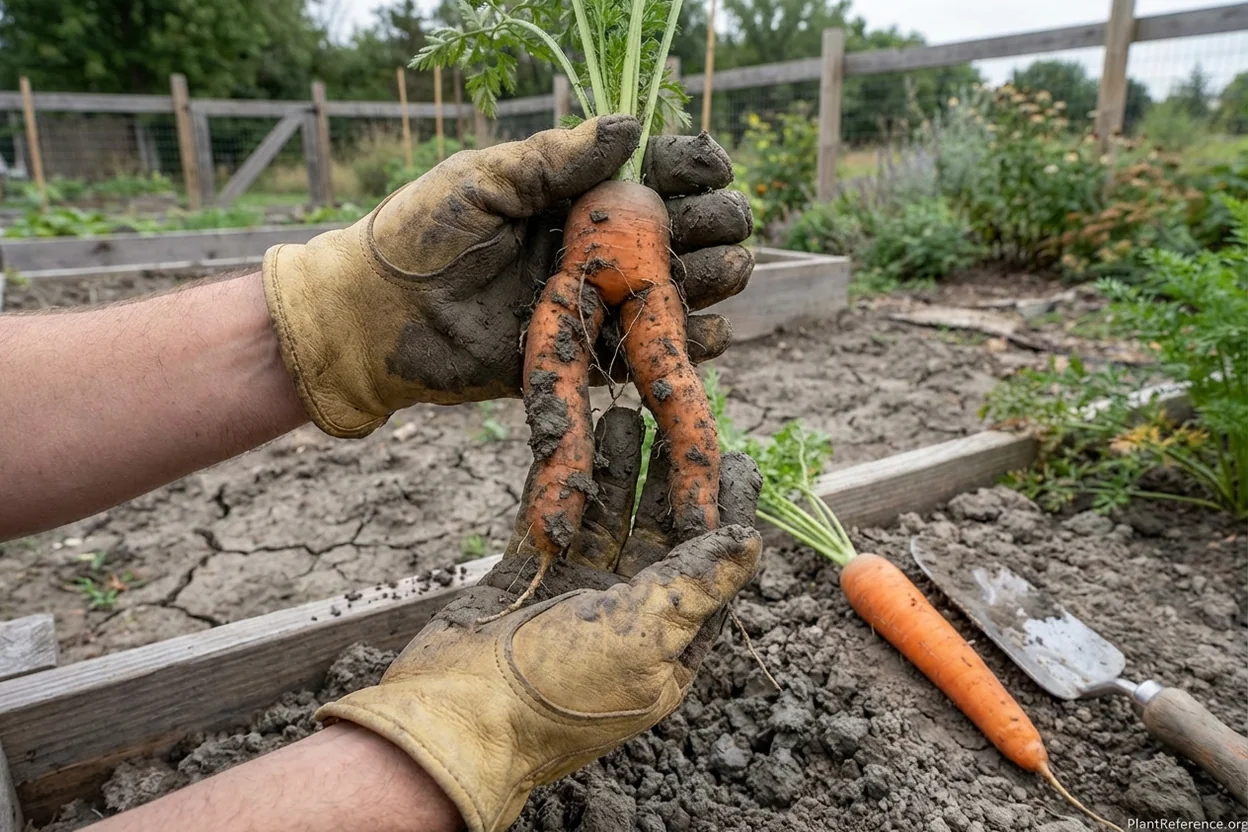
Forked, twisted carrots are the most common complaint I hear from Indianapolis gardeners, and the cause is almost always mechanical—a rock, a clay clod, or a compacted layer that the root tip couldn't penetrate. The fix is either switching to 🌿Daucus carota ssp. sativus 'Chantenay' or 🌿Daucus carota ssp. sativus 'Danvers 126' that can handle the resistance, or investing in raised beds with loose fill for longer varieties. Raised Bed Soil Settling and Compaction: Prevention and Solutions
Aster Yellows
Aster yellows is a phytoplasma disease carried by leafhoppers that migrate into Indiana on spring wind currents from the Gulf states. Infected carrot foliage turns yellow and develops a rosette of stunted shoots. The roots become hairy, woody, and intensely bitter. There is no treatment—infected plants must be pulled and destroyed immediately. Row covers installed at planting exclude the leafhopper vector, and removing dandelion and wild carrot weeds eliminates local disease reservoirs.
Carrot Weevil
The carrot weevil is a significant pest across the Great Lakes and Ohio Valley region, and Indianapolis is well within its range. Larvae tunnel into the upper portion of the root near the crown, leaving brown, corky channels. Rotate your carrot planting location each season—the weevil is a poor flier and mostly walks, so even 15-20 feet (5-6 m) of distance reduces infestation. When to Plant Kale in Indianapolis: Complete Guide + Best Varieties for Zone 5b
Summer Heat and Bitterness
When soil temperatures stay above 75-80°F (24-27°C), carrot roots stop bulking and develop bitter terpenoid compounds. This is exactly what happens during a typical Indianapolis July. Harvest spring-planted carrots before mid-July, and schedule your fall crop to bulk up during September and October when soil temperatures drop back into the sweet spot. When to Plant Peppers in Indianapolis: Complete Guide + Best Varieties for Zone 5b
Harvest & Storage
Spring carrots reach harvestable size when shoulders measure 3/4-1 inch (2-2.5 cm) in diameter at the soil surface, typically 65-80 days after sowing. 🌿Daucus carota ssp. sativus 'Chantenay' should be pulled before exceeding 2 inches (5 cm) in diameter to prevent the core from turning woody. Always loosen soil alongside the row with a garden fork before pulling—Indianapolis clay grips roots tightly and snaps off the tips if you pull straight up. When to Plant Tomatoes in Indianapolis: Complete Guide + Best Varieties for Zone 5b
Fall carrots are where the real payoff comes. Leave roots in the ground through several hard frosts. Temperatures below 40°F (4°C) trigger a biochemical conversion of stored starch into soluble sugars—the plant's natural antifreeze mechanism—producing carrots that taste noticeably sweeter than anything from the spring crop. Before the ground freezes solid in late November, mound 8-12 inches (20-30 cm) of straw or dry leaf mulch over the row. You can dig roots as needed through December. When to Plant Squash in Indianapolis: Complete Guide + Best Varieties for Zone 5b
For long-term storage, remove foliage immediately after harvest—the leaves continue transpiring and pull moisture from the root. Store unwashed carrots in perforated plastic bags at 32-38°F (0-3°C). Keep them away from apples and pears, which release ethylene gas that triggers bitter isocoumarin production in carrot tissue. In a root cellar packed in damp sand at 32-40°F (0-4°C), 🌿Daucus carota ssp. sativus 'Danvers 126' and the Nantes cultivar 'Bolero' store for four to five months.
Frequently Asked Questions
Reading about plants and recognising them are different skills. These three build the second.
- Daily PlantIdentify the day’s mystery plant from a close-up photograph.
- Keyed OutWork a dichotomous key, lead by lead, to name a hidden specimen.
- Name That PlantName a specimen from botanical clues dealt hardest first.
Free to play, no account needed
Aisha manages a small tropical nursery on the east side of Houston, specializing in plants that can handle the Gulf Coast's humidity, heat, and unpredictable flooding. She studied horticulture in college and worked at a wholesale grower before opening her own operation. Growing up, her parents kept a kitchen garden with okra, bitter gourd, and curry leaf plants—a tradition she's continued. Houston's subtropical climate lets her grow things most of the country can't, but it also means dealing with fungal issues, standing water, and summers where it's too hot for even tomatoes. Aisha writes about tropical and subtropical plant care, humidity management, and working with heavy clay soils.