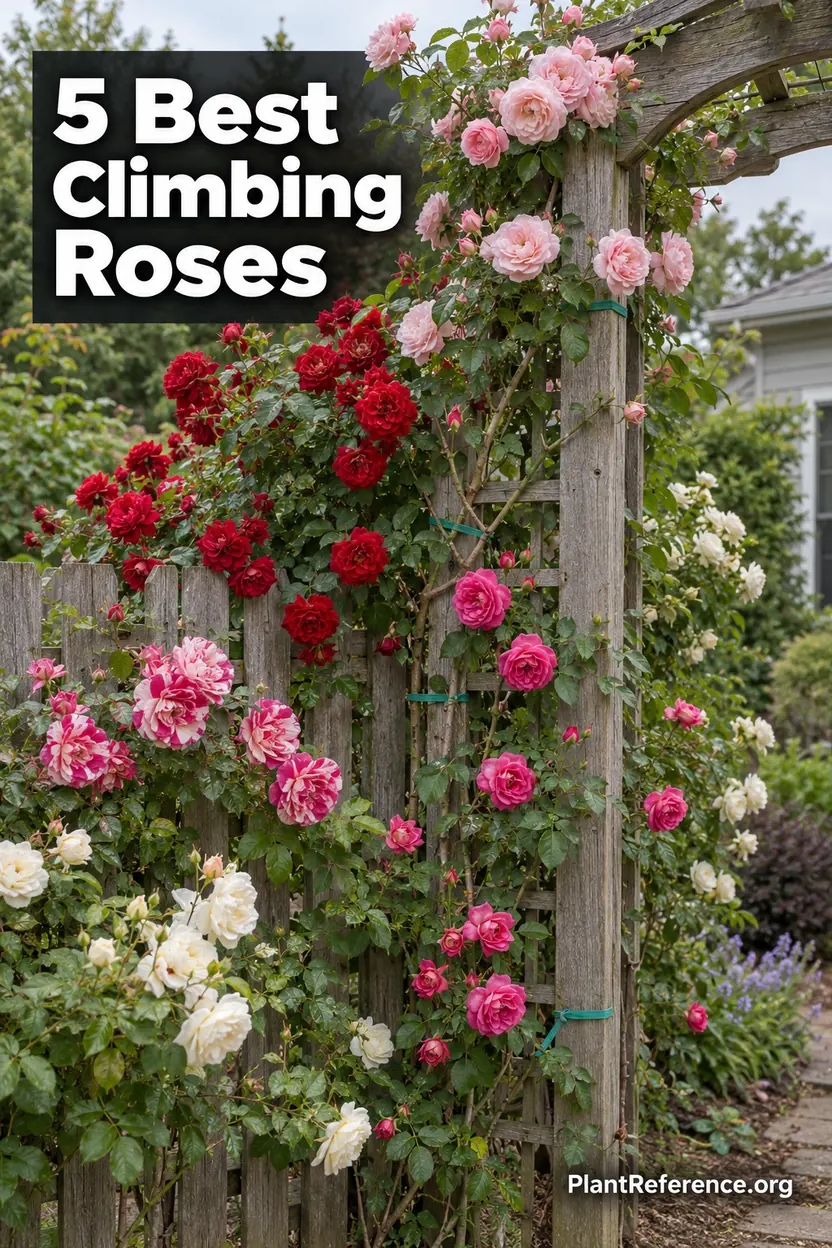
Best Climbing Roses for Fences, Arbors, and Trellises
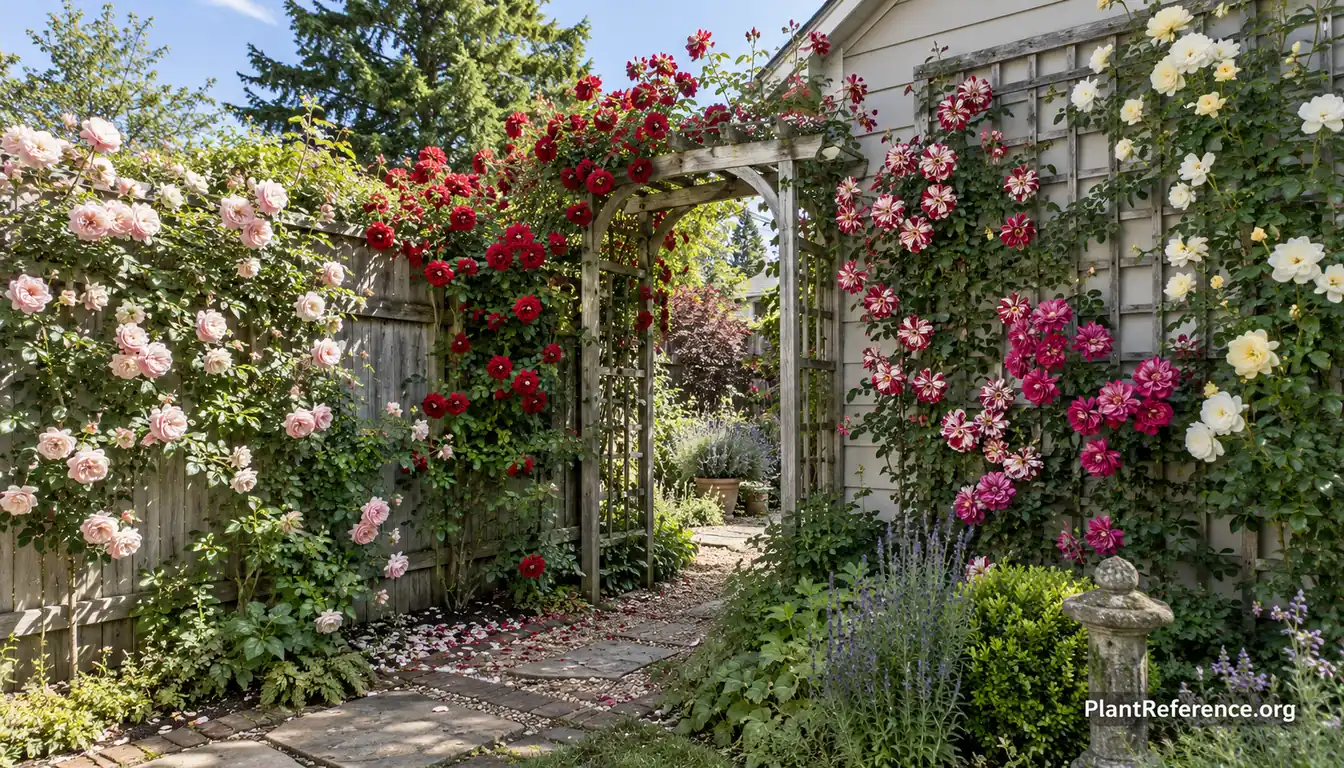
— Image © PlantReference.org 2026
Pets & Toxicity
Recorded toxicity for plants linked in this guide. An unknown status is not a safety assessment.
No linked plant is recorded as toxicDetailsHide
The best climbing roses do not truly climb: they produce long canes that gardeners must tie or weave onto a support. Garden roses Rosa spp. (ROH-zuh) lack tendrils, hooks, and adhesive pads. The right cultivar therefore combines flower quality with cane length, repeat bloom, health, hardiness, thorn level, and a growth habit that matches the fence, arbor, or trellis.
How These Climbing Roses Were Ranked
This ranking favors reliable repeat bloom, practical training, disease performance, fragrance, and a clear landscape role. The research describes climbing roses as producing canes 8-20+ feet (2.4-6+ m), but cultivar size and climate alter that range. Confirm the current nursery's mature dimensions and hardiness guidance before installing a permanent structure.
Support quality is part of cultivar success. A rose can become heavier after rain and wind, so attach the trellis or wires to sound posts or masonry before planting. Climbing Roses: Planting, Training, and Pruning Guide explains the complete system, while How to Grow Climbing Roses in the Pacific Northwest adds cool-maritime context.
Rank | Cultivar | Standout quality | Best use |
|---|---|---|---|
1 | Rosa 'New Dawn' | Disease resistance and repeat bloom | Large fence or arbor |
2 | Fragrant, nearly thornless canes | Walkways and entries | |
3 | Fragrant dark red flowers | Feature trellis or wall | |
4 | Rosa 'Fourth of July' | Red-and-white striped flowers | Informal fence display |
5 | Rosa 'Eden' | Cream-and-pink layered flowers | Romantic arbor focal point |
1. Rosa 'New Dawn': Best Overall
Rosa 'New Dawn' ranks first because it combines blush-pink flowers, repeat bloom, strong disease resistance, and hardiness across Zones 5-9. The research identifies it as the world's most popular climbing rose, and the reason is balance rather than one dramatic feature. It can cover a substantial support while remaining useful in gardens where constant fungicide treatment is undesirable.
Use Rosa 'New Dawn' on a large fence, pergola edge, or roomy arbor where long canes can spread horizontally. Disease resistance lowers risk; it does not remove the need for sunlight, airflow, and soil-level watering. Compare its profile with other strong performers in Best Disease-Resistant Roses for the Pacific Northwest.
2. 🌿Rosa 'Zephirine Drouhin': Best Near Walkways
🌿Rosa 'Zephirine Drouhin' is the access-friendly choice. Its deep-pink flowers repeat, carry strong fragrance, and grow on nearly thornless canes. That combination makes it especially useful near an entry, narrow side path, or seating area where hooked thorns would catch sleeves and turn routine tying into an unpleasant job.
The research places 🌿Rosa 'Zephirine Drouhin' in Zones 5-9. Give it the sun and airflow available in your garden, then monitor foliage rather than assuming a famous cultivar performs identically in every region. For wet-climate disease prevention, Black Spot on Roses: Identification and Treatment and Powdery Mildew on Roses: Prevention and Treatment offer separate diagnostic paths.
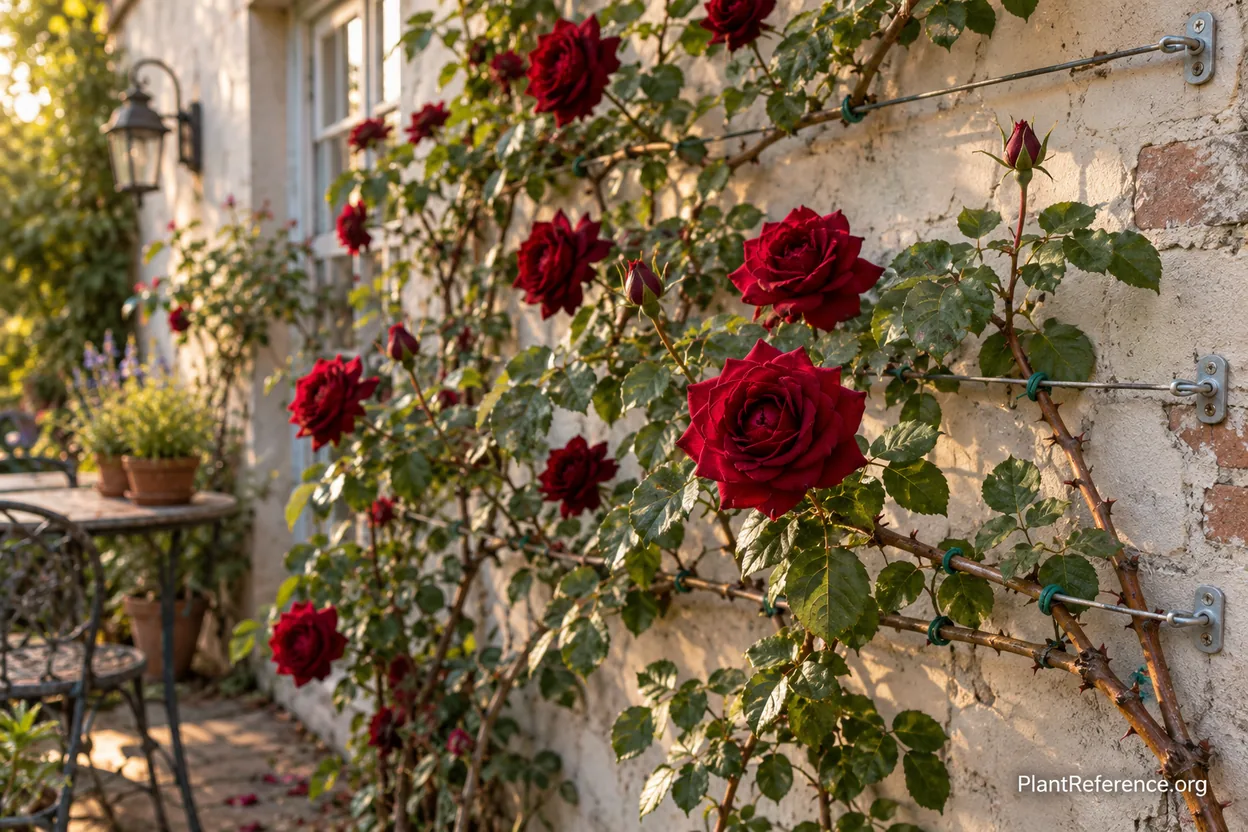
3. 🌿Rosa 'Don Juan': Best Dark Red Climber
🌿Rosa 'Don Juan' provides dark red, fragrant, repeat-blooming flowers for a strong focal point. Train it where viewers can approach the blooms safely and notice the scent: a freestanding trellis near a patio or a wall-mounted wire system beside a broad path works better than a remote back fence.
Dark red flowers read best with adequate light and a quieter background. Pale masonry, weathered gray wood, or cream companion flowers create contrast. Because the research does not assign a single hardiness range here, verify the seller's current zone rating and ask local growers about cane survival before treating 🌿Rosa 'Don Juan' as interchangeable with Rosa 'New Dawn'.
4. Rosa 'Fourth of July': Best Striped Climber
Rosa 'Fourth of July' is the playful choice, producing repeat-blooming red-and-white striped flowers. The irregular pattern gives each cluster more movement than a solid-color rose, making it effective across a simple fence where the flowers supply the visual detail.
Avoid pairing Rosa 'Fourth of July' with too many competing flower colors or ornate support materials. A plain dark fence, simple steel trellis, or natural wood frame lets the stripes remain the feature. Confirm local hardiness and mature size before ordering, then allocate enough width for horizontal training rather than forcing all canes straight upward.
5. Rosa 'Eden': Best Romantic Flower Form
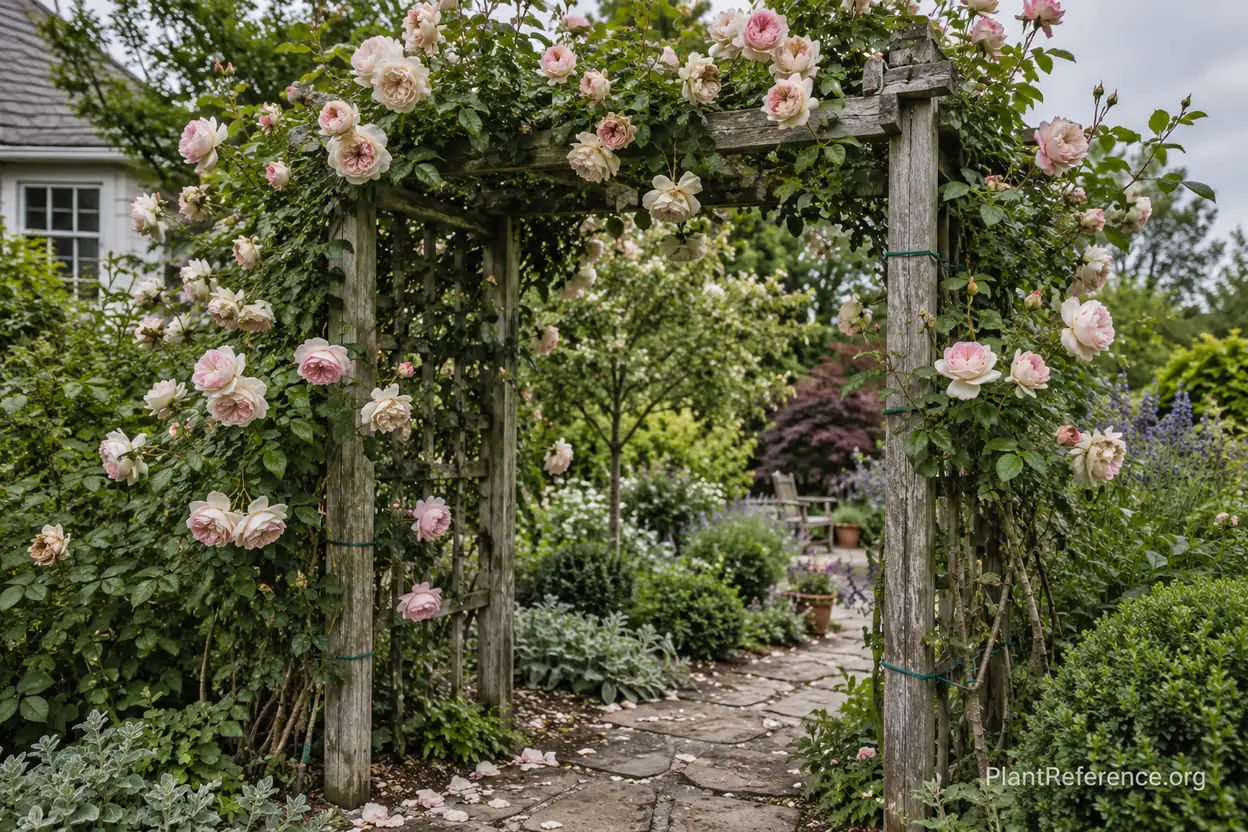
Rosa 'Eden', also sold as Rosa 'Pierre de Ronsard', produces repeat cream-and-pink flowers with a deeply layered, old-fashioned appearance. It is the visual-form winner for an arbor or prominent trellis where individual blooms can be viewed closely. The soft palette pairs naturally with stone, painted wood, or restrained companion planting.
Heavy, many-petaled blooms can respond differently to rain and humidity than simpler flowers. Use open placement and observe how the plant performs in your microclimate. Growing Roses in the Pacific Northwest: Complete Guide explains why spring and autumn moisture can matter even when summer conditions are comparatively dry.
Match the Rose to the Support
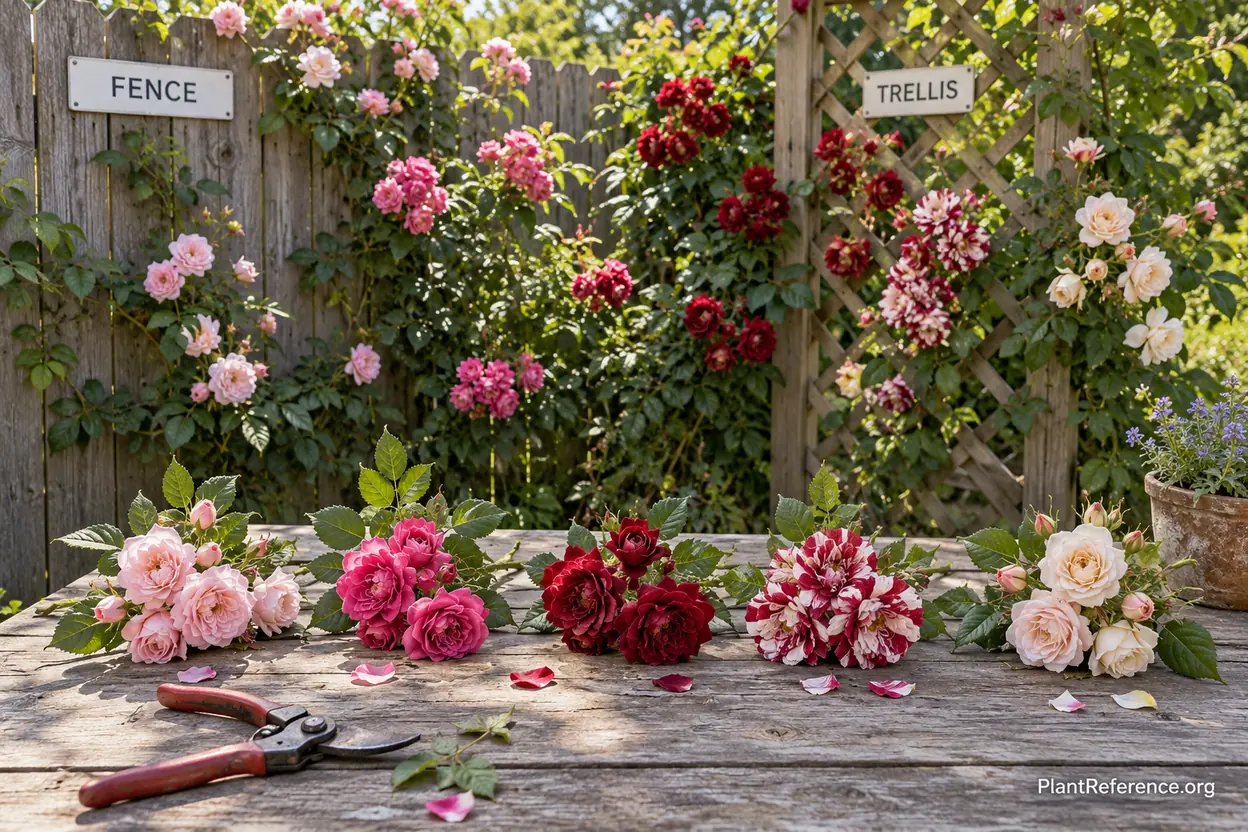
Choose the support before the rose. Fences provide width for horizontal training; arbors need clearance and structurally sound posts; wall systems need stand-off space so air can move behind foliage. A narrow decorative trellis may suit a young plant but fail under a mature canopy, especially when rain adds weight.
Use a broad fence for Rosa 'New Dawn' and other vigorous long-caned climbers.
Place 🌿Rosa 'Zephirine Drouhin' near entries where fewer thorns improve access.
Reserve a pale wall or feature trellis for 🌿Rosa 'Don Juan'.
Give Rosa 'Fourth of July' a simple background that does not compete with striped flowers.
Build a sturdy arbor for the layered flower display of Rosa 'Eden'.
Leave enough access to untie, inspect, and prune canes from both sides. Do not thread a permanent cane behind lattice where it cannot be removed without breakage. If buying dormant stock, Bare-Root vs Container Roses: Which Should You Buy? compares formats, and Own-Root vs Grafted Roses: Pacific Northwest Guide explains what to inspect at the crown.
Train and Prune for More Flowers
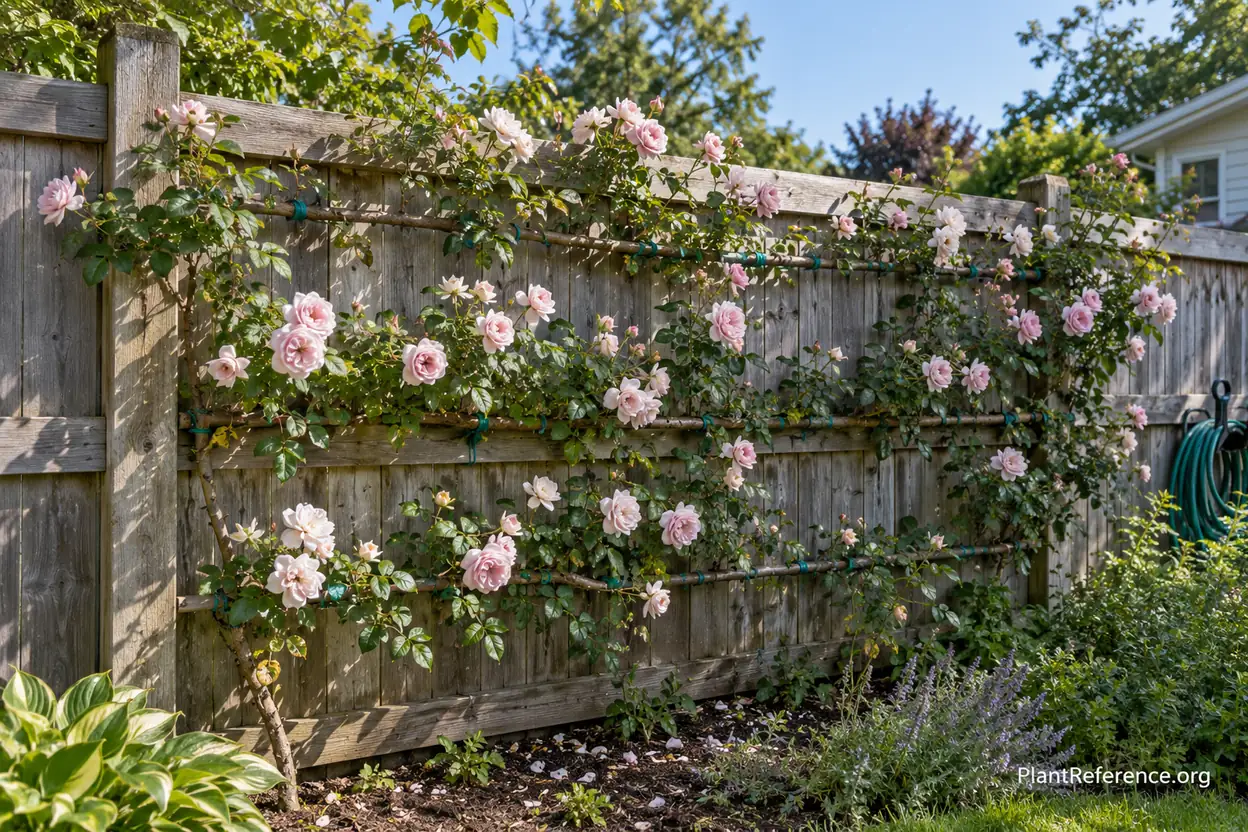
Training main canes horizontally is the most important flowering technique. Plant hormones favor upward growth; when a long cane is lowered toward horizontal, buds along its length produce vertical flowering laterals. A cane tied straight up often concentrates flowers near the tip, leaving the lower structure bare.
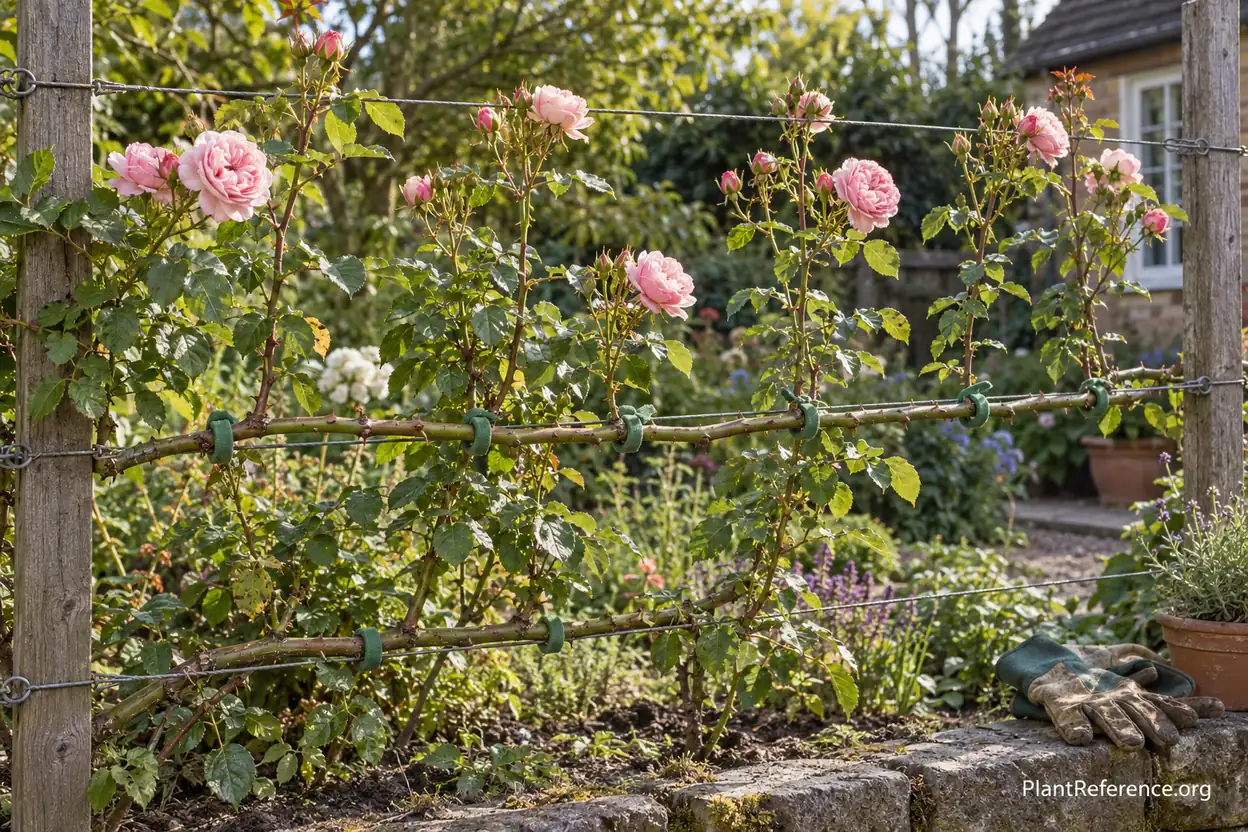
Do not prune a new climbing rose heavily during its first 2-3 years; it needs time to build the permanent framework. After establishment, maintain 4-6 main canes, shorten lateral shoots to 2-3 buds in spring, and remove one oldest main cane every 2-3 years for renewal. Once-blooming climbers flower on old wood and must be pruned after flowering, while repeat bloomers are generally pruned in late winter or early spring. How to Prune Roses: When and How to Prune Every Type of Rose covers that timing distinction.
Tie with material broad enough to avoid cutting into expanding canes, and leave a little slack. Inspect ties at least annually. Clean bypass pruners make controlled cuts, but use loppers or a saw for wood beyond the hand tool's rated capacity. Japanese Beetles on Roses: Control That Works is useful when flowers are damaged even though training and pruning are correct.
For broad disease resistance and repeat performance, Rosa 'New Dawn' is the safest first choice. Where access matters, 🌿Rosa 'Zephirine Drouhin' offers a rare combination of fragrance and nearly thornless canes. The best climber is ultimately the one whose cane habit, hardiness, and flower character fit a support built to last.
Frequently Asked Questions
Reading about plants and recognising them are different skills. These three build the second.
- Daily PlantIdentify the day’s mystery plant from a close-up photograph.
- Keyed OutWork a dichotomous key, lead by lead, to name a hidden specimen.
- Name That PlantName a specimen from botanical clues dealt hardest first.
Free to play, no account needed
Tagged with
Sarah earned her doctorate in plant biology and spent time working in botanical garden education before transitioning to freelance writing and consulting. Now based in Portland, Oregon, she teaches plant identification workshops at local community centers and maintains a modest collection of over 60 houseplants in her small apartment. Sarah specializes in helping beginners understand plant science without the jargon—her approach focuses on practical observation over theory. She's killed her fair share of fiddle leaf figs and finally cracked the code on keeping them alive.