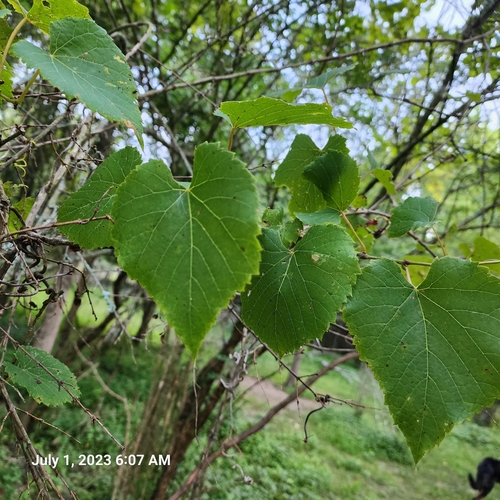
Vitis, Genus, vulpina, Species,
- Genus & species
frost grape
Overview
Vitis vulpina is a vigorous deciduous woody vine of the grape family native to bottomlands, streambanks, thickets, and woodland edges across the eastern and central United States. It climbs by forked tendrils to 30-60 feet (9-18 m) into trees and over fences, with stems reaching several inches thick at the base. The heart-shaped leaves are 3-7 inches (8-18 cm) long, glossy green, toothed, and usually unlobed or shallowly lobed, turning yellow in autumn. Small greenish flowers open in late spring in branched clusters, the species being mostly dioecious so that fruiting vines need a nearby male. Female vines bear hanging clusters of small black grapes 0.2-0.4 inch (6-10 mm) wide that stay sour until autumn frost sweetens them, hence the common name. The fruit feeds birds and mammals, while the dense growth gives cover and nesting sites. Its vigor lets it smother shrubs and small trees and pull down weak supports, so it needs room and a strong structure. In cultivation it is used on arbors, fences, and trellises, for wildlife plantings, and in naturalized hedgerows.
Native Range
Native to the eastern and central United States, from New York and the Great Lakes south to Florida and west to Texas and Nebraska. It grows in moist bottomlands, along streambanks, and in thickets, fencerows, and woodland edges.Suggested Uses
Used on arbors, pergolas, fences, and trellises, in wildlife and habitat plantings, and in naturalized hedgerows and screens. The grapes are also used for jelly and wine where the sour fruit is sweetened.How to Identify
Appearance
Size & Dimensions
Height30' - 60'
Width/Spread10' - 20'
Bloom Information
Small greenish, fragrant flowers open in late spring, May to June, in branched clusters. The vines are mostly dioecious, so only female plants near a male set fruit. Flowering is followed by grapes that ripen black in autumn.
Detailed Descriptions
Foliage Description
greenGrowing Conditions
Sun Requirements
Requires 4-12 hours of direct sunlight daily
• Full Sun: 6+ hours of direct sunlight
• Partial Shade: 3-6 hours of direct sunlight
• Full Shade: Less than 3 hours of direct sunlight
Care & Maintenance
Care Guide
Grow in full sun to part shade in moist, fertile, well-drained soil; the species tolerates a wide range of soils and seasonal flooding. Established vines are drought-tolerant and need little care beyond support and space. A sturdy arbor, fence, or tree is needed, since the heavy stems can pull down weak structures. Prune hard in late winter to control the rampant growth and keep it within bounds. It fruits most reliably with a male vine nearby for pollination. Hardy in USDA zones 5-9.Pruning
Prune hard in late winter while dormant to limit the vigorous growth and remove tangled or dead wood. Vines tolerate cutting back to a few buds and resprout strongly. Yearly pruning keeps the vine within its support.Pruning Schedule
Prune: February–March
winter