Vitis, Genus, cinerea, Species,
- Genus & species
graybark grape
Overview
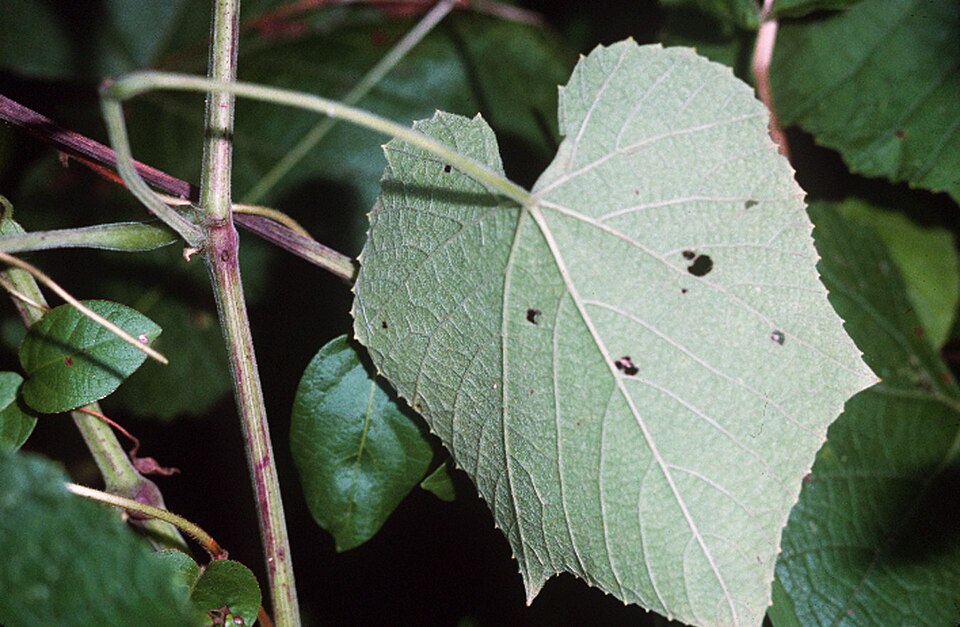
Vitis cinerea is a vigorous deciduous woody vine of the central and eastern United States, climbing 25-40 feet (7.5-12 m) into trees by means of forked tendrils. Old stems develop shreddy gray-brown bark, and the young shoots, leaf undersides, and tendrils are covered with gray hairs that give the species its name. The heart-shaped leaves are 3-7 inches (8-18 cm) long, sometimes shallowly lobed, green above and grayish-hairy beneath, turning yellow in autumn. Small greenish, fragrant flowers open in branched clusters in May and June, followed by hanging clusters of black grapes 0.25-0.5 inch (6-12 mm) wide that ripen in fall and persist after the leaves drop. The fruit is tart until fully ripe and is eaten by many birds and mammals. V. cinerea grows in bottomland woods, stream banks, fence rows, and thickets, tolerating a range of soils and periodic flooding. The vine grows fast and heavy and can shade out or pull down small trees and shrubs, so it needs strong support and space away from valued plants. Plants are hardy in USDA zones 5-9 and resprout strongly after being cut back.
Native Range
Vitis cinerea is native to the central and eastern United States, from the Great Lakes and Mid-Atlantic south to the Gulf and west into Texas and the southern Great Plains. It grows in bottomland forests, along streams and rivers, in fence rows, and in moist thickets.Suggested Uses
Grown on sturdy arbors, pergolas, and fences in native, wildlife, and edible landscapes, and used to screen large structures where its vigor is welcome. It is planted 8-12 feet (2.4-3.7 m) apart on strong support and away from small trees and shrubs. The grapes feed birds and mammals and can be made into jelly or juice.How to Identify
Appearance
Size & Dimensions
Height25' - 40'
Width/Spread10' - 20'
Bloom Information
Small greenish, fragrant flowers open in branched clusters in May and June, opposite the leaves. The flowers are inconspicuous but draw bees and other insects with their scent and nectar. Both bisexual-flowered and functionally male vines occur, so fruiting varies from plant to plant.
Detailed Descriptions
Foliage Description
green above, grayish beneath; yellow in fallGrowing Conditions
Sun Requirements
Requires 6-12 hours of direct sunlight daily
• Full Sun: 6+ hours of direct sunlight
• Partial Shade: 3-6 hours of direct sunlight
• Full Shade: Less than 3 hours of direct sunlight
Care & Maintenance
Care Guide
Vitis cinerea grows in full sun to partial shade and tolerates loam, clay, or sandy soil at pH 5.5 to 7.5, including moist bottomland and ground that floods briefly. It fruits most heavily in full sun and is hardy in USDA zones 5-9. The vine needs medium moisture but withstands short dry spells once established. It grows fast and heavy, so it requires a strong arbor, fence, or large tree and regular control to keep it off smaller plants. Pruning when dormant keeps it within bounds.Pruning
Pruning in late winter, while the vine is dormant, controls its size and removes tangled, dead, or weak stems. Vitis cinerea fruits on shoots from year-old wood, so leaving some of the previous season's growth preserves the fall crop. Cutting an overgrown vine to the ground renews it, and it resprouts strongly the next season.Pruning Schedule
Prune: February–March
winter