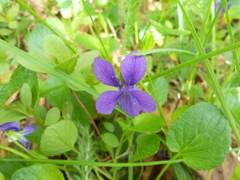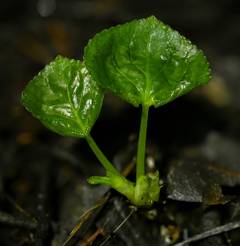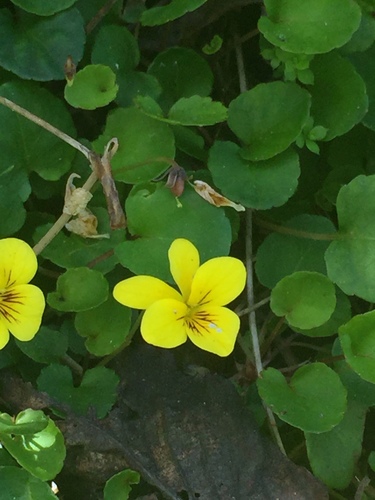
Viola, Genus, sempervirens, Species,
- Genus & species
evergreen yellow violet
Overview
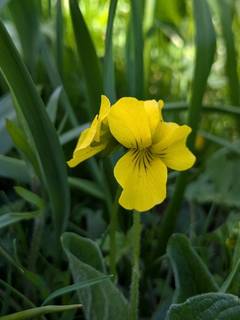
Viola sempervirens is a low-growing evergreen perennial reaching 1-4 inches (2.5-10 cm) tall and 6-18 inches (15-45 cm) wide, forming a creeping mat from spreading aboveground stolons that root at the nodes. Leaves are kidney-shaped to broadly heart-shaped, 0.5-1.5 inches (12-38 mm) across, with shallowly scalloped margins, dark green above with dark purple flecks or mottling, and on long petioles. Foliage persists year-round in mild Pacific coastal climates (zones 7-9), browning in colder zones. Bright yellow flowers about 0.4-0.6 inch (10-15 mm) across appear singly on slender stalks above the foliage from March through June, with peak bloom from April to mid-May. The two upper petals are pure yellow while the three lower petals have brown-purple veining and the lateral pair are sparsely bearded. Cleistogamous self-pollinating flowers form near the base from late spring through fall and set seed without opening. Capsules ripen May through August and explosively eject seeds 3-6 feet (90-180 cm) from the parent plant. Spreads vigorously by stolons rooting at every node, expanding 4-8 inches (10-20 cm) per year, eventually forming mats 2-4 feet (60-120 cm) across over 3-5 years. Lifespan of an individual rosette 3-6 years; clonal mats persist much longer through ongoing stolon expansion.
Native Range
Native to redwood forests, moist coniferous forests, and shaded streamside terraces from southern British Columbia south through coastal Washington and Oregon to the redwood and Douglas-fir belt of central California. Found at elevations from sea level to 4,000 feet (1,200 m), most commonly below 2,500 feet (760 m).Suggested Uses
Used as a groundcover in shaded woodland gardens, moist coniferous understory plantings, and rain garden margins in the Pacific Northwest and northern California. Spaced 8-12 inches (20-30 cm) apart in groupings of 9-15 plants for solid coverage in 2-3 years. Functions as a larval host for the western meadow fritillary and the silver-bordered fritillary butterflies.How to Identify
Appearance
Size & Dimensions
Height1" - 4"
Width/Spread6" - 1'6"
Bloom Information
Flowers from March through June across the range, with peak bloom from April to mid-May in coastal zones 8-9. Hot, dry conditions in late spring shorten bloom by 1-2 weeks; cool maritime springs extend it through early July. Each flower lasts 4-7 days; total bloom on a single plant lasts 6-8 weeks. Cleistogamous flowers continue to set seed from late spring through fall.
Detailed Descriptions
Flower Description
yellow with brown-purple veiningFoliage Description
dark green with dark purple flecksGrowing Conditions
Sun Requirements
Requires 2-5 hours of direct sunlight daily
• Full Sun: 6+ hours of direct sunlight
• Partial Shade: 3-6 hours of direct sunlight
• Full Shade: Less than 3 hours of direct sunlight
Care & Maintenance
Care Guide
Plant container-grown stock in spring or fall in moist, humus-rich soil with light to moderate shade. Water weekly during the first growing season; established plants tolerate seasonal drought of 3-4 weeks but show leaf scorch in prolonged dry summers. Tolerates a soil pH range from 5.0 to 6.5 and grows well in acidic conifer-litter soils typical of redwood and Douglas-fir forests. Slugs may damage foliage in moist gardens; iron phosphate baits reduce damage. Spreading stolons can extend beyond intended planting areas; trim back at the perimeter or pull rooted nodes to restrain spread. Plants form dense weed-suppressing mats in moist shade.Pruning
No structural pruning is required. Trim back stolons at the colony perimeter in spring or fall to restrain spread. Cut spent flowering stalks to the base if self-seeding is not wanted; cleistogamous summer flowers near the base will continue to set seed regardless.Pruning Schedule
Prune: March & October
early springfall
Container Growing
Suitable for container growing
Minimum container size: 1 gallons