Viola, Genus, glabella, Species,
- Genus & species
stream violet
Pacific North America and Northeast Asia
Overview
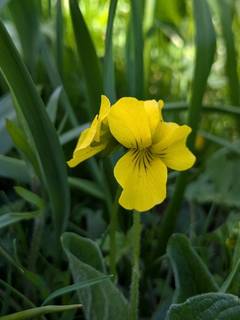
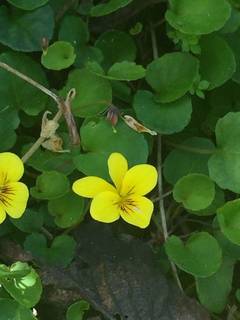
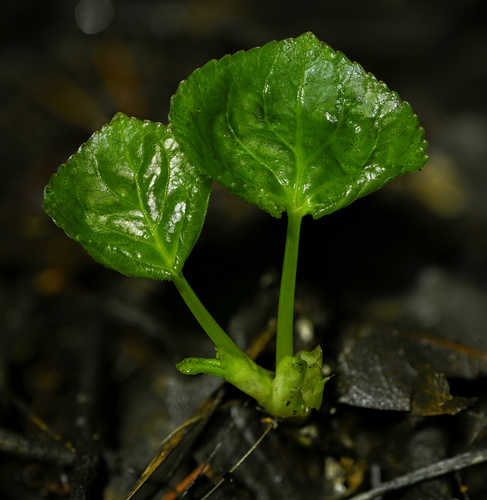
Viola glabella is a herbaceous perennial reaching 4-12 inches (10-30 cm) tall and 6-12 inches (15-30 cm) wide, forming clumps from creeping rhizomes. Stems are slender and erect, with leaves appearing along the upper portion of the stem rather than only at the base. Leaves are heart-shaped to broadly kidney-shaped, 1.5-3 inches (4-7.5 cm) across, with shallowly scalloped margins; both basal and stem leaves have long petioles. Bright yellow flowers about 0.5-0.75 inch (12-19 mm) across appear from April through July, with peak bloom in May. The two upper petals lack markings while the three lower petals have brown-purple veining and the lateral pair are sparsely bearded. Cleistogamous (self-pollinating) flowers form near the base from late spring through fall and set seed without opening. Capsules ripen July through September and explosively eject seeds 3-6 feet (90-180 cm) from the parent plant. Foliage dies back to the rhizome after the first hard frost in zones 5-9. Spreads by both rhizomes and self-seeding, expanding 2-4 inches (5-10 cm) per year, eventually forming colonies 1-3 feet (30-90 cm) across over 3-5 years. Lifespan 5-10 years.
Native Range
Native to moist forests, streamside terraces, and seep meadows from southern Alaska south through coastal and interior British Columbia, Washington, Oregon, and northern California to the central Sierra Nevada, with disjunct populations in northeast Asia (Russian Far East, Japan, China). Found at elevations from sea level to 7,000 feet (2,100 m), most commonly below 4,500 feet (1,370 m).Suggested Uses
Used in shaded woodland gardens, moist native plant borders, streamside plantings, and as a groundcover under deciduous trees. Spaced 6-10 inches (15-25 cm) apart in groupings of 9-15 plants. Functions as a larval host for the western meadow fritillary and several other regional fritillary butterflies.How to Identify
Appearance
Size & Dimensions
Height4" - 1'
Width/Spread6" - 1'
Bloom Information
Flowers from April through July across the range, with peak bloom in May at most lowland sites. In high-elevation populations (above 4,500 feet / 1,370 m), bloom occurs from June through July. Each flower lasts 4-7 days; total bloom on a single plant lasts 4-6 weeks. Cleistogamous flowers continue to set seed from late spring through fall.
Detailed Descriptions
Flower Description
yellow with brown-purple veining on lower petalsFoliage Description
medium greenGrowing Conditions
Sun Requirements
Requires 2-6 hours of direct sunlight daily
• Full Sun: 6+ hours of direct sunlight
• Partial Shade: 3-6 hours of direct sunlight
• Full Shade: Less than 3 hours of direct sunlight
Care & Maintenance
Care Guide
Plant container-grown stock or sow seed in fall in moist, humus-rich soils with light to moderate shade. Water during the first growing season; established plants tolerate seasonal drought of 2-3 weeks but go dormant earlier in dry summers. Tolerates a soil pH range from 5.5 to 7.0; soils amended with leaf-mulch or compost retain moisture and support stronger growth. Slugs may damage foliage in moist gardens; iron phosphate baits reduce damage. Crowns persist 5-7 years and self-seeding maintains populations long-term. Volunteer seedlings can be transplanted in early spring or removed by hoeing if the colony has expanded beyond the desired area.Pruning
No structural pruning is required. Remove dead foliage in late fall as old leaves brown. Cut spent flowering stalks to the base if self-seeding is not wanted; cleistogamous summer flowers near the base will continue to set seed regardless.Pruning Schedule
Prune: November
fall
Container Growing
Suitable for container growing
Minimum container size: 1 gallons