1 / 9
© yerbasanta, some rights reserved (CC-BY-NC) · iNaturalist
Rosa gymnocarpa
bald-hip rose
British Columbia south through Washington and Oregon to California; dry to moist conifer forest understories, forest edges, and open woodlands
Learn more
Overview
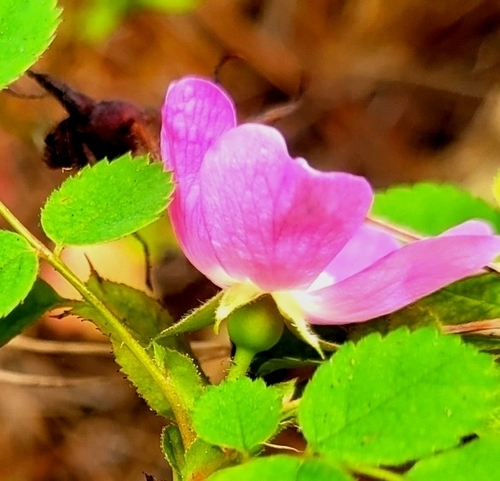
Rosa gymnocarpa is bald-hip rose (wood rose), an upright deciduous shrub growing 1-5 feet (30-150 cm) tall and 2-4 feet (60-120 cm) wide. Pink lightly fragrant solitary five-petaled flowers 0.6-1 inch (15-25 mm) in May-July (5 weeks). Small oval red-orange hips 0.3-0.5 inch (8-13 mm) in August-September. Pinnately compound leaves with 5-9 small leaflets and doubly serrated margins; slender stems with only fine needle-like prickles (no stout paired infrastipular prickles). In Rosaceae. Gymnocarpa = naked fruit. The diagnostic feature is that the sepals drop off before the hip ripens, leaving 'bald' hips — unique among all native PNW roses (every other native rose retains sepals on ripe hips). Native to BC south through WA, OR, CA. Found in dry to moist conifer forest understories, at forest edges, and in open woodlands. The only native PNW rose adapted to deep forest shade. The most drought-tolerant native PNW rose once established. Bald hips are edible (high in vitamin C) but small. Non-toxic. Zones 5-9. Full shade to partial shade. Growth rate is slow.
Native Range
Native to British Columbia south through Washington and Oregon to California. Found in dry to moist conifer forest understories, at forest edges, and in open woodlands. The only native PNW rose adapted to deep forest shade.Suggested Uses
Grown as a native rose in dry shaded conifer woodland gardens, native plant gardens, and forest edge plantings, spaced 2-4 feet (60-120 cm). Diagnostic bald hips. Only PNW native rose for deep shade. Most drought-tolerant native rose. Non-toxic. Zones 5-9.How to Identify
Appearance
Size & Dimensions
Height1' - 5'
Width/Spread2' - 4'
Reaches mature size in approximately 5 years
Bloom Information
Late spring to mid summer (May-July). Pink lightly fragrant solitary five-petaled flowers 0.6-1 inch (15-25 mm). 5 weeks. Bee- and butterfly-visited. Small oval red-orange bald hips follow in August-September.Detailed Descriptions
Flower Description
Pink to pale pink, lightly fragrant, solitary five-petaled flowers 0.6-1 inch (15-25 mm); May-July; followed by small oval red-orange hips 0.3-0.5 inch (8-13 mm) in August-September; the diagnostic feature is that the sepals drop off before the hip ripens — leaving 'bald' hips (gymnocarpa = naked fruit), which is unique among all native PNW rosesFoliage Description
Medium green; pinnately compound with 5-9 small hairless leaflets, each 0.5-1.5 inches (13-38 mm), with doubly serrated margins; slender stems with fine needle-like prickles 1-3 mm — no stout paired infrastipular prickles (which distinguishes from R. nutkana and R. pisocarpa); the only native PNW rose adapted to deep forest shade; turns yellow to orange in fallGrowing Conditions
Sun Requirements
Tolerates up to 4 hours of direct sunlight daily
• Full Sun: 6+ hours of direct sunlight
• Partial Shade: 3-6 hours of direct sunlight
• Full Shade: Less than 3 hours of direct sunlight
Care & Maintenance
Care Guide
Full shade to partial shade (0-4 hours). Well-drained loam, sand, or rocky soil pH 5.0-7.0. Most drought-tolerant native PNW rose once established. Only native PNW rose for deep forest shade. Cold-hardy (zone 5). Non-toxic. Zones 5-9.Pruning
Prune in early spring (February-March) to remove damaged or crossing canes. Minimal pruning required — the natural form is the goal.Pruning Schedule
J
F
M
A
M
J
J
A
S
O
N
D
early spring