Rosa, Genus, canina, Species,
- Genus & species
dog rose
Overview
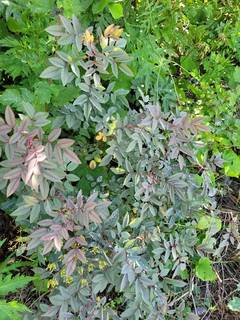
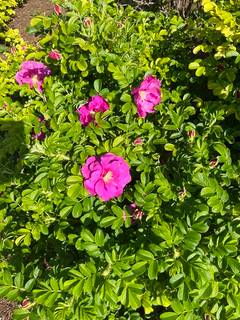
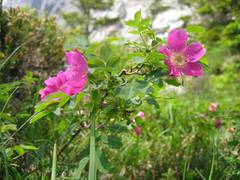
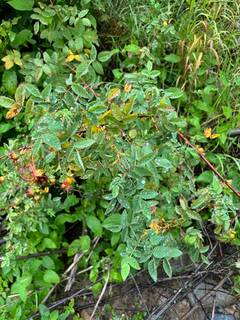
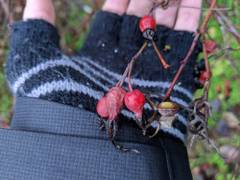
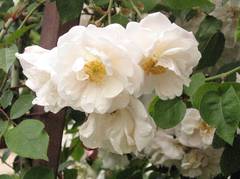
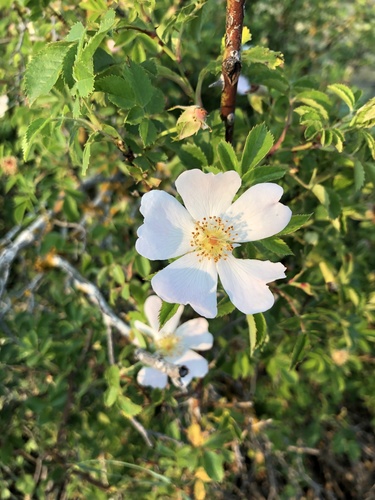
Rosa canina is a vigorous, arching, deciduous shrub in the rose family (Rosaceae) reaching 6-10 feet (1.8-3 m) tall and 6-8 feet (1.8-2.4 m) wide with long, scrambling, thorny canes. Canes are green to reddish-brown, armed with stout, curved, hooked thorns (prickles) 5-8 mm long spaced along the internodes. Leaves are pinnately compound with 5-7 ovate, serrated leaflets, each 1-1.5 inches (2.5-4 cm) long, medium green, glabrous above. Flowers are single, five-petalled, 1.5-2 inches (4-5 cm) across, white to pale pink, borne singly or in clusters of 2-4 at branch tips. Petals are notched at the apex. Flowers carry a light, sweet scent. Fruit (rose hips) are ovoid-elliptic, 0.5-0.75 inch (12-20 mm) long, bright scarlet-red, ripening in September-October and persisting through winter. Hips are high in vitamin C — 10-50 times the concentration found in oranges by weight — and have been used for centuries in teas, syrups, and preserves. The species is the wild rose typical of European hedgerows and woodland edges, and is widely used as rootstock for grafting cultivated rose varieties, due to vigour, disease tolerance, and compatibility with most cultivars. Plants self-seed prolifically via bird-dispersed hips. The species has naturalised in North America, where it is treated as invasive in some regions. Susceptible to black spot (Diplocarpon rosae), powdery mildew, and rose rust (Phragmidium mucronatum), though generally less affected than hybrid teas.
Native Range
Rosa canina is native across Europe, from the British Isles and Scandinavia south to the Mediterranean, and eastward through the Caucasus to western Iran and North Africa, where the species occurs in hedgerows, woodland margins, scrubland, and disturbed ground from sea level to approximately 5,000 feet (1,500 m).Suggested Uses
Planted as an informal hedge, barrier, or wildlife habitat shrub, spaced 5-6 feet (1.5-1.8 m) apart. The thorny habit deters access when the species is used as a boundary planting. Hips are harvested for food and medicinal use — picking after the first frost gives the highest sugar content. Widely used as rootstock for grafted roses. In wildlife gardens, the hips supply winter food for birds including blackbirds, thrushes, and waxwings, and the dense thorny growth gives nesting habitat.How to Identify
Appearance
Size & Dimensions
Height6' - 10'
Width/Spread6' - 8'
Bloom Information
Single flowers open from late May through June, lasting individually 3-5 days. Each cluster of 2-4 flowers opens sequentially. Bloom period spans 3-4 weeks. Pollination is by bees, hoverflies, and beetles. Hips develop from July, colouring to scarlet-red by September-October and persisting on bare branches through winter.
Detailed Descriptions
Flower Description
White to pale pinkFoliage Description
Medium greenGrowing Conditions
Sun Requirements
Requires 4-10 hours of direct sunlight daily
• Full Sun: 6+ hours of direct sunlight
• Partial Shade: 3-6 hours of direct sunlight
• Full Shade: Less than 3 hours of direct sunlight
Care & Maintenance
Care Guide
Plants grow in full sun to partial shade in any moderately fertile, well-drained soil with a pH of 5.5-7.5. The species tolerates chalk, clay, and sandy soils. Plants are spaced 5-6 feet (1.5-1.8 m) apart for hedging, 8 feet (2.4 m) as a specimen. Watering during the first growing season supports establishment; once established, supplemental irrigation is rarely needed. A balanced rose fertiliser in early spring supports steady growth. Black spot and powdery mildew are managed by improving air circulation through thinning crowded canes. In the Pacific Northwest, the species grows vigorously and may need annual pruning to control size.Pruning
Pruning takes place in late winter (February-March). Dead, damaged, and crossing canes are removed. One-third of the oldest canes is thinned at the base annually to promote vigorous new growth. Remaining canes are shortened by one-third to maintain shape. For hedging, light trimming follows flowering and a second trim follows in late winter. The thorns are sharp and hooked, so pruning typically uses heavy-duty gloves and long-sleeved protection.Pruning Schedule
Prune: February–March
late spring