Ribes, Genus, missouriense, Species,
- Genus & species
Missouri gooseberry
Overview
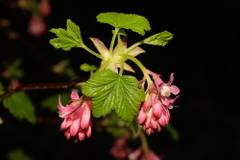
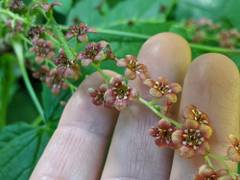
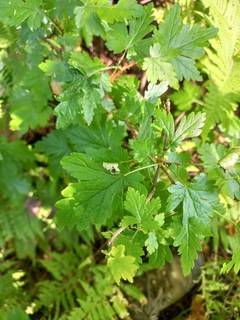
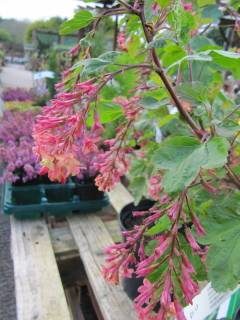
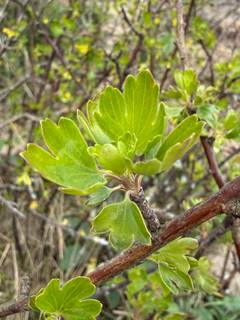
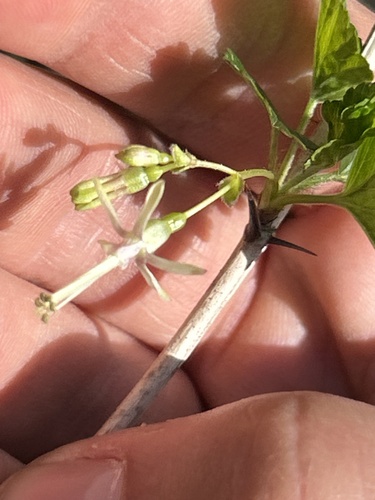
Ribes missouriense is a deciduous, spiny shrub in the currant family, forming a rounded thicket 3-6 feet (0.9-1.8 m) tall and wide on arching, gray-barked stems. Each node bears one to three slender spines 0.3-0.7 inch (8-18 mm) long, and the internodes are often set with finer prickles. The maple-like leaves are 0.75-2 inches (2-5 cm) wide with three to five toothed lobes, turning yellow before dropping in autumn. In April and May, pendulous flowers hang singly or in small clusters from the leaf axils; each has a greenish-white, bell-shaped tube about 0.3 inch (8 mm) long with reflexed sepals and long, protruding stamens. Bees and hummingbirds visit the nectar-rich blooms, which ripen into smooth, round berries 0.4-0.5 inch (10-13 mm) across that turn from green to deep purple-black by midsummer. The tart fruit is edible and feeds many birds and mammals. It grows in open woods, thickets, fencerows, prairie edges, and stream banks across the central United States. The spiny stems build dense cover but can snag clothing and resprout from the base. Like other gooseberries, it can host white pine blister rust, a fungus that alternates between Ribes and five-needle pines.
Native Range
Native to the central United States, from the Great Plains east to the Appalachian foothills. Its core range runs through Missouri, Kansas, Iowa, Illinois, and neighboring states, reaching north to Minnesota and south to Oklahoma and Tennessee. It grows in moist to dry woodlands, thickets, prairie margins, and along streams and fencerows.Suggested Uses
Ribes missouriense is used in wildlife and edible-landscape plantings, informal hedges, and naturalized thickets where its spiny stems form protective cover. The tart berries are cooked into jams, pies, and preserves, and they feed songbirds and small mammals. It suits woodland edges, hedgerows, and restoration plantings on a range of soils.How to Identify
Appearance
Size & Dimensions
Height3' - 6'
Width/Spread3' - 6'
Bloom Information
Bloom comes in April and May as the leaves expand. The small, pendulous greenish-white flowers hang from the leaf axils for two to three weeks. Long projecting stamens make the flowers conspicuous to bees and hummingbirds despite their muted color.
Detailed Descriptions
Foliage Description
green, yellow in autumnGrowing Conditions
Sun Requirements
Requires 4-10 hours of direct sunlight daily
• Full Sun: 6+ hours of direct sunlight
• Partial Shade: 3-6 hours of direct sunlight
• Full Shade: Less than 3 hours of direct sunlight