Prunus, Genus, avium, Species,
- Genus & species
Wild cherry
Europe, western Asia, and northwest Africa
Overview
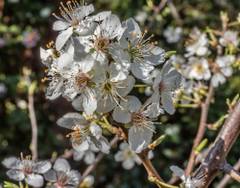
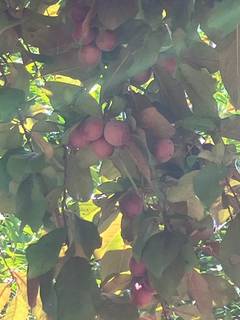
Prunus avium is a deciduous tree reaching 50-80 feet (15-25 m) tall and 25-40 feet (7.5-12 m) wide, with a straight central trunk and whorled tiers of ascending branches that give young trees a conical outline. Bark is glossy red-brown to purple-grey, banded with horizontal lenticels, and peels in thin papery strips. Leaves are alternate, oval to obovate, 2.5-6 inches (6-15 cm) long, drawn out to a tapered tip, coarsely toothed, and carrying one or two red nectary glands where the blade meets the 0.8-1.6 inch (2-4 cm) petiole. White five-petalled flowers 1-1.2 inches (2.5-3 cm) across open in April in stalked clusters of two to six, ahead of or alongside the emerging leaves. Fruit is a rounded drupe 0.4-0.8 inch (10-20 mm) across, ripening from red to dark purple-black in July, the flesh running from bitter to sweet depending on provenance. Autumn foliage turns orange, red, and crimson over 2-3 weeks. Trees sucker from shallow roots and build thickets along woodland edges. Bacterial canker, silver leaf, and cherry blackfly recur in most plantings, and the species is short-lived for its size, with crowns declining after 60-80 years. All parts other than the fruit flesh contain cyanogenic glycosides.
Native Range
Prunus avium is native to Europe from Britain and southern Scandinavia south to Spain and Greece, and east through Turkey and the Caucasus to northern Iran and western Siberia, with outlying populations in northwest Africa. It grows in deciduous woodland, hedgerows, and woodland margins on free-draining base-rich soils. Cultivation for fruit and timber has carried it to North America, Australia, and New Zealand, where it naturalises along roadsides and forest edges.Suggested Uses
Grown as a specimen and avenue tree in parks and large gardens, spaced 30-40 feet (9-12 m) apart, and as a nurse and timber species in mixed broadleaf woodland planting. Hedgerow and woodland-edge schemes use it for April flower and July fruit taken by thrushes, blackbirds, and small mammals. Grafted fruiting selections on dwarfing rootstocks hold at 8-13 feet (2.4-4 m) in garden orchards.How to Identify
Appearance
Size & Dimensions
Height50' - 80'
Width/Spread25' - 40'
Bloom Information
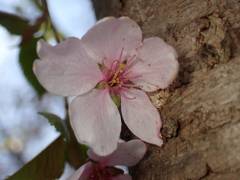
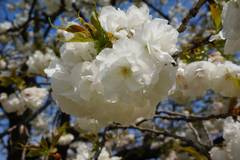
Flowering runs from early April to early May, generally 7-14 days ahead of leaf expansion in the same district. Clusters of two to six white flowers, each 1-1.2 inches (2.5-3 cm) across with five rounded petals and about 30 stamens, open together and cover the whole crown for 10-14 days. Flowers are insect-pollinated, and most wild trees are self-incompatible, so fruit set depends on a second unrelated seedling within pollinator range. Fruit ripens in July, 10-12 weeks after flowering.
Detailed Descriptions
Foliage Description
Mid greenGrowing Conditions
Sun Requirements
Requires 6-10 hours of direct sunlight daily
• Full Sun: 6+ hours of direct sunlight
• Partial Shade: 3-6 hours of direct sunlight
• Full Shade: Less than 3 hours of direct sunlight
Care & Maintenance
Care Guide
Grows in full sun to light shade and reaches full size on deep, moist, free-draining loam at pH 6.0-7.5, tolerating chalk but failing on waterlogged clay, where root rot follows within a few seasons. Water demand is moderate; established trees ride out short dry spells but shed fruit early in prolonged drought. It is hardy through zones 3-8 and flowers early enough that late frosts below 28 F (-2 C) during bloom destroy the crop. Suckers appear 10-20 feet (3-6 m) from the trunk and are severed at the root annually to stop thicket formation. Bacterial canker, showing as gummy trunk exudate and dying shoot tips, and silver leaf, showing as a silvery sheen across foliage, both enter through winter pruning wounds. Feeding is seldom needed on reasonable soils, and surplus nitrogen produces soft growth that canker colonises.Pruning
All cutting is carried out from June to August while sap flow is active and wounds close quickly; winter pruning opens the tree to silver leaf and bacterial canker. Formative work in the first five years selects a single leader and removes narrow-angled branches, since the whorled branching habit otherwise builds crowded congested tiers. Mature trees require little beyond removal of dead, crossing, and cankered wood. Cuts larger than 2 inches (5 cm) across close slowly, so large limb removal is staged across several seasons.Pruning Schedule
Prune: June–August
summer