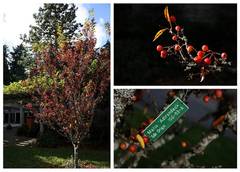
Image 1 of 5
1 / 5
© Leslie Seaton from Seattle, WA, USA, some rights reserved (CC-BY) · Wikimedia Commons
Malus, Genus, domestica, Species, 'Pristine', Cultivar,
- Genus & species
- Cultivar
pristine apple
Hybrid origin (Central Asia, Malus sieversii ancestor)
Overview
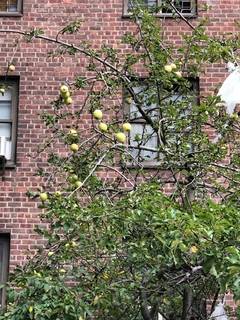
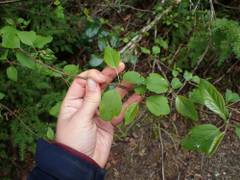
Malus domestica 'Pristine' is an early-ripening, disease-resistant yellow apple cultivar released in 1994 from the PRI breeding program (Purdue–Rutgers–Illinois), reaching 144–240 inches (360–600 cm) tall and 144–240 inches (360–600 cm) wide on standard rootstock; trees on dwarf rootstocks (M.9, M.26) hold at 96–144 inches (240–360 cm). Foliage is alternate, ovate, finely toothed, dark green, 2.5–4 inches (6–10 cm) long, with yellow fall color. Flowers are pale pink in bud opening to white, 1–1.5 inches (2.5–4 cm) across, in clusters of 4–6 in late April through May. Fruit is round to slightly conic, 2.5–3 inches (6–7.5 cm) across, weighing 5–7 oz (140–200 g), with smooth pale-yellow skin sometimes blushed pink and crisp white flesh that is mildly tart; ripens in early-to-mid July through early August in zones 4–8, weeks before mid- and late-season apple cultivars. Cross-pollination by another apple cultivar within 50 feet (15 m) is required for fruit set. Resistant to apple scab (Venturia inaequalis); moderately resistant to fire blight, cedar-apple rust, and powdery mildew. Cold hardiness extends to USDA zone 4 (−30°F / −34°C). Storage life is 4–6 weeks at 32°F (0°C)—shorter than late-season apples. Fruit is edible and non-toxic.
Native Range
The species M. domestica is of complex hybrid origin with M. sieversii (wild Asian apple from Kazakhstan) as the principal ancestor; the species was carried to North America by European colonists in the 1600s. The cultivar 'Pristine' was released in 1994 by the PRI cooperative apple breeding program (Purdue, Rutgers, and the University of Illinois) from a cross involving 'Camuzat' and PRI selection PRI 1018-101.Suggested Uses
Grown in the ground in zones 4–8 spaced 96–240 inches (240–600 cm) apart depending on rootstock. Cultivated for fresh-eating fruit in early summer, when later-season apples are not yet available; storage life is 4–6 weeks at 32°F (0°C). Disease resistance suits low-spray, organic, and home-orchard production.How to Identify
Appearance
Size & Dimensions
Height12' - 20'
Width/Spread12' - 20'
Bloom Information
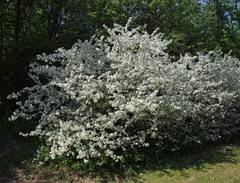
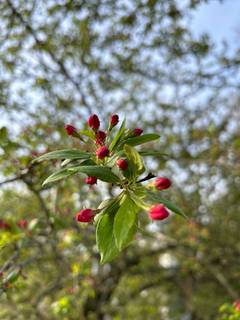
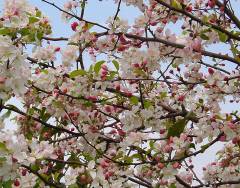
Flowers in late April through May in zones 4–8, with peak bloom over 7–10 days. Pale pink buds open to white flowers 1–1.5 inches (2.5–4 cm) across in clusters of 4–6 at spur tips. Bloom is mid-season—'Pristine' overlaps with most common apple pollinizers. Fruit set requires cross-pollination from a different apple cultivar.
Detailed Descriptions
Flower Description
Pale pink in bud, opening whiteFoliage Description
Dark green; yellow in fallGrowing Conditions
Sun Requirements
Requires 6-10 hours of direct sunlight daily
• Full Sun: 6+ hours of direct sunlight
• Partial Shade: 3-6 hours of direct sunlight
• Full Shade: Less than 3 hours of direct sunlight
Care & Maintenance
Care Guide
Plant in 6 or more hours of direct sun in zones 4–8. Adapts to loam soils within a pH range of 6.0–7.0; sites with poor drainage cause Phytophthora root rot. Once established, water deeply weekly during dry weather and during fruit fill (May–July); 1 inch (2.5 cm) of water per week is the typical requirement. Cold-hardy to USDA zone 4 (−30°F / −34°C). Resistant to apple scab and moderately resistant to fire blight, cedar-apple rust, and powdery mildew, which reduces fungicide and bactericide spray requirements compared with standard apples. Codling moth (Cydia pomonella) is the main fruit pest in the eastern and midwestern United States. Fruit thinning to one fruit per cluster increases size.Pruning
Prune in late winter (February–March in zones 4–8) when fully dormant. Train young trees to a central leader form for standard-size trees or modified central leader for semi-dwarf trees. Annual pruning removes about 20–30% of the previous year's growth. Heavy pruning of mature trees stimulates excessive water sprout growth. Summer pruning in late June–early July before harvest opens the canopy for fruit color development.Pruning Schedule
Prune: February–March & June–July
wintersummer
Container Growing
Suitable for container growing
Minimum container size: 20 gallons