Penstemon, Genus, strictus, Species,
- Genus & species
Rocky Mt penstemon
Overview
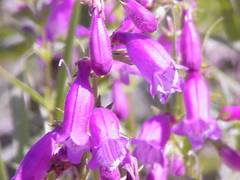
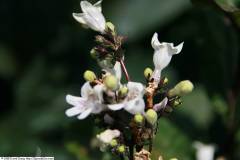
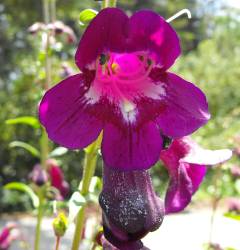
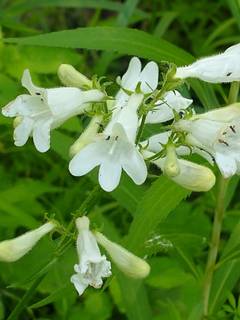
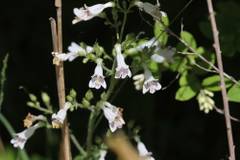
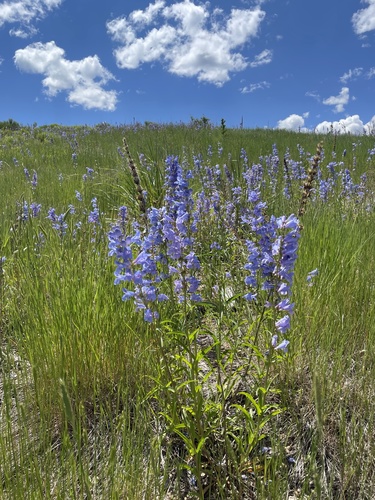
An upright herbaceous perennial reaching 1-3 feet (30-90 cm) tall from a basal mat of leaves with multiple flowering stems. Basal leaves lance-shaped to oblanceolate, 2-4 inches (5-10 cm) long, dark green and glabrous, with smooth margins. Stem leaves narrower and clasping, often with a slight upward curve. Inflorescences narrow erect spike-like racemes 8-20 inches (20-50 cm) long, with flowers held in pairs in a one-sided arrangement at the upper portion of the stem. Each flower 1-1.25 inches (2.5-3 cm) long, deep blue to violet-purple, two-lipped, with the corolla tube widening abruptly and the lower lip flaring outward. Sterile staminode bearded with yellow hairs. Capsules 0.3-0.4 inch (8-10 mm), ripening in late summer. Plants form a dense basal mat that expands slowly over 3-5 years to a width of 12-18 inches (30-45 cm). Foliage often persists through winter as an evergreen basal rosette in zones 4-8.
Native Range
Native to the southern Rocky Mountain region of the western United States, occurring in Colorado, Utah, New Mexico, Arizona, and Wyoming. Found in mountain meadows, ponderosa pine and aspen forest openings, sagebrush flats, and gravelly road cuts at 6,000 to 11,000 feet (1,830-3,350 m) elevation.Suggested Uses
Commonly planted in mountain native plant gardens, xeric pollinator plantings, and dry meadow restorations at 18-24 inch (45-60 cm) spacing. Suitable for containers of at least 3 gallons (11 L) with adequate drainage. Pairs in cultivation with other Rocky Mountain natives such as Castilleja integra, Hymenoxys hoopesii, and Penstemon eatonii.How to Identify
Appearance
Size & Dimensions
Height1' - 3'
Width/Spread1' - 1'6"
Bloom Information
June through August depending on elevation; lower-elevation populations bloom in June, alpine populations into August. Each spike holds open flowers for 3-4 weeks; the full bloom period in a stand extends 4-6 weeks. Plants in cooler summers extend bloom to 6-8 weeks.
Detailed Descriptions
Flower Description
deep blue to violet-purpleFoliage Description
dark greenGrowing Conditions
Sun Requirements
Requires 6-12 hours of direct sunlight daily
• Full Sun: 6+ hours of direct sunlight
• Partial Shade: 3-6 hours of direct sunlight
• Full Shade: Less than 3 hours of direct sunlight
Care & Maintenance
Care Guide
Plant container-grown specimens in autumn or early spring into well-drained loamy or gritty soil. Water weekly during the first growing season; established plants tolerate periods of 3-4 weeks without rain. The species adapts to a wider range of garden conditions than most Penstemon, persisting in moderately heavy clay if drainage is adequate. Powdery mildew develops on stressed plants in humid conditions but does not kill them. Plants establish in year 1-2 and persist 5-10 years; division every 4-5 years rejuvenates older clumps and extends planting life.Pruning
Cut spent flower stems to the basal rosette after seed has dispersed in late summer. The basal rosette persists as evergreen winter foliage in mild zones; only damaged or dead leaves are removed in early spring. Cut entire plant to 2-3 inches (5-7.5 cm) above the soil in late autumn in colder zones (3-4) where foliage browns over winter.Pruning Schedule
Prune: August–October
summerfall
Container Growing
Suitable for container growing
Minimum container size: 3 gallons