Penstemon, Genus, pinifolius, Species,
- Genus & species
pine penstemon
American Southwest (southern New Mexico and southeastern Arizona; dry rocky pine-juniper woodland and montane scrub at 6000-9000 ft / 1800-2700 m)
Overview
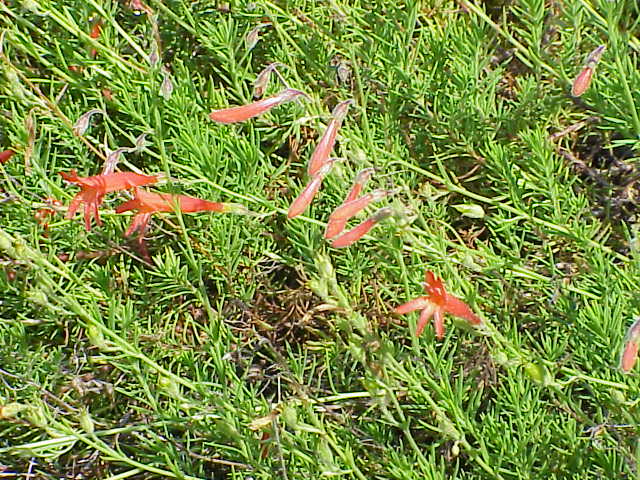
Penstemon pinifolius is an evergreen subshrubby perennial reaching 10–15 inches (25–38 cm) tall with a spread of 12–18 inches (30–45 cm) and a low mounding densely branched habit. Native to the American Southwest (New Mexico and Arizona), this species runs entirely different in character from the European hybrid penstemons—leaves run needle-like, 0.5–1 inch (1.3–2.5 cm) long, resembling pine needles (the source of the specific epithet pinifolius), bright to dark green in color, and densely packed along wiry stems. Flowers run narrow tubular, 1–1.2 inches (2.5–3 cm) long, bright scarlet-orange in color, and open in loose terminal racemes from June through September. Growth rate runs slow. Hardy to zone 4. The combination of needle-like evergreen foliage and bright scarlet-orange tubular flowers draws hummingbirds heavily across the bloom window. Drought tolerance runs extreme across established plants, and the species handles the dry sandy and rocky soils that defeat the lusher European hybrid penstemons.
Native Range
Penstemon pinifolius is native to the American Southwest, ranging across southern New Mexico and southeastern Arizona. The species grows in dry rocky pine-juniper woodland and montane scrub habitats at 6,000–9,000 feet (1,800–2,700 m) elevation. The high-altitude dry rocky native ecology translates in garden cultivation to the requirement for sharp drainage, lean soil, and full sun—conditions that defeat most perennials but suit this species closely.Suggested Uses
Planted in rock gardens, gravel gardens, xeriscape plantings, or raised beds at 12–15 inch (30–38 cm) spacing in zone-4-and-warmer gardens. Needle-like evergreen foliage supplies year-round textural interest across all four seasons, which runs rare among penstemons where the European hybrids run semi-evergreen at their peak. Bright scarlet-orange flowers from June through September draw hummingbirds heavily. Drought tolerance runs extreme. Sharp drainage is essential for winter survival. Rich moist soils and heavy clay are poor fits for the species.How to Identify
Appearance
Size & Dimensions
Height10" - 1'3"
Width/Spread1' - 1'6"
Bloom Information
Narrow tubular flowers 1–1.2 inches (2.5–3 cm) long open in bright scarlet-orange coloration in loose terminal racemes from June through September. Fresh bloom duration runs 8–12 weeks. The scarlet-orange tubular flower form positions the species as a primary hummingbird plant across the summer garden season.
Detailed Descriptions
Flower Description
Bright scarlet-orange; narrow tubular 1-1.2 inches; loose terminal racemes; June-SeptemberFoliage Description
Bright to dark green; needle-like leaves 0.5-1 inch; densely packed on wiry stems; pine-needle-like texture; evergreen retentionGrowing Conditions
Sun Requirements
Requires 6-12 hours of direct sunlight daily
• Full Sun: 6+ hours of direct sunlight
• Partial Shade: 3-6 hours of direct sunlight
• Full Shade: Less than 3 hours of direct sunlight
Care & Maintenance
Care Guide
Full sun in sharply drained lean rocky or sandy soil (pH 6.0–8.0) matches the species' cultivation needs. Hardy to zone 4 (−30°F / −34°C). Sharp drainage is essential because wet winter conditions rot the crown within a single season. Drought tolerance develops rapidly after establishment, and mature plants handle extended summer drought without supplementary irrigation. Lean soil supports compact growth—rich soil or fertilizer application causes floppy elongated stems that lose the species' characteristic dense habit. Soil amendment and fertilization are avoided across the species' care cycle.Pruning
Light trimming in early spring removes dead stem tips and maintains compact form. Hard cutback is avoided because the subshrubby woody framework is the species' growing structure and severe cutback below the woody zone fails to regenerate from the crown.Pruning Schedule
Prune: March–April
early spring
Container Growing
Suitable for container growing
Minimum container size: 2 gallons