Penstemon, Genus, pruinosus, Species,
- Genus & species
Chelan penstemon
Overview
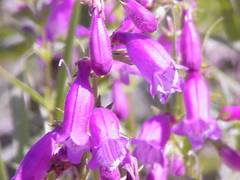
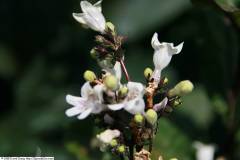
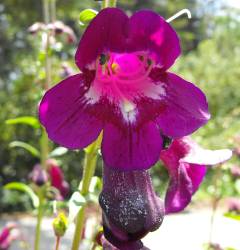
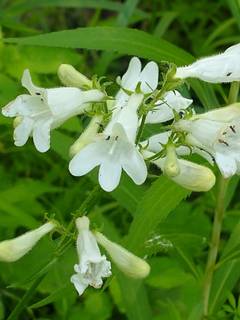
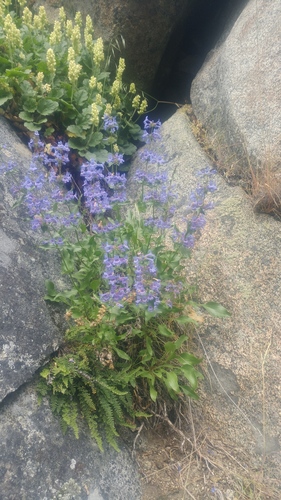
An upright herbaceous perennial reaching 8-24 inches (20-60 cm) tall from a basal cluster of leaves with one to several flowering stems. Basal leaves lance-shaped to oblanceolate, 1-3 inches (2.5-7.5 cm) long, blue-green to glaucous (covered with a waxy bloom that gives the plant its species epithet, pruinosus meaning 'frost-covered'). Stem leaves smaller, opposite, lance-shaped, clasping. Inflorescences narrow erect panicles 4-12 inches (10-30 cm) tall bearing 10-30 tubular flowers held at the upper portion of the stem in dense clusters. Each flower 0.6-1 inch (15-25 mm) long, deep blue to violet-purple with a paler throat, two-lipped, with glandular hairs on the corolla and inflorescence axis. Sterile staminode bearded with golden-yellow hairs. Capsules 0.25-0.4 inch (6-10 mm), ripening in summer. Plants form clumps 6-12 inches (15-30 cm) wide after 3-4 years and persist 4-7 years from seed in suitable rocky sites. Glandular foliage feels sticky to the touch and emits a slight resinous scent.
Native Range
Native to eastern Washington, north-central Oregon, and adjacent southern British Columbia, with the species centered in the Columbia Basin. Found on dry rocky slopes, sagebrush steppe, ponderosa pine woodland, and gravelly road cuts at 500 to 4,500 feet (150-1,370 m) elevation.Suggested Uses
Commonly planted in xeric gardens, dry rock gardens, and Intermountain West native plant gardens at 12-18 inch (30-45 cm) spacing. Suitable for containers of at least 3 gallons (11 L) with at least 50% mineral grit and no winter saturation. Pairs in cultivation with other Columbia Basin natives such as Eriogonum heracleoides and Festuca idahoensis.How to Identify
Appearance
Size & Dimensions
Height8" - 2'
Width/Spread6" - 1'
Colors
Bloom Information
Detailed Descriptions
Flower Description
deep blue to violet-purpleFoliage Description
blue-green to glaucousGrowing Conditions
Sun Requirements
Requires 6-12 hours of direct sunlight daily
• Full Sun: 6+ hours of direct sunlight
• Partial Shade: 3-6 hours of direct sunlight
• Full Shade: Less than 3 hours of direct sunlight
Care & Maintenance
Care Guide
Plant container-grown specimens in autumn or early spring into sharply draining gritty soil. Established plants tolerate periods of 4-6 weeks without rain; summer irrigation in clay soils causes root rot. Soils that retain moisture at the basal crown through winter cause rot within one season. Aphids appear on flower stems in warm springs but disappear with summer heat. Plants are short-lived in heavy soil and may decline within 2-3 years; lifespan in well-drained sandy or rocky sites extends to 6-8 years. Self-sown seedlings replace mature plants in stable stands.Pruning
Cut spent flower stems to the basal rosette after seed has dispersed in late summer. Cut entire plant to 2-3 inches (5-7.5 cm) above the soil in late autumn; new growth emerges from the basal crown in spring. Damaged or yellowing stems can be removed at the base at any time during the growing season.Pruning Schedule
Prune: August & October
summerfall
Container Growing
Suitable for container growing
Minimum container size: 3 gallons