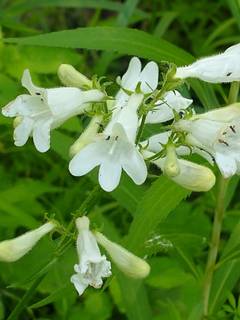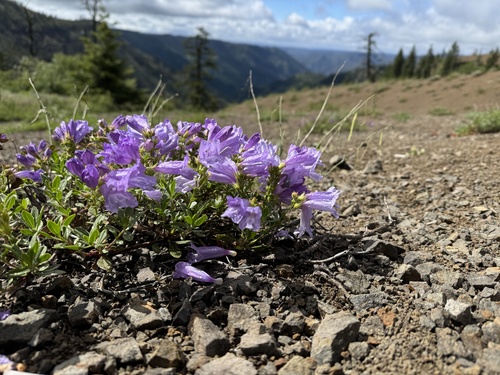
Penstemon, Genus, fruticosus, Species,
- Genus & species
shrubby penstemon
Western North America (Cascades, Rockies, Intermountain West)
Overview
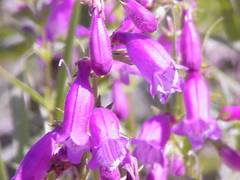
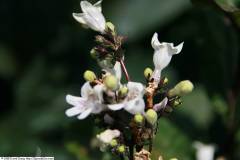
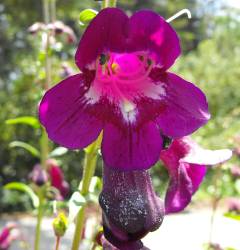
Penstemon fruticosus is an upright evergreen subshrub reaching 8-16 inches (20-40 cm) tall and 12-24 inches (30-60 cm) wide on woody stems that branch from a central crown. Leaves opposite, leathery, lance-shaped to elliptic, 0.5-1.5 inches (12-38 mm) long, dark green with smooth or finely toothed margins, persisting through winter. Flowers tubular-funnelform, lavender to violet-purple (occasionally pink), 1-1.75 inches (2.5-4.4 cm) long, with a hairy yellow staminode in the throat, borne in 2-6 flowered racemes from June through August. Variety scouleri has narrower lance-shaped leaves than the type and pink to lavender-pink flowers. Forms loose mounds 12-24 inches (30-60 cm) wide in 4-6 years. Plants do not survive in heavy clay soils that stay wet through winter and are prone to crown rot in irrigated garden beds with summer water.
Native Range
Native to dry montane forests, sub-alpine ridges, and rocky open slopes in western North America from southern British Columbia and Alberta south through Washington, Oregon, Idaho, Montana, and Wyoming, generally at elevations of 2,000-9,000 feet (600-2,750 m).Suggested Uses
Used in rock gardens, dry borders, gravel beds, and west-facing slopes at 18-24 inch (45-60 cm) spacing in zones 4-8. Combines with native bunchgrasses, Eriogonum umbellatum, and other dry-adapted natives in xeric plantings. Containers require sharply drained gritty mix in pots of at least 2 gallons (7.5 L); plants in moisture-retentive potting mix typically last only one season.How to Identify
Appearance
Size & Dimensions
Height8" - 1'4"
Width/Spread1' - 2'
Bloom Information
June through August across the species range, with peak bloom in late June through July at most sites. Flowering begins in late May at low elevations and may extend into early September at high elevations. Individual flowers last 5-7 days; clumps produce sequential racemes over 4-6 weeks.
Detailed Descriptions
Flower Description
Lavender to violet-purple, rarely pinkFoliage Description
Dark green, leatheryGrowing Conditions
Sun Requirements
Requires 6-12 hours of direct sunlight daily
• Full Sun: 6+ hours of direct sunlight
• Partial Shade: 3-6 hours of direct sunlight
• Full Shade: Less than 3 hours of direct sunlight
Care & Maintenance
Care Guide
Establishes from container stock in 1-2 growing seasons in well-drained gritty or sandy soils with light watering through the first summer. Mature plants tolerate drought once established and rot quickly in irrigated garden soil; established plants need no summer water in zones 5-7 west-side gardens. Crown rot is the leading cause of death in cultivation, occurring most often in heavy clay or in mulched sites that stay damp around the crown. Foliage scorches in soils that warm above 80 degrees F (27 degrees C) at root depth without afternoon shade. Spider mites occur in hot dry interior gardens. Plants are short-lived (5-7 years) in cultivation and benefit from periodic replacement from cuttings.Pruning
Cut spent flower stems at the base in late summer to neaten appearance and limit self-seeding. Tip-prune unproductive woody stems by 1-3 inches (2.5-7.5 cm) in early spring to encourage branching from the base. Plants respond poorly to hard pruning into old wood; cuts into bare leafless wood usually fail to break new growth.Pruning Schedule
Prune: March & August
early springsummer
Container Growing
Suitable for container growing
Minimum container size: 2 gallons