Penstemon, Genus, barrettiae, Species,
- Genus & species
Barrett's penstemon
Columbia River Gorge (Pacific Northwest)
Overview
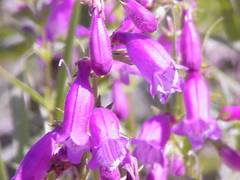
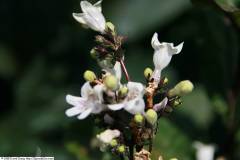
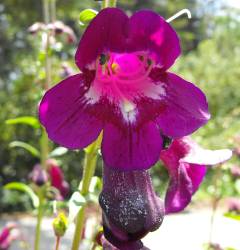
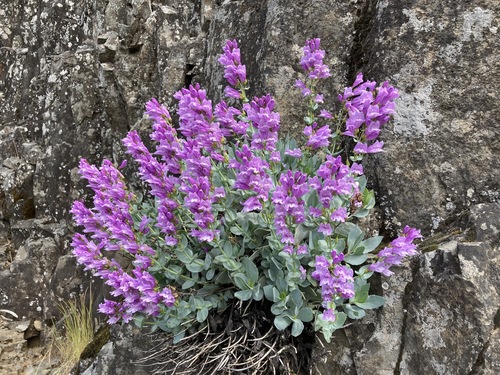
A subshrubby perennial reaching 8-16 inches (20-40 cm) tall from a woody base, forming a low mound or trailing mat 18-30 inches (45-75 cm) wide. Leaves evergreen, opposite, lance-shaped to oblong, 1.5-3 inches (4-7.5 cm) long, blue-green to glaucous, with smooth or sparsely toothed margins and a slightly waxy surface. Inflorescences erect terminal panicles 6-10 inches (15-25 cm) tall with 10-30 tubular flowers held at the stem tips. Each flower 1-1.25 inches (2.5-3 cm) long, lavender to rose-purple with a paler throat marked by darker guidelines, two-lipped with the lower lip flaring outward. Capsules 0.25-0.4 inch (6-10 mm), ripening in summer. Plants form a slowly expanding woody-based mound and may root where lower stems contact moist soil. Drought-deciduous lower leaves drop during summer in hot dry sites; upper foliage persists year-round in zones 6-9. Range is restricted to a small area of the Columbia River Gorge along the Oregon-Washington border, where the species is listed as imperiled.
Native Range
Endemic to the Columbia River Gorge of Oregon and Washington, primarily on basalt cliffs, talus slopes, and rocky riverbanks at 100 to 1,500 feet (30-460 m) elevation. The species occurs on fewer than 50 sites within a range of approximately 50 miles (80 km).Suggested Uses
Commonly planted in rock gardens, dry stone walls, and sloped sites with sharp drainage at 18-24 inch (45-60 cm) spacing. Suitable for containers of at least 3 gallons (11 L) with at least 50% mineral grit and no winter saturation. The species is listed as imperiled in Oregon and Washington; cultivated material from native plant nurseries supports conservation rather than wild collection.How to Identify
Appearance
Size & Dimensions
Height8" - 1'4"
Width/Spread1'6" - 2'6"
Colors
Bloom Information
Detailed Descriptions
Flower Description
lavender to rose-purpleFoliage Description
blue-green to glaucousGrowing Conditions
Sun Requirements
Requires 6-12 hours of direct sunlight daily
• Full Sun: 6+ hours of direct sunlight
• Partial Shade: 3-6 hours of direct sunlight
• Full Shade: Less than 3 hours of direct sunlight
Care & Maintenance
Care Guide
Plant container-grown specimens in autumn or early spring into sharply draining gritty soil with at least 50% mineral content. Water weekly during the first growing season; established plants tolerate periods of 4-6 weeks without rain. Soils that retain moisture at the crown cause root rot within one season. Aphids appear on flower stems in warm springs but disappear with summer heat. Plants persist 6-10 years in suitable rocky sites; lifespan in heavy or moisture-retentive soil rarely exceeds 2-3 years. Cuttings root in 4-6 weeks in late summer and are the typical propagation method for cultivated material.Pruning
Cut spent flower stems to the topmost healthy leaves after flowering in early summer. Light shaping can be done in early spring before new growth emerges; older wood does not regrow when cut hard, so removal is limited to no more than one-third of stem length per year. Damaged stems can be removed at the woody base at any time.Pruning Schedule
Prune: March & June–July
summerearly spring
Container Growing
Suitable for container growing
Minimum container size: 3 gallons