Mangave, Genus, spp., Multiple species,
- Genus
- Multiple species
mangave
Garden hybrid; parent genera native to Mexico and southern United States
Overview
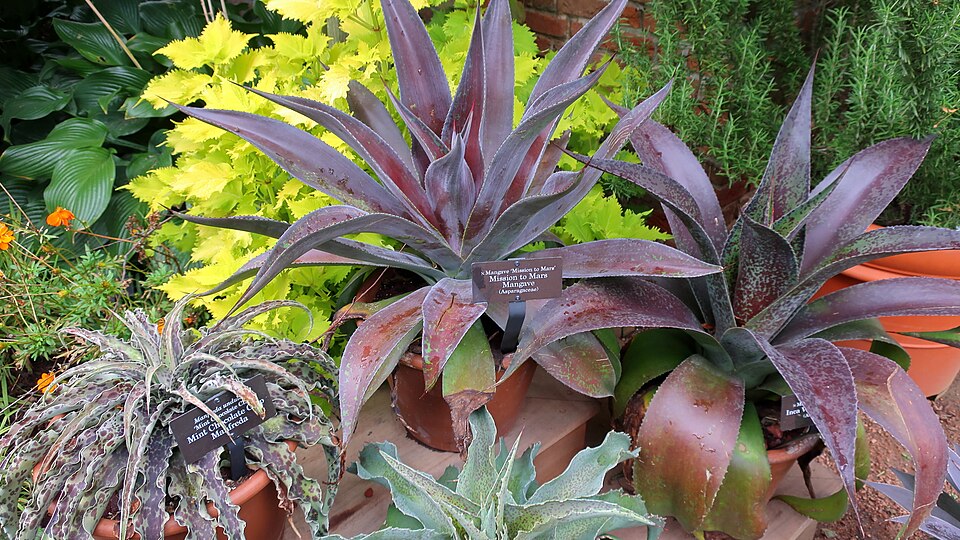
Mangave is a group of intergeneric hybrid succulents created by crossing Manfreda with Agave, both in the asparagus family (Asparagaceae). The crosses combine the faster growth, soft texture, and spotted, colorful leaves of Manfreda with the fuller rosette form and substance of Agave, producing evergreen rosettes 8-24 in (20-60 cm) tall and 1-3 ft (30-90 cm) wide. Leaves are fleshy, lance-shaped, and usually unarmed or only lightly toothed, in shades of green, gray, burgundy, and bronze, many heavily freckled with purple-red spots that deepen in strong light. Unlike most agaves, these hybrids grow quickly and do not die after flowering. When a mature rosette does bloom, it sends up a tall spike of tubular flowers, then offsets to continue the clump. Plants are frost-tender and store water in their fleshy leaves, tolerating heat and drought but rotting in cold, wet soil. As hybrids, they are propagated by tissue culture or offsets rather than seed.
Native Range
Mangave does not occur in the wild; it is a garden hybrid group between Manfreda and Agave. The parent genera are native to Mexico and the southern United States, where they grow in arid grasslands, rocky slopes, and scrub. The hybrids were developed by nurseries beginning in the late 20th century.Suggested Uses
Mangave is grown in containers, succulent and gravel gardens, and mixed dry plantings where its spotted rosettes add color. Single rosettes are set as container plantings, or spaced 18-24 in (45-60 cm) apart in the ground in frost-free areas. The bold form combines with grasses, sedums, and other drought-tolerant plants.How to Identify
Appearance
Size & Dimensions
Height8" - 2'
Width/Spread1' - 3'
Bloom Information
Flowering is infrequent and occurs only on mature rosettes, usually in summer. A tall branched or spike-like stem 4-8 ft (1.2-2.4 m) high carries tubular greenish to brownish flowers over several weeks. Unlike a true agave, the rosette continues to grow and offset after blooming rather than dying.
Detailed Descriptions
Flower Description
Greenish to brownishFoliage Description
Green, gray, burgundy, and bronze, freckled purple-redGrowing Conditions
Sun Requirements
Requires 6-10 hours of direct sunlight daily
• Full Sun: 6+ hours of direct sunlight
• Partial Shade: 3-6 hours of direct sunlight
• Full Shade: Less than 3 hours of direct sunlight
Care & Maintenance
Care Guide
Mangave grows in full sun to light shade in gritty, fast-draining soil with a pH of 6.0-7.5, and needs only occasional water once established. Strong light brings out the leaf spotting and color, while shade yields greener, looser rosettes. The hybrids are frost-tender, hardy outdoors in USDA zones 9-11 and grown as container plants moved under cover elsewhere. Cold, wet soil causes crown and root rot, so winter dryness matters more than the cold itself. Plants are fed lightly in spring and given room for offsets to develop. Mealybugs and scale are the main pests under glass.Pruning
Mangave needs no routine pruning. Lower leaves are removed as they shrivel, and any spent flower spike is cut to the base after bloom. Offsets are detached in spring or summer to propagate or limit clump size.Container Growing
Suitable for container growing
Minimum container size: 3 gallons