Liriope, Genus,
- Genus
lilyturf
Eastern Asia across China, Japan, Korea, and Vietnam; woodland floors, shaded slopes, and forest margins in temperate and subtropical zones
Overview
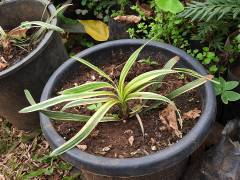
Liriope spp. is a genus of about 6 clumping evergreen perennials in the family Asparagaceae, with two species widely grown as garden ground covers: L. muscari (big blue lilyturf, non-spreading clumping type) and L. spicata (creeping lilyturf, spreading by underground stolons). Plants grow 12–18 inches (30–45 cm) tall and 12–18 inches (30–45 cm) wide from a fibrous root system, with narrow arching strap-shaped grass-like dark green leaves 12–18 inches (30–45 cm) long and 0.25–0.5 inch (6–12 mm) wide arranged in a dense evergreen tuft that holds its shape through the entire year. Violet-purple, lavender, or white small globe-shaped flowers 0.2 inch (5 mm) across open densely packed in erect flowering spikes 4–8 inches (10–20 cm) long carried above or among the foliage from August through September across a 4–5 week bloom period, and the spent flower spikes are followed by shiny black berries 0.3 inch (8 mm) across that persist through fall and into early winter for a secondary ornamental feature. Species separation is a significant cultural consideration because L. muscari forms a slowly expanding non-aggressive clump that holds its position indefinitely and is the standard landscape form used in Southern US gardens for mass plantings and formal edging, while L. spicata spreads aggressively by underground stolons and can take over adjacent lawn, border, and bed areas within a few years of planting, which makes it suited only to contained positions where the spreading growth can be managed or where a rapid spreading ground cover is the design goal. The variegated cultivars 'Variegata' and 'Gold Band' carry cream or gold longitudinal stripes along the leaf margins and brighten shaded positions where the species-type dark green foliage recedes into the background. The species tolerates a wide range of growing conditions including full sun, full shade, drought, heavy clay, air pollution, and root competition from surface-rooted trees — this tolerance of difficult sites is the main reason for the widespread use of the genus as a ground cover in Southern US landscape design. Limitation: foliage develops a tattered or discolored appearance through the winter months in zones 5 and 6 because of cold damage to the evergreen leaves, and the entire planting calls for an annual cutback to 3–4 inches (7–10 cm) in late winter before new growth emerges to remove the damaged foliage and allow a fresh flush of leaves in spring. All parts of the plant contain saponins and are toxic to cats and dogs if the foliage or berries are ingested. Deer-resistant because of the saponin content.
Native Range
Native to eastern Asia across China, Japan, Korea, and Vietnam, growing on woodland floors, shaded slopes, and forest margins in temperate and subtropical forest zones. L. muscari is widespread across the range and has been cultivated in East Asian gardens for centuries before its introduction to western horticulture in the 19th century, and L. spicata is native to a similar but slightly more northerly range extending into cooler forest habitats in Korea and northeastern China.Suggested Uses
Used as a mass-planted ground cover under trees and shrubs, as a formal border edging along walkways and driveways, as erosion control on shaded slopes, and in containers of at least 3 gallons (11 L) at 12–18 inch (30–45 cm) spacing between plants. L. muscari is used for formal and mass plantings where the slow non-spreading habit holds the planting at a fixed size, and L. spicata is used for rapid ground-cover applications in contained areas where the aggressive spread is an asset rather than a problem. The tolerance of full shade, drought, heavy clay, and tree root competition makes the genus a default ground cover for difficult positions in Southern US landscape design. Gardens where pet access to the foliage or berries is a concern are unsuitable because of the saponin toxicity to cats and dogs, and uncontained positions in small gardens are unsuitable for L. spicata because the aggressive spread can take over lawn and border areas within a few years.How to Identify
Appearance
Size & Dimensions
Height1' - 1'6"
Width/Spread1' - 1'6"
Bloom Information
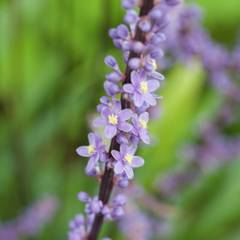
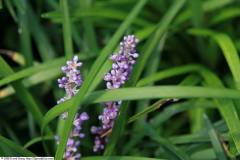
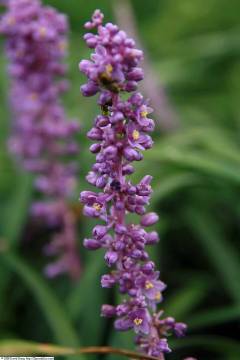
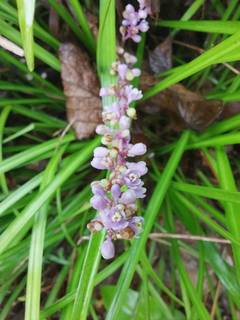
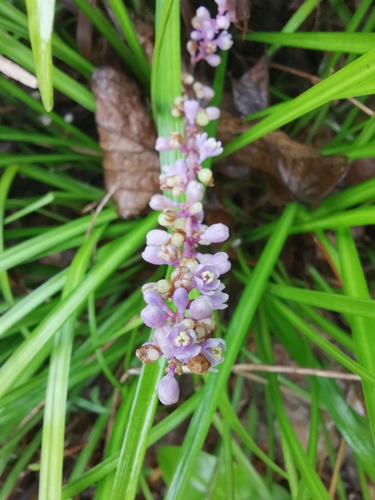
Violet-purple, lavender, or white small globe-shaped flowers 0.2 inch (5 mm) across open densely packed in erect flowering spikes 4–8 inches (10–20 cm) long carried above or among the foliage from August through September across a 4–5 week bloom period. Honeybees and native bees work the flowers for nectar during the late-summer bloom window when few other garden ground covers are in flower. Spent flower spikes are followed by shiny black berries 0.3 inch (8 mm) across that develop through October and persist through fall and into early winter for a secondary ornamental feature after the flowers have faded.
Detailed Descriptions
Flower Description
violet-purple, lavender, or white small globe-shaped flowers 0.2 inch (5 mm) across, densely packed in erect spikes 4-8 inches (10-20 cm) long carried above or among the foliage; followed by shiny black berries 0.3 inch (8 mm) across in fall and early winterFoliage Description
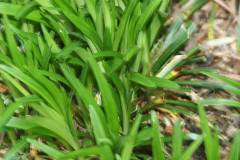
dark green; narrow arching strap-shaped grass-like leaves 12-18 inches (30-45 cm) long and 0.25-0.5 inch (6-12 mm) wide, arranged in a dense evergreen tuft; the cultivars 'Variegata' and 'Gold Band' carry cream or gold longitudinal stripes along the leaf marginsGrowing Conditions
Sun Requirements
Requires 1-8 hours of direct sunlight daily
• Full Sun: 6+ hours of direct sunlight
• Partial Shade: 3-6 hours of direct sunlight
• Full Shade: Less than 3 hours of direct sunlight
Care & Maintenance
Care Guide
Site in part shade to full sun or full shade with 1–8 hours of direct sun per day, and the genus tolerates a wide range of light exposures from deep shade under tree canopies to full afternoon sun in Southern US climates. Well-drained soil with a pH of 5.5–7.0 holds the clumps through winter without rot, and the genus tolerates clay, loam, sandy, compacted, and poor soils without significant decline. Drought tolerance is well developed once the plants are established and the root system has reached a soil depth where summer moisture is more consistent. Species selection is the main cultural consideration: L. muscari forms a slowly expanding non-aggressive clump suited to mass plantings and formal edging, while L. spicata spreads aggressively by underground stolons and is suited only to contained positions or rapid ground-cover applications. The entire planting is mowed or sheared to 3–4 inches (7–10 cm) in late winter (February or March) before new growth emerges to remove winter-damaged foliage and allow a fresh spring flush. All parts contain saponins and are toxic to cats and dogs if ingested. Deer-resistant. Hardy in USDA zones 5–9.Pruning
The entire planting is mowed with a rotary lawnmower set to the highest cutting height, or sheared with a string trimmer or hedge shears, to 3–4 inches (7–10 cm) above the crown in late winter (February or March) before new growth emerges from the center of the tuft. This annual cutback removes the tattered and cold-damaged foliage from the winter months and allows a fresh flush of clean green leaves to emerge from the crown during spring, and the new growth covers the cut stems within a few weeks of the cutback. No other pruning is needed through the growing season. Spent flower spikes can be left for the fall berry display or cut after ripening if the fall interest is not wanted.Pruning Schedule
Prune: February–March
early spring
Container Growing
Suitable for container growing
Minimum container size: 3 gallons