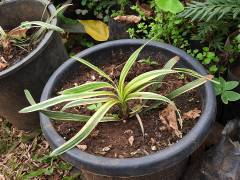
Liriope, Genus, muscari, Species, 'Big Blue', Cultivar,
- Genus & species
- Cultivar
big blue lilyturf
Garden cultivar selected from the species Liriope muscari, which is native to East Asia (China, Japan, Taiwan, Korea); woodland understory and forest-margin habitats.
Overview
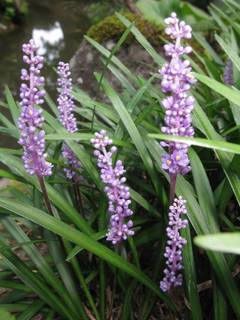
Liriope muscari Big Blue is the leading lilyturf cultivar in southern United States landscape commercial use, growing 12-18 inches (30-45 cm) tall and wide as a clumping evergreen perennial in the asparagus family (Asparagaceae). The species name 'muscari' references the resemblance of the violet-blue flower spikes to the unrelated grape hyacinth genus Muscari (in the Asparagaceae family alongside Liriope), with the dense terminal spike architecture being the species' principal field-identification character. Dark green narrow arching glossy grass-like evergreen leaves form a dense fountain-shaped clump 12-18 inches across that holds the dark green foliage color 12 months of the year and gives ground-cover function across the dormant season. Violet-blue to purple six-tepaled flowers in dense terminal spikes 6-8 inches (15-20 cm) tall appear in August and September across a 4-week active flowering window above the foliage clump, with the spikes being followed by blue-black berries that persist through fall and winter as a tertiary ornamental feature beyond the year-round foliage and the late-summer flower display. The three-season ornamental display (year-round evergreen foliage plus late-summer flowers plus fall-into-winter berries) and the substantial tolerance range for cultivation conditions make the cultivar a recurring choice for difficult landscape positions where most other ground covers struggle. The cultivar tolerates full sun to full shade (one of the broadest sun-exposure ranges in the perennial cultivar list), nearly any soil texture (clay, sand, loam), drought once established, summer heat-and-humidity, and competition from established tree-root systems that displaces other ground-cover species. The clumping habit is the principal field-identification character that separates Liriope muscari from the closely related stoloniferous Liriope spicata: L. muscari forms expanding clumps that stay where they are planted and spread slowly by basal-crown enlargement, while L. spicata produces underground stolons that colonize a substantial planting area within 3-5 seasons and is generally considered too aggressive for cultivated borders. Choosing L. muscari (or any of its cultivars) over L. spicata avoids the colonization-management work that L. spicata requires across multiple seasons. The genus Liriope is in the asparagus family (Asparagaceae) alongside Asparagus, Hosta, Hyacinthoides, Polygonatum (Solomon's seal), and other genera that share the family-level steroidal saponin chemistry — the same compound class that gives the family the mild gastrointestinal toxicity that recurs across most asparagus-family cultivated plants. All plant parts of Liriope muscari contain saponins and produce mild gastrointestinal upset if ingested by humans or pets, with the bitter taste discouraging serious ingestion in most cases. The single essential annual maintenance task is shearing all foliage to 3 inches (8 cm) above ground level in late February through March before new spring growth emerges; the spring shearing removes the previous-year foliage that has acquired winter-burn damage and allows the fresh new growth to form a clean clump for the new season. Deer avoid the foliage from the same family-shared saponin chemistry.
Native Range
Liriope muscari Big Blue is a garden cultivar selected from the species Liriope muscari, which is native to East Asia with a continuous native range across China, Japan, Korea, and Taiwan. The species occurs in deciduous woodland understory, forest-margin habitats, and shaded grassland positions across the East Asian native range, with the species' shade tolerance and broad soil tolerance reflecting the woodland-understory native habitat where light levels are low and soil conditions vary. The species was introduced to European cultivation in the 19th century and to North American cultivation by the early 20th century, and has reached wide commercial garden-trade distribution across the temperate and subtropical United States as a principal ground-cover and edging perennial.Suggested Uses
Used as an evergreen ground cover, border edging, mass planting under trees, walkway and path border planting, and shade-garden component planting. The cultivar is the most versatile shade ground cover in southern United States landscape commercial use because of the broad sun-exposure tolerance, the broad soil tolerance, the year-round evergreen foliage, the late-summer flower display, and the fall-into-winter berry persistence. Container culture in 3-gallon (11 liter) or larger pots works for the moderate root volume of the clumping habit. The cultivar pairs with companion shade-garden perennials including Hosta, Heuchera, Astilbe, Polygonatum, and Pulmonaria for a multi-species shade-garden composition where the Liriope grass-like foliage texture contrasts with the broader-leaved companions and supplies a strong year-round structural element to the planting.How to Identify
Appearance
Size & Dimensions
Height1' - 1'6"
Width/Spread1' - 1'6"
Colors
Bloom Information
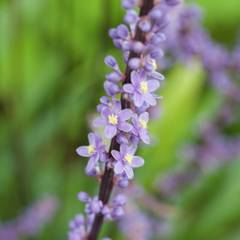
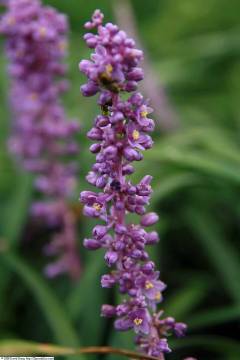
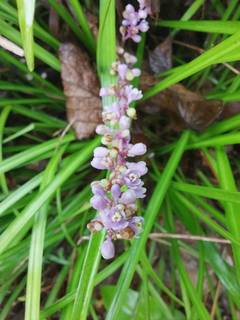
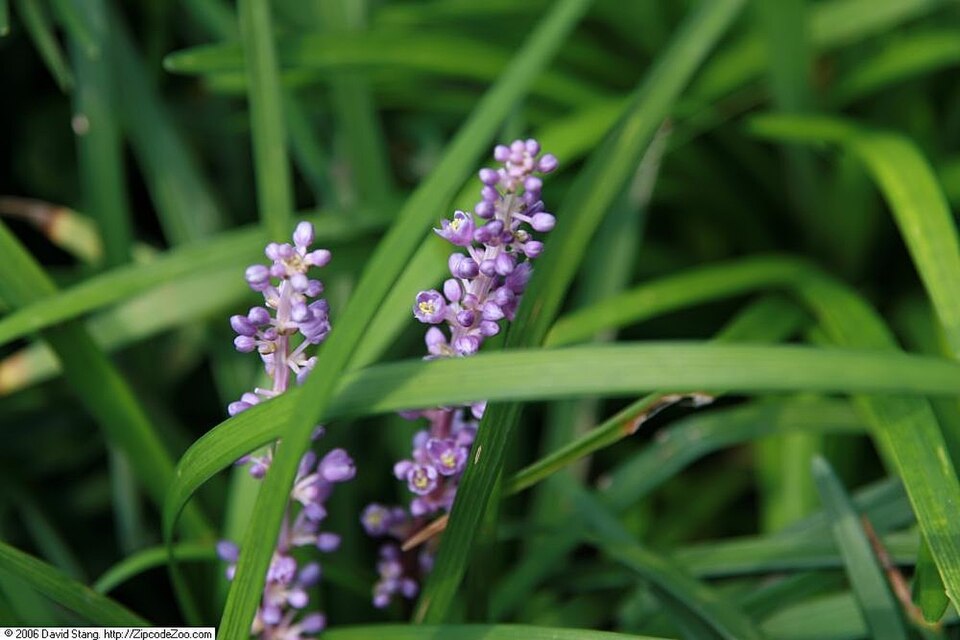
Violet-blue to purple six-tepaled flowers open in dense terminal spikes 6-8 inches (15-20 cm) tall above the foliage clump from August through September across a 4-week active flowering window. The spike architecture resembles the dense flower spikes of grape hyacinth (Muscari, also in the asparagus family), and the visual similarity is the source of the species name 'muscari'. Pollination is by bees and other insect pollinators that work the open spike flowers, and the late-summer bloom timing fills a flowering window when many other shade-tolerant perennials have completed their flowering. Blue-black berries develop after the flower spike fades and persist through fall and winter as a continuing ornamental feature beyond the active flowering window.
Detailed Descriptions
Flower Description
Violet-blue to purple six-tepaled flowers carried in dense terminal spikes 6-8 inches (15-20 cm) tall above the foliage clump; the species name 'muscari' references the spike's resemblance to grape hyacinth (Muscari) flowers, and the dense spike architecture is the source of the species-level common nameFoliage Description
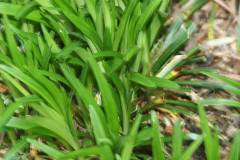
Dark green; narrow arching glossy grass-like evergreen leaves forming a dense fountain-shaped clump that holds the dark green foliage color through winter even in zone 6 conditions, supplying ground-cover function 12 months of the yearGrowing Conditions
Sun Requirements
Requires 2-8 hours of direct sunlight daily
• Full Sun: 6+ hours of direct sunlight
• Partial Shade: 3-6 hours of direct sunlight
• Full Shade: Less than 3 hours of direct sunlight
Care & Maintenance
Care Guide
Plant in any sun exposure from full sun through full shade; the cultivar tolerates 2-10 hours of direct light, with the broad exposure range being one of the cultivar's principal cultivation features and the reason for its widespread landscape use in mixed sun-and-shade positions where most other perennials struggle. Any soil texture (clay, sand, loam) at pH 5.5-7.5 supports the cultivar; the cultivar tolerates clay and the species' woodland-understory native habitat means rich organic conditions are favored but lean conditions are also tolerated. Watering is during establishment and through extended drought, with the cultivar being moderately drought-tolerant once the clump root system develops. The single essential annual maintenance task is shearing all foliage to 3 inches (8 cm) above ground level in late February through March before new spring growth emerges; the shearing produces fresh clean foliage for the new season and removes winter-burn damage from the previous-year foliage. The cultivar is non-fertilizer-dependent because the asparagus-family physiology supports the plant on lean soils, and over-fertilization produces leggy weak growth at the expense of clump density. The clumping (non-stoloniferous) habit means containment management is generally not needed because the cultivar stays where it is planted and spreads slowly by basal-crown enlargement rather than aggressively by underground runners.Pruning
Shear all foliage to 3 inches (8 cm) above ground level in late February through March before new spring growth emerges. The single annual shearing is the principal maintenance task for the cultivar and produces fresh clean foliage for the new growing season. No deadheading is needed because the violet flower spikes are followed by blue-black berries that persist through winter as a continuing ornamental feature.Pruning Schedule
Prune: February–March
early spring
Container Growing
Suitable for container growing
Minimum container size: 3 gallons