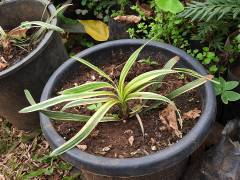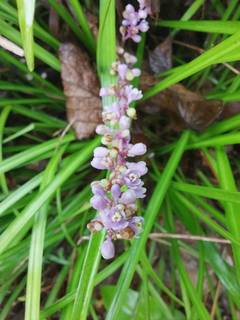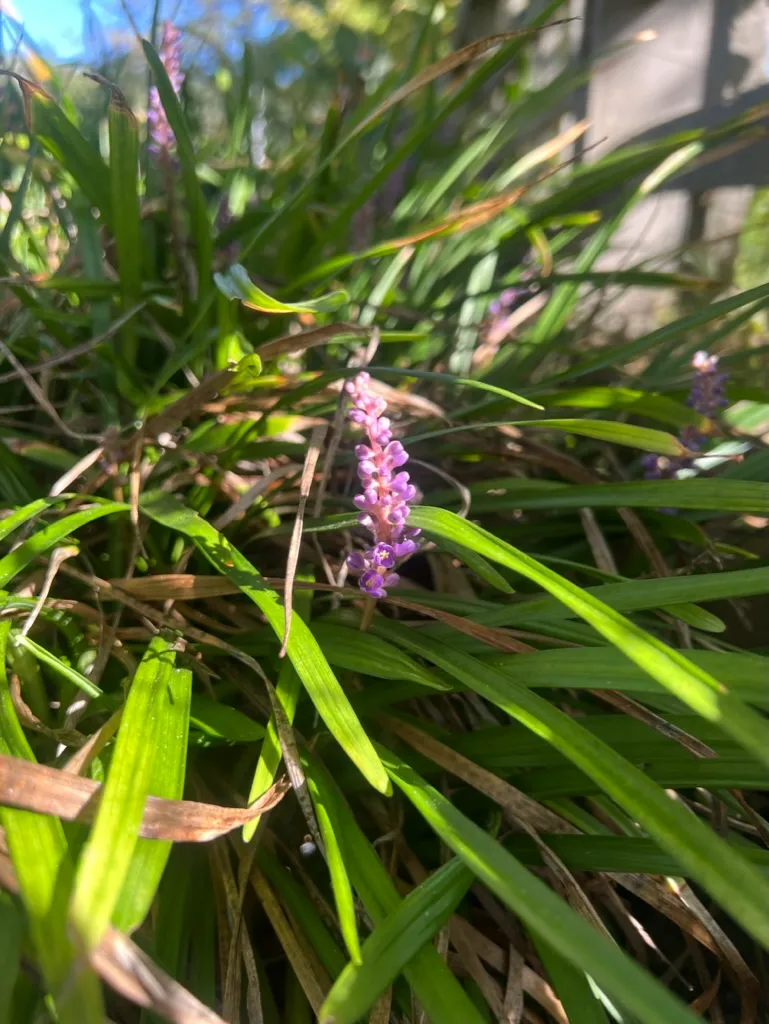
Image 1 of 4
1 / 4
Plant Reference
Liriope, Genus, muscari, Species,
- Genus & species
lily turf
Eastern Asia — China, Japan, Korea, and Taiwan; woodland understory, forest margins, and rocky slopes at low to middle elevations
Overview
Liriope muscari is a clumping evergreen perennial in the family Asparagaceae growing 12–18 inches (30–45 cm) tall and 12–18 inches (30–45 cm) wide from a fibrous-rooted crown that produces dense tufts of arching strap-shaped foliage. Despite the grass-like appearance and the common names lily turf and lilyturf, the species is not a grass — Asparagaceae is the asparagus family, and the species is more closely related to Asparagus, Hosta, Yucca, and Agave than to any true grass in the family Poaceae. The specific epithet muscari refers to the resemblance of the flower spikes to those of the unrelated genus Muscari (the grape hyacinths in family Asparagaceae subfamily Scilloideae) — the lavender-purple flower spikes of L. muscari carry the same dense vertical raceme arrangement that gives Muscari its common name. The species is clumping rather than stoloniferous and forms tight discrete clumps that expand only slowly at the edges — this clumping habit separates L. muscari from the related L. spicata (creeping lilyturf), which spreads aggressively by underground stolons and which is classified as invasive in parts of the southeastern United States. Leaves are dark green, semi-glossy, strap-shaped, 0.5 inch (1.3 cm) wide, and 12–18 inches (30–45 cm) long, arching outward from the clumping crown. Lavender-purple to violet tiny flowers 0.25 inch (6 mm) across open in dense spike-like racemes 3–6 inches (7–15 cm) tall in August and September across a 4-week bloom period, and glossy black berries 0.25 inch (6 mm) across develop from the spent flowers and persist into winter. The species tolerates a wide range of difficult conditions — deep shade through full sun, drought, summer heat, southeastern humidity, heavy clay soils, and coastal salt-spray exposure — and the wide tolerance combined with the clumping habit, the late-summer flower spikes, and the year-round evergreen foliage supports the species' wide use as an edging and ground-cover plant across the southeastern United States and across temperate gardens in zones 5 through 10. Limitation: crown rot caused by Phytophthora species develops in waterlogged soils and in poorly drained planting positions, and this soil-borne disease is the primary disease pressure on the species in cultivation. Cultivars in commerce include 'Big Blue' (the standard wider-leaved selection with prominent lavender-purple flower spikes and the dominant form in the nursery trade), 'Variegata' (cream-edged leaves with the same lavender-purple bloom), and 'Monroe White' (white flower spikes for a less-common color variant). Native to eastern Asia (China, Japan, Korea, and Taiwan). Non-toxic. Deer-resistant. Drought-tolerant once established.
Native Range
Native to eastern Asia — China, Japan, Korea, and Taiwan — growing in woodland understory, forest margins, and rocky slopes at low to middle elevations on a range of soil types from acidic woodland loam to rocky alkaline substrates. The species' wide tolerance of soil pH, light, and moisture conditions in the native range translates to a similarly wide tolerance in cultivation, and the species has been planted across the southeastern United States and across temperate gardens worldwide as an evergreen edging and ground-cover plant since the late 19th century introduction to western horticulture.Suggested Uses
Used as an evergreen edging plant along walks and bed edges, ground cover in mass plantings, accent perennial in mixed shade borders, and container specimen in containers of at least 2 gallons (7.5 L) at 12–18 inch (30–45 cm) spacing between plants in USDA zones 5 through 10. The wide tolerance of light (deep shade through full sun), soil (loam to clay to sand), and difficult conditions (drought, heat, humidity, salt) combines with the clumping non-spreading habit, the late-summer lavender-purple flower spikes, the year-round evergreen foliage, and the very low maintenance requirement (one annual late-winter mow-back) to make the species a foundation evergreen ground-cover plant across the southeastern United States and across temperate gardens in zones 5 through 10. The clumping habit makes the species a safe choice in regions where the related stoloniferous L. spicata is invasive — L. muscari does not spread aggressively by stolons and stays in tight discrete clumps. Waterlogged poorly drained planting positions are unsuitable because of the Phytophthora crown rot pressure.How to Identify
Appearance
Size & Dimensions
Height1' - 1'6"
Width/Spread1' - 1'6"
Bloom Information
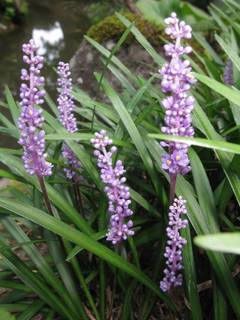
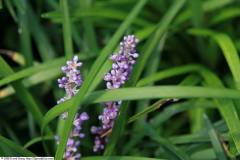
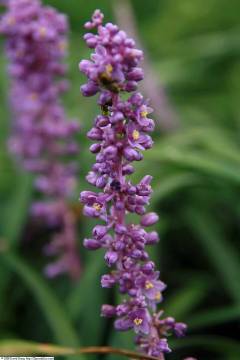
Lavender-purple to violet tiny flowers 0.25 inch (6 mm) across open in dense spike-like racemes 3–6 inches (7–15 cm) tall in August and September across a 4-week bloom period. The dense vertical raceme form resembles the flower spikes of the unrelated grape hyacinth genus Muscari and is the basis for the specific epithet muscari. Honeybees and other late-summer pollinators work the flowers for nectar across the August–September bloom window. Glossy black berries 0.25 inch (6 mm) across develop from the spent flowers and persist into winter, supplying a secondary fall and winter ornamental feature.
Detailed Descriptions
Flower Description
lavender-purple to violet tiny flowers 0.25 inch (6 mm) across carried in dense spike-like racemes 3-6 inches (7-15 cm) tall that rise above or among the strap-shaped foliage in August and September; the racemes resemble the flower spikes of the unrelated genus Muscari (the grape hyacinths) and the resemblance is the basis for the specific epithet muscari; followed by glossy black berries 0.25 inch (6 mm) across that persist into winterFoliage Description
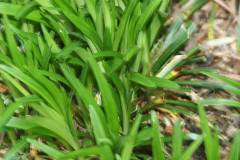
dark green semi-glossy strap-shaped leaves 0.5 inch (1.3 cm) wide and 12-18 inches (30-45 cm) long arching outward from a clumping crown; evergreen year-round, though the foliage may look tattered by late winter in zones 5 and 6 where cold weather damages the leaf tips and a spring mow-back to 3-4 inches (7-10 cm) is the standard maintenance to refresh the plantingGrowing Conditions
Sun Requirements
Requires 1-8 hours of direct sunlight daily
• Full Sun: 6+ hours of direct sunlight
• Partial Shade: 3-6 hours of direct sunlight
• Full Shade: Less than 3 hours of direct sunlight
Care & Maintenance
Care Guide
Site in part shade to full sun or full shade with 1–8 hours of direct sun per day in well-drained loam, clay, or sand soil with a pH of 5.5–7.0. The species tolerates a wide range of difficult conditions including deep shade, drought, summer heat, southeastern humidity, heavy clay soils, and coastal salt-spray exposure, and drought tolerance develops once the root system is established. Crown rot caused by Phytophthora species develops in waterlogged soils and in poorly drained planting positions, and drainage amendment supports disease prevention in heavy soils. The standard maintenance is a single annual mow or shear to 3–4 inches (7–10 cm) in late winter (February or March) before new growth emerges to remove the previous year's tattered foliage and to refresh the planting — fresh green strap-shaped foliage emerges within a few weeks of the cutback. Non-toxic and deer-resistant. Hardy in USDA zones 5–10.Pruning
The standard maintenance is a single annual mow or shear of the entire planting to 3–4 inches (7–10 cm) in late winter (February or March) before new growth emerges, to remove the previous year's tattered cold-damaged foliage and to refresh the planting for the new growing season. Fresh green strap-shaped foliage emerges within a few weeks of the cutback. The mow-back is done with a string trimmer, hedge shears, or a rotary mower set to its highest deck height depending on the planting size, and large mass plantings are routinely mowed in a single pass to handle ground-cover scale.Pruning Schedule
Prune: February–March
early spring
Container Growing
Suitable for container growing
Minimum container size: 2 gallons