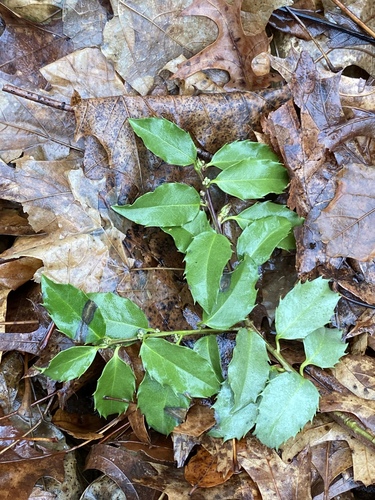
Ilex meserveae
Meserve holly
Garden hybrid: I. aquifolium (western Europe) × I. rugosa (northern Japan, Sakhalin); created by Kathleen Meserve in Long Island, New York, 1950s-1960s
Overview
Ilex × meserveae is a group of evergreen holly hybrids in the holly family (Aquifoliaceae spp.) reaching 6–10 feet (1.8–3 m) tall with a spread of 5–8 feet (1.5–2.4 m). The hybrid group was created by Kathleen Meserve on Long Island, New York, during the 1950s and 1960s through crosses between I. aquifolium (English holly from western Europe) and I. rugosa (prostrate holly from northern Japan and Sakhalin). The cross combined the glossy foliage and red berry production of the English holly parent with the cold hardiness of the Asian parent, which produced a holly group that grows reliably in zone 5 where I. aquifolium alone fails. Dark blue-green glossy leaves run 1.5–2.5 inches (4–6 cm) long with spiny margins — smaller than the 2–3 inch leaves of I. aquifolium but carrying the same spined holly leaf silhouette. Young stems develop a purple tint that identifies the hybrid group visually from other holly groups in the trade. The group is dioecious — female cultivars carry bright red berries in winter when pollinated by a male cultivar within range. Growth rate runs moderate. Hardy to zone 5.
Native Range
Ilex × meserveae is a garden hybrid between I. aquifolium (native to western Europe) and I. rugosa (native to northern Japan and Sakhalin). The hybrid was created by Kathleen Meserve in Long Island, New York, during the 1950s and 1960s through a multi-year breeding program that combined cold-hardy Asian holly genetics with the traditional English-holly appearance.Suggested Uses
Grown as a hedge, screen, or specimen shrub at 5–8 foot (1.5–2.4 m) spacing. The zone 5 cold hardiness runs as the primary advantage over I. aquifolium — the Meserve group extends spiny-leaved red-berried holly cultivation into colder climates where English holly fails reliably. Planting male and female cultivars together in the same garden supplies the pollination pathway needed for berry production on the female plants. The blue-green foliage and purple stems separate this group from English holly visually. Heat and humidity tolerance runs lower than southern hollies like I. vomitoria. Wet soils, alkaline soil conditions, and hot humid climate zones from 8 upward are all unsuitable given the cultural profile.How to Identify
Appearance
Size & Dimensions
Height6' - 10'
Width/Spread5' - 8'
Reaches mature size in approximately 7 years
Bloom Information
Small white four-petaled flowers open in May and June. The hybrid group is dioecious — female cultivars produce bright red berries when pollinated by a male cultivar within 200 feet (60 m). 'Blue Prince' is the standard male pollinator for the 'Blue Princess' and related female cultivars. Berries ripen in autumn and persist on the plant through the full winter window into early spring.
Detailed Descriptions
Flower Description
Small white flowers; dioecious; bright red berries persist through winter on female cultivars with a male pollinator within rangeFoliage Description
Glossy dark blue-green spiny 1.5-2.5 inches long; purple-tinted young stemsGrowing Conditions
Sun Requirements
Requires 4-8 hours of direct sunlight daily
• Full Sun: 6+ hours of direct sunlight
• Partial Shade: 3-6 hours of direct sunlight
• Full Shade: Less than 3 hours of direct sunlight
Care & Maintenance
Care Guide
Grows in full sun to partial shade in moist well-drained slightly acidic soil at pH 5.0–6.5, tolerating loam and sand. Hardy to zone 5 — the hybrid was developed specifically for cold-climate holly growing and carries cold tolerance beyond the native I. aquifolium limits. Winter sun and wind exposure in the coldest end of the hardiness range can cause leaf scorch, so siting with a windbreak or under light high shade in exposed positions reduces the winter-damage risk. Berry production on female cultivars requires a male cultivar within 200 feet (60 m) for pollination during the May–June flowering window.Pruning
Pruning for shape is done in late winter or early spring before new growth emerges. The hybrid group responds to shearing and carries formal hedging well, and the dense branching framework builds a solid screen with minimal intervention over time. Heavy pruning in late summer or fall is avoided because it removes the developing flower buds that would set next year's berries on female cultivars.Pruning Schedule
J
F
M
A
M
J
J
A
S
O
N
D
late spring