Hosta, Genus,
- Genus
hostas
Overview
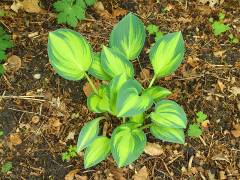
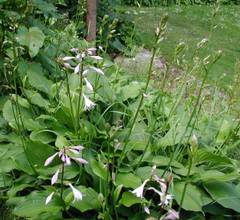
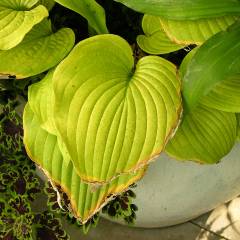
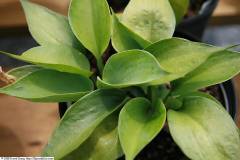
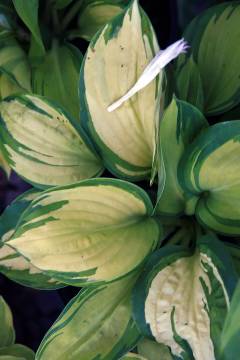
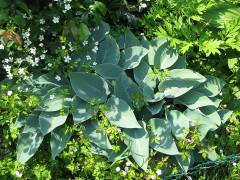
Hosta is a genus of about 45 species of herbaceous perennials in the family Asparagaceae, native to the woodlands of Japan, China, and Korea. Grown chiefly for foliage, plants form mounded clumps of broad, ribbed leaves that rise from short rhizomes, with mature clumps ranging from 15 to 90 cm (6 to 36 in) tall and spreading wider. Leaf shape runs from narrow and lance-like to broad and heart-shaped, in shades of green, blue-gray, chartreuse, and gold, and many forms are variegated with white or cream margins or centers. The blue tones come from a waxy coating that wears off in strong sun. In summer, leafless scapes carry one-sided racemes of funnel-shaped flowers in white or lavender, and a few species such as H. plantaginea are fragrant. Plants emerge late in spring and die back fully with the first hard frost. Slugs, snails, and deer feed heavily on the foliage and are the main limitation in many gardens. All parts contain saponins toxic to dogs, cats, and horses if eaten.
Native Range
The genus is native to eastern Asia, in Japan, China, and the Korean peninsula, where most species grow in woodland, on shaded slopes, and along streams. Japan holds the greatest number of species.Suggested Uses
Used as foliage groundcover and edging in shade borders, woodland gardens, and along paths, and in containers where slugs can be managed more easily. The bold leaves contrast with ferns and narrow-leaved shade plants. Heavy slug, snail, and deer pressure limits use in some gardens.How to Identify
Appearance
Size & Dimensions
Height6" - 3'
Width/Spread1' - 5'
Bloom Information
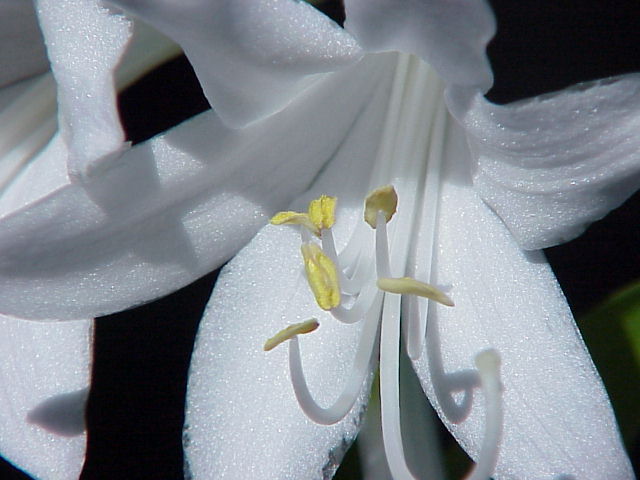
Flowering occurs in summer, broadly June to August depending on species, when scapes rise above the foliage. Each scape opens funnel-shaped flowers from the bottom upward over two to three weeks. Bloom is secondary to the foliage in most plantings, and the fragrant white-flowered species open in the evening.
Detailed Descriptions
Flower Description
white to lavenderFoliage Description
green, blue-gray, chartreuse, or gold, often variegatedGrowing Conditions
Sun Requirements
Tolerates up to 4 hours of direct sunlight daily
• Full Sun: 6+ hours of direct sunlight
• Partial Shade: 3-6 hours of direct sunlight
• Full Shade: Less than 3 hours of direct sunlight
Care & Maintenance
Care Guide
Most species grow in part to full shade and moist, fertile, well-drained soil with a pH of 6.0 to 7.5. Blue-leaved forms hold their color in shade, while gold and variegated forms take more sun without scorching. Hardiness spans USDA zones 3–8, and the plants need a period of winter cold to grow well. Consistent moisture produces the fullest foliage, as dry soil browns the leaf edges. Slugs and snails chew holes in the leaves, especially in wet weather, and deer browse whole clumps. Clumps are long-lived and can be divided in spring or early autumn.Pruning
Removing flower scapes after bloom, or before they open in foliage plantings, directs energy into the leaves. Cutting frosted foliage to the ground in autumn removes slug habitat over winter. Damaged or scorched leaves can be trimmed away during the season.Pruning Schedule
Prune: October–November
fall
Container Growing
Suitable for container growing
Minimum container size: 3 gallons