Image 1 of 9
1 / 9
© No machine-readable author provided. EugeneZelenko assumed (based on copyright claims)., some rights reserved (CC-BY-SA) · Wikimedia Commons
Eucalyptus, Genus, torquata, Species,
- Genus & species
Coral gum
Goldfields region, Western Australia
Overview
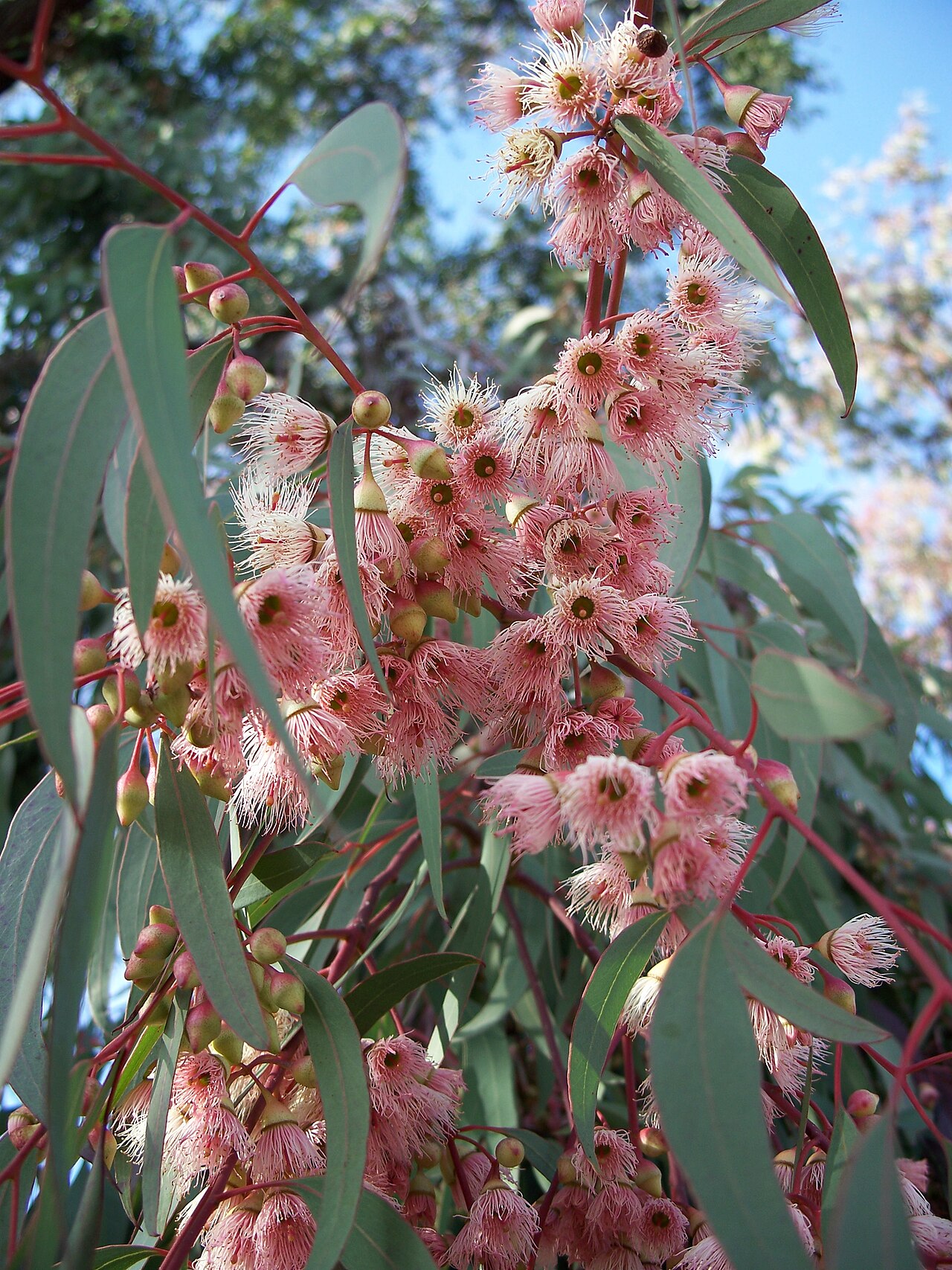
Eucalyptus torquata is an evergreen tree in the Myrtaceae growing 13-33 feet (4-10 m) tall and 10-20 feet (3-6 m) wide, usually on a single short trunk with a rounded, slightly pendulous crown. Bark is rough, flaky and grey-brown, persisting over the trunk and larger limbs. Adult leaves are alternate, narrow-lanceolate, 2.4-4.7 inches (6-12 cm) long and 0.4-0.8 inches (1-2 cm) wide, dull grey-green on both surfaces. Flower buds hang in umbels of 3-7 on drooping stalks; each bud is lantern-shaped, 0.6-0.9 inches (15-22 mm) long, with a ribbed corrugated cap that is shed to release a brush of coral-pink to red stamens 0.8-1.2 inches (20-30 mm) across tipped with cream anthers. Fruit are ribbed barrel-shaped capsules 0.4-0.6 inches (10-16 mm) long that stay on the tree for several years. Main flowering runs August to November, with scattered heads at other times. The tree grows on alkaline, gravelly and mildly saline soils to pH 8.5 and tolerates dry periods of 6-9 months once established, but its wood is brittle and limbs break in storm wind, early growth is slow at 12-20 inches (30-50 cm) per year, and it declines in humid summer climates where root rot pressure is high.
Native Range
Eucalyptus torquata is native to Western Australia, restricted in the wild to the Goldfields region between Coolgardie, Kalgoorlie and Norseman. It grows on stony rises and greenstone breakaways in low open woodland on alkaline loams and gravels receiving 8-11 inches (200-280 mm) of annual rainfall. The natural range spans under 60 miles (100 km), though the species is planted across southern Australia and in dry-summer regions overseas.Suggested Uses
Planted as a street and median tree in dry inland and Mediterranean-climate towns across southern Australia, spaced 16-26 feet (5-8 m) apart. Used in low-water gardens, roadside shelterbelts and mine-site revegetation on alkaline soils. Also grown for cut flowers and worked by commercial apiaries as a nectar source during the August to November flowering window.How to Identify
Appearance
Size & Dimensions
Height13' - 33'
Width/Spread10' - 20'
Bloom Information
Main flowering runs from August to November in southern Australia, with scattered heads opening through much of the remaining year on established trees. Buds take 10-14 months from first visible formation to opening. Each head stays open 10-14 days and a tree carries overlapping cohorts, so colour is held for 10-14 weeks. Nectar volumes draw honeyeaters and honeybees across the flowering window.
Detailed Descriptions
Flower Description
Coral-pink to red with cream anthersFoliage Description
Dull grey-greenGrowing Conditions
Sun Requirements
Requires 8-12 hours of direct sunlight daily
• Full Sun: 6+ hours of direct sunlight
• Partial Shade: 3-6 hours of direct sunlight
• Full Shade: Less than 3 hours of direct sunlight
Care & Maintenance
Care Guide
Eucalyptus torquata grows in full sun with 8-12 hours of direct exposure and makes sparse growth with few flowers under shade. It roots on free-draining sand, gravel, loam and light clay across pH 6.0-8.5, including calcareous and mildly saline soils, and declines quickly on wet ground. Irrigation of 4-5 gallons (15-20 litres) every two weeks through the first two summers establishes the root system, after which trees carry through on 8-12 inches (200-300 mm) of annual rainfall. Established trees tolerate 23F (-5C), while unhardened first-year growth is damaged near 28F (-2C). Fertiliser is seldom applied, and soil phosphorus above 20 ppm damages roots across this genus. In humid-summer climates with rainfall above 40 inches (1,000 mm), collar and root rot caused by Phytophthora species cuts working life to under 10 years.Pruning
Pruning is carried out after the main flush ends in late spring, since buds initiated the previous summer would otherwise be cut away. Formative pruning over the first 3 years to a single leader or 3-5 evenly spaced scaffold limbs reduces later limb failure in this brittle-wooded species. Cuts up to 2 inches (50 mm) across close within one to two seasons, while larger trunk cuts frequently develop decay pockets. Old capsules are left in place; their removal has no bearing on later flowering.Pruning Schedule
Prune: November–December
late springsummer