Eucalyptus, Genus, cinerea, Species,
- Genus & species
Argyle apple
Southern tablelands of New South Wales and north-eastern Victoria, Australia
Overview
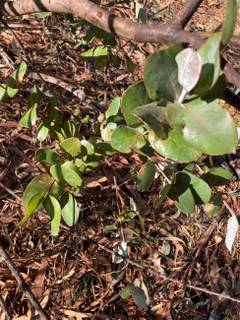
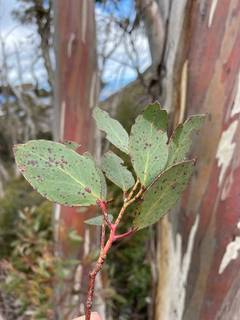
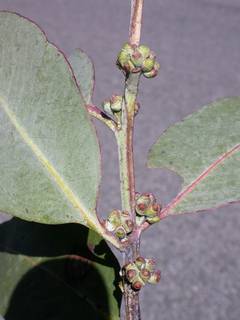
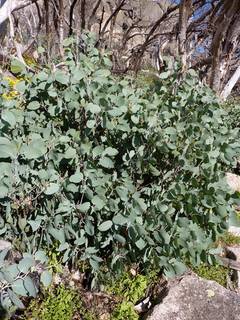
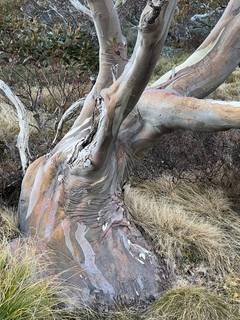
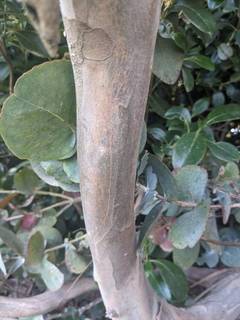
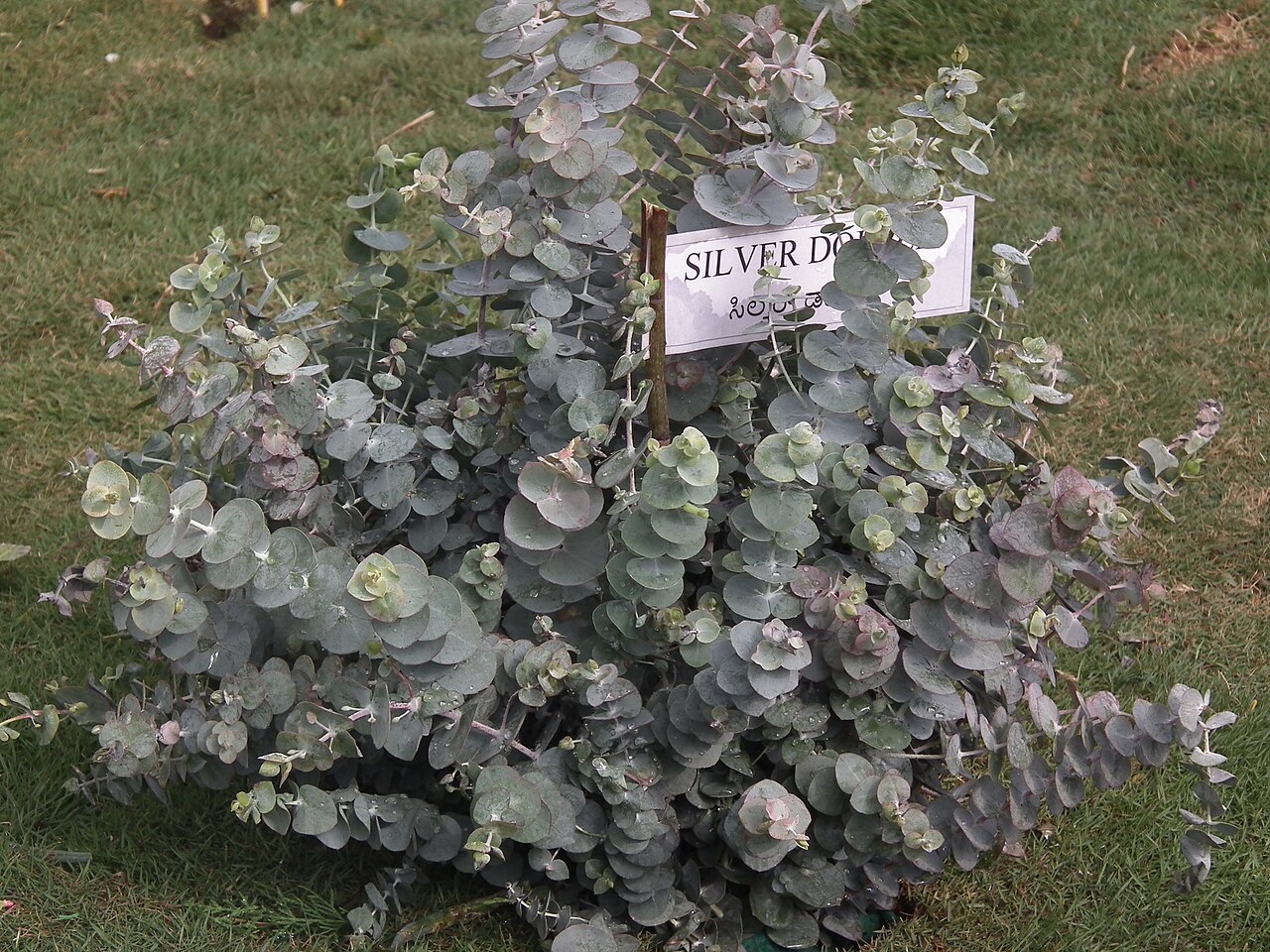
Eucalyptus cinerea is an evergreen tree in the Myrtaceae growing 25-50 feet (8-15 m) tall and 15-30 feet (4.5-9 m) wide, with a short trunk and an open, irregularly branched crown. Bark is rough, fibrous and reddish-brown, persisting on the trunk and larger branches rather than shedding in strips. Juvenile leaves are opposite, stalkless, orbicular to broadly ovate, 1.2-2.4 inches (3-6 cm) across and coated in a blue-grey waxy bloom; plants hold this leaf form for many years, and adult leaves, when produced, are alternate, lance-shaped, 2.4-5 inches (6-13 cm) long and also glaucous. White flowers open in three-flowered umbels from September to December, each 0.4-0.6 inches (10-15 mm) across and made up of stamens rather than petals. Woody capsules 0.16-0.28 inches (4-7 mm) long follow and persist on the branches for several seasons. Crushed foliage releases a cineole-scented oil. The species tolerates 14F (-10C) once established, drought periods of 8-12 weeks and shallow infertile soils, but lives only 50-70 years, sheds limbs in storms and occupies a small, fragmented wild range in south-eastern Australia. Coppiced stands are cut on a 12-18 month cycle for the cut-foliage trade.
Native Range
Eucalyptus cinerea is native to south-eastern Australia, where wild stands occur on the southern tablelands of New South Wales around Bungendore, Captains Flat and Bathurst, and in north-eastern Victoria near Beechworth. It grows on shallow, often skeletal soils over granite and sedimentary rock in dry woodland between 1,300 and 3,300 feet (400-1,000 m). Natural populations are small and fragmented, and three subspecies are recognised: subsp. cinerea, subsp. triplex and subsp. victoriensis.Suggested Uses
Grown as a small shade and screening tree in dry-climate gardens and parks, spaced 20-30 feet (6-9 m) apart. Coppiced blocks are managed at 3 feet (1 m) spacing for cut foliage supplied to the florist trade on a 12-18 month cutting cycle. Also used in farm windbreak rows and low-water street plantings in USDA zones 8-10, though limb shedding restricts its use over car parks and seating areas.How to Identify
Appearance
Size & Dimensions
Height25' - 50'
Width/Spread15' - 30'
Bloom Information
Flowering runs from September to December in south-eastern Australia, with a peak of 4-6 weeks that shifts later at higher elevations. Buds develop over 9-12 months from first appearance to opening and are held in groups of three on a short common stalk. Flowers are white to cream and consist of stamens 0.2-0.3 inches (5-8 mm) long; the fused sepals and petals form a cap that is shed as the flower opens. Individual trees flower more heavily in alternate years.
Detailed Descriptions
Flower Description
White to creamFoliage Description
Blue-grey to silver-greyGrowing Conditions
Sun Requirements
Requires 7-12 hours of direct sunlight daily
• Full Sun: 6+ hours of direct sunlight
• Partial Shade: 3-6 hours of direct sunlight
• Full Shade: Less than 3 hours of direct sunlight
Care & Maintenance
Care Guide
Eucalyptus cinerea grows in full sun with 7-12 hours of direct exposure and thins markedly in part shade. It roots on free-draining loam, sand and gravelly clay at pH 5.0-7.5, and declines where soil stays saturated for more than a few days. Water use is 4-6 gallons (15-25 litres) weekly through the first two summers; after three years established trees carry through on 20 inches (500 mm) of annual rainfall without irrigation. Cold tolerance reaches about 14F (-10C) on established trees, while first-year plants are damaged near 25F (-4C). Fertiliser demand is minimal, and soil phosphorus above 20 ppm damages roots across this genus, so low-phosphorus feeds are used on depleted sites. Trees planted from large containers often form coiled roots and blow over between years 5 and 12, which is why 4-8 inch (100-200 mm) tubestock is the usual planting size.Pruning
Pruning is carried out in late spring to summer, when cuts seal within one season; cuts made in winter in cool climates close slowly and admit decay fungi. Coppicing to 4-12 inches (10-30 cm) above ground in the second year produces multi-stemmed regrowth of 6-10 feet (1.8-3 m) per season carrying juvenile foliage, and stools are recut every 12-18 months. Removal of more than a third of the crown in one operation on an unmanaged mature tree triggers heavy epicormic shooting along the trunk. Lower limbs are lifted progressively over the first 5 years where clearance is wanted.Pruning Schedule
Prune: November–January
late springsummer