Equisetum, Genus, ×, Hybrid, ferrissii, Species,
- Genus & species
- Hybrid
Ferriss' horsetail
Overview
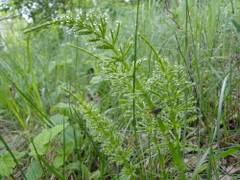
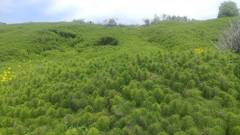
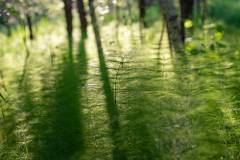
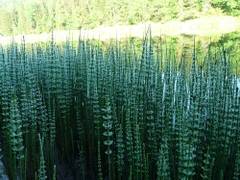
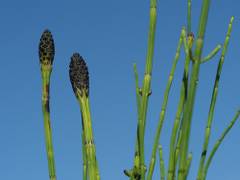
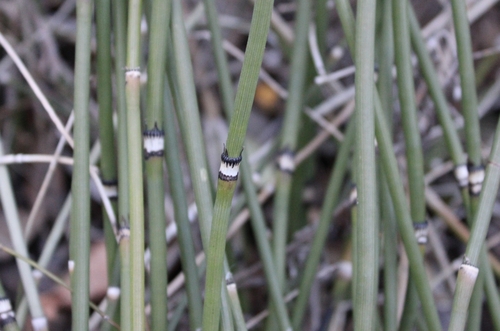
Equisetum × ferrissii is a rhizomatous, evergreen horsetail of hybrid origin between E. hyemale and E. laevigatum, intermediate between its two scouring-rush parents. It produces erect, unbranched, hollow green stems 16–40 inches (40–100 cm) tall and about 0.2–0.3 inch (5–8 mm) thick, ridged lengthwise and jointed at regular nodes. At each node a tight sheath bears small, scale-like, non-photosynthetic leaves fused into a collar marked with an ash-grey band and a dark upper rim. The stems are rough to the touch from silica deposits in the surface. As a sterile hybrid, plants spread only by creeping rhizomes, forming dense colonies; the cone-like strobili at the stem tips are usually malformed and shed little or no viable spore. It grows in moist to wet ground along streambanks, ditches, and roadsides, and tolerates periodic flooding. The fast rhizomes make it difficult to remove once established, and fragments left in the soil regrow readily. Unlike E. hyemale, many stems die back in hard winters in the colder part of its range.
Native Range
The hybrid occurs across temperate North America wherever the ranges of E. hyemale and E. laevigatum overlap, from southern Canada through much of the United States. It grows in moist, open habitats such as streambanks, ditches, railway embankments, and roadsides.Suggested Uses
Planted at pond and stream margins, in rain gardens, and in bog plantings where upright stems and tolerance of wet soil suit waterside settings. Often grown in sunken containers or raised beds to contain the spreading rhizomes.How to Identify
Appearance
Size & Dimensions
Height1'4" - 3'4"
Width/Spread1' - 3'
Bloom Information
This horsetail produces no flowers, reproducing by spores like its fertile relatives. The cone-like strobili form at the stem tips in spring and early summer but are usually malformed and release little viable spore. Spread is almost entirely by underground rhizomes.
Detailed Descriptions
Foliage Description
Green stems; leaves reduced to scale-like sheathsGrowing Conditions
Sun Requirements
Requires 4-10 hours of direct sunlight daily
• Full Sun: 6+ hours of direct sunlight
• Partial Shade: 3-6 hours of direct sunlight
• Full Shade: Less than 3 hours of direct sunlight
Care & Maintenance
Care Guide
Grows in full sun to part shade on moist to wet soils, including clay, sand, and ground that floods periodically, across a pH range of 5.0–8.0. Needs consistent moisture and tolerates standing water and poor drainage that would kill most plants. Spreads by deep, fast rhizomes and is usually confined to containers or areas bounded by a solid root barrier sunk well below the surface. Stems are cut to the ground in late winter to clear old growth before new shoots emerge, and no feeding is needed. Hardy through USDA zones 4–9. Few pests or diseases affect it.Pruning
Stems are cut to ground level in late winter to clear old growth before new shoots rise. Spent or broken stems can be removed in any season. No shaping is needed.Pruning Schedule
Prune: February–March
winterearly spring
Container Growing
Suitable for container growing
Minimum container size: 5 gallons