Echinacea, Genus, spp., Multiple species,
- Genus
- Multiple species
coneflowers
Overview
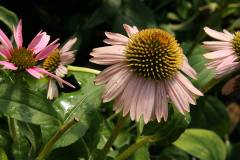
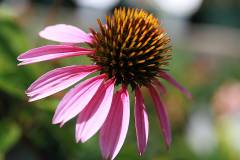
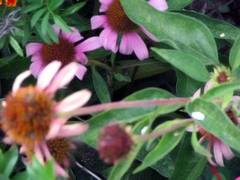
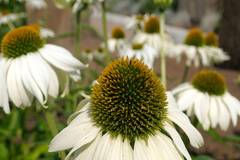
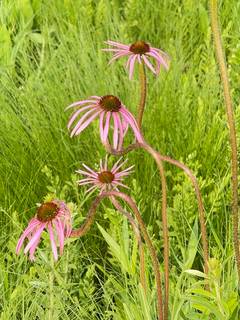
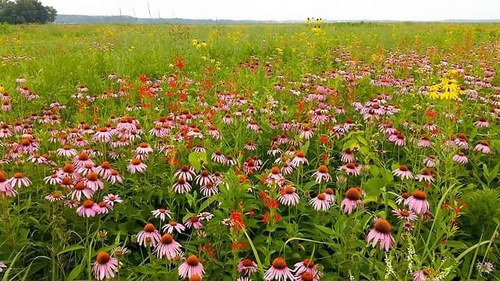
Echinacea is a genus of about ten species of perennial herbs in the daisy family (Asteraceae), native to the prairies and open woodlands of central and eastern North America. Plants form upright clumps 24 to 60 inches (60 to 150 cm) tall and 18 to 24 inches (45 to 60 cm) wide, with coarse, bristly, lance-shaped leaves and stiff, unbranched flower stems. Each flower head has a raised, dome-shaped central cone of spiny, orange-brown disc florets surrounded by a single row of ray florets that droop slightly downward. In most species the rays are pink-purple, though E. paradoxa bears yellow rays and selected cultivars extend the range to white, orange, and red. Flowering occurs from early summer into fall, and the persistent seed cones hold ripe seed into winter. Plants grow in full sun and tolerate heat, drought, and poor soils once their deep taproots are established, but they are slow to recover from transplanting and may rot in wet winter soils. The roots and tops of E. purpurea and E. angustifolia are harvested for herbal products.
Native Range
Echinacea is endemic to central and eastern North America, ranging across the tallgrass prairies, glades, and open woods of the United States and into southern Canada. E. angustifolia occurs widely on the Great Plains, while E. purpurea is centered in the southeastern and midwestern states.Suggested Uses
Echinacea is used in perennial borders, prairie and meadow plantings, pollinator gardens, and cut-flower beds. The dried seed cones add winter structure and feed birds. Plants suit naturalistic plantings spaced 18 to 24 inches (45 to 60 cm) apart.How to Identify
Appearance
Size & Dimensions
Height2' - 5'
Width/Spread1'6" - 2'
Bloom Information
Detailed Descriptions
Flower Description
pink-purple, also yellow, white, orange, or red in some species and cultivarsFoliage Description
dark greenGrowing Conditions
Sun Requirements
Requires 6-12 hours of direct sunlight daily
• Full Sun: 6+ hours of direct sunlight
• Partial Shade: 3-6 hours of direct sunlight
• Full Shade: Less than 3 hours of direct sunlight
Care & Maintenance
Care Guide
Echinacea grows in full sun and average to lean, well-drained soil. Established plants are drought-tolerant and carry deep taproots that do not tolerate disturbance, so divisions and transplants recover slowly. Wet, poorly drained winter soils cause crown and root rot, the most common cause of plant loss. Plants need little fertilizer; rich soil produces tall, floppy stems. Clumps can be left undisturbed for several years and divided only when the centers decline. Aster yellows, a disease spread by leafhoppers, can deform the flowers and is managed by removing affected plants.Pruning
Echinacea is cut back to basal growth in late fall or early spring. Spent flower stems can be removed to prolong bloom, or left standing so the seed cones feed finches and other birds through winter. Plants self-sow where seedheads are left in place.Container Growing
Suitable for container growing