Digitalis, Genus, obscura, Species,
- Genus & species
sunset foxglove
Spain and northern Morocco (dry rocky calcareous hillsides, garrigue)
Overview
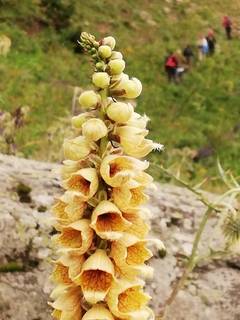
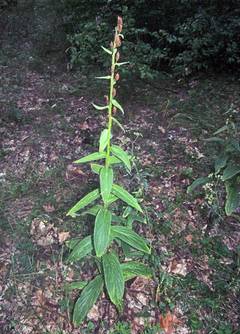
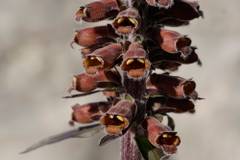
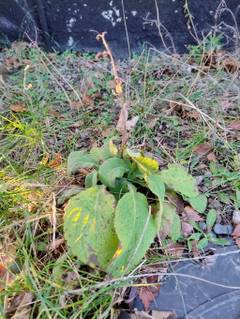
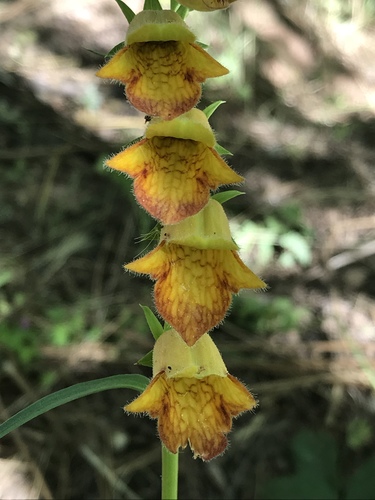
Digitalis obscura is a woody, upright, evergreen sub-shrub reaching 12–24 inches (30–60 cm) tall with a spread of 12–18 inches (30–45 cm). The species carries one-sided racemes of russet-orange to tawny-yellow tubular pendant flowers 1–1.5 inches (2.5–4 cm) long with brown-red veining on the interior of the tube from May through July. The russet-orange flower color sets the species apart from the other foxgloves in cultivation, which are mostly purple, pink, white, or yellow; D. obscura is one of only two Iberian species in the genus with warm-toned flowers (the other being D. parviflora). Leaves are dark green, glossy, narrowly lance-shaped, leathery, 2–4 inches (5–10 cm) long, arranged on woody stems and persisting year-round—the species is a true perennial sub-shrub living 8–15 years under matching conditions, in contrast with the herbaceous biennial foxgloves (D. purpurea and relatives) which die after their second-year bloom. The specific epithet 'obscura' translates as 'dark' or 'obscure,' referencing the dusky, muted flower color. All parts contain the cardiac glycosides digitoxin and digoxin and are toxic to humans and animals if ingested; the same compounds are the source of the medical drug digitalis. Hummingbirds visit the flowers for nectar despite the toxicity of the plant tissues. The species is adapted to Mediterranean summer-dry conditions on calcareous soils in its Spanish and Moroccan range. Growth rate is moderate. The dark green leathery foliage carries strong visual weight in winter when most Mediterranean-style plantings go dormant.
Native Range
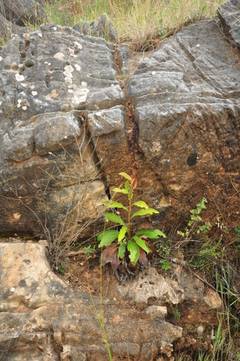
Digitalis obscura is native to Spain and northern Morocco, growing on dry rocky calcareous hillsides and garrigue scrub in the Sierra Nevada, Sierra de Guadarrama, and the Atlas Mountains at elevations of 1,500–6,500 feet (450–2,000 m). The Iberian foxgloves (D. obscura, D. parviflora, D. thapsi) are genetically distinct from the northern European biennial foxgloves and represent a separate evolutionary lineage adapted to Mediterranean summer drought and winter-moist conditions.Suggested Uses
Planted in gravel gardens, Mediterranean-style plantings, dry borders, and on sunny slopes at 12–18 inch (30–45 cm) spacing. The russet-orange flower color fills a warm-toned niche that few commercial perennials occupy—most orange-flowering perennials (crocosmia, daylilies, many salvias) bloom in midsummer, while D. obscura opens earlier in May–July. The evergreen leathery foliage carries winter interest in Mediterranean-style plantings where many companions are dormant or cut back. Paired with Rosmarinus officinalis, Santolina chamaecyparissus, Cistus species, and low ornamental grasses such as Stipa tenuissima, the species combines well in dry-climate compositions. Grows in containers of at least 3 gallons (11 L) with sharp-drainage medium. Sites with summer irrigation, heavy clay soils, and zones colder than 7 are poor fits—all three cause rapid decline.How to Identify
Appearance
Size & Dimensions
Height1' - 2'
Width/Spread1' - 1'6"
Bloom Information
One-sided racemes of russet-orange to tawny-yellow tubular pendant flowers 1–1.5 inches (2.5–4 cm) long with brown-red veining inside the tube bloom from May through July. Bloom duration is 4–5 weeks. Hummingbirds visit the flowers. The evergreen foliage persists year-round and carries the ornamental display outside the flowering period.
Detailed Descriptions
Flower Description
Russet-orange to tawny-yellow with brown-red veining inside the tube; tubular, pendant, 1-1.5 inches (2.5-4 cm)Foliage Description
Dark green, glossy, narrow lance-shaped, leathery, 2-4 inches (5-10 cm), evergreenGrowing Conditions
Sun Requirements
Requires 6-12 hours of direct sunlight daily
• Full Sun: 6+ hours of direct sunlight
• Partial Shade: 3-6 hours of direct sunlight
• Full Shade: Less than 3 hours of direct sunlight
Care & Maintenance
Care Guide
Plant in full sun in sharply drained, dry, calcareous soil. Supplemental summer irrigation shortens the lifespan and can cause root rot—the species is adapted to summer drought and evolved to tolerate 3–4 dry months without irrigation. Alkaline soil (pH to 8.0) is well-tolerated and often matches the wild habitat, where the species grows on pure limestone substrates. Hardy to zone 7 (0°F / −18°C) with reliable cold tolerance when drainage is sharp; winter wet soils at this hardiness margin are more damaging than cold itself. The woody stems develop 3–8 inch (8–20 cm) scaffolding after 3–4 years. Deer-resistant because of the cardiac glycoside content. No serious pest or disease problems. All parts are toxic; handling during pruning is done with gloves as a practical precaution because skin contact with sap can cause irritation in sensitive individuals.Pruning
Spent flower racemes are removed after bloom in late summer (August) to tidy the sub-shrub and prevent heavy seed set that would divert energy from vegetative growth. Leggy or frost-damaged stems are cut back in early spring (March) before new growth begins. The woody sub-shrub form develops naturally—the cultivar is not hard-pruned because the oldest wood does not regenerate after heavy cuts.Pruning Schedule
Prune: March & August
summerearly spring
Container Growing
Suitable for container growing
Minimum container size: 3 gallons