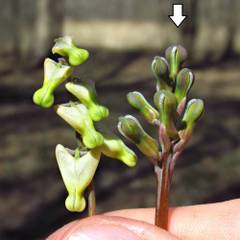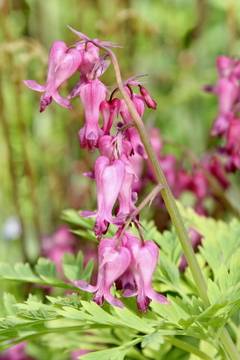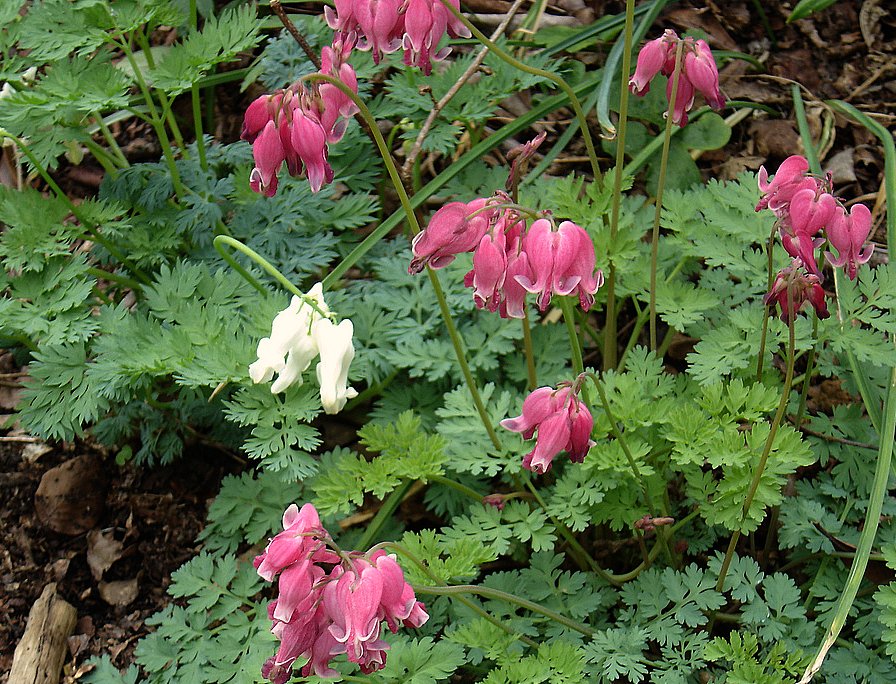
Dicentra, Genus, 'King of Hearts', Cultivar,
- Genus
- Cultivar
king of hearts bleeding heart
Hybrid of garden origin (D. formosa × D. peregrina)
Overview
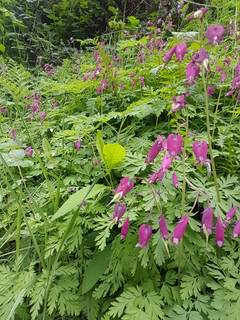
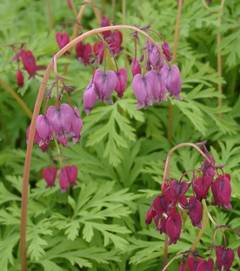
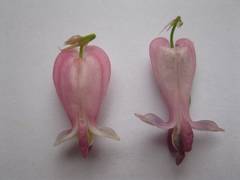
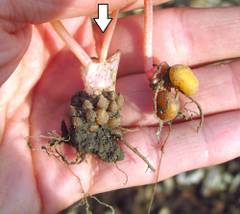
Dicentra 'King of Hearts' is a compact, mounding, herbaceous perennial reaching 8–12 inches (20–30 cm) tall with a spread of 12–18 inches (30–45 cm). The hybrid (likely D. formosa × D. peregrina, developed through the Holbrook Farm breeding program) carries pendant, heart-shaped flowers 0.75 inch (2 cm) long in bright rose-pink, borne in arching racemes of 5–10 above the foliage from April through September. The finely divided, fern-like foliage is distinctly blue-gray to silvery—more deeply dissected and more silvery than D. formosa 'Bacchanal.' The compact habit and slower rhizomatous spread make this cultivar more manageable in smaller gardens than the vigorous D. formosa selections such as 'Luxuriant' and 'Bacchanal.' Growth rate is moderate. The cultivar spreads by rhizomes but less aggressively than 'Bacchanal' or 'Luxuriant'—the rhizomes move roughly 2–4 inches (5–10 cm) per year rather than 6–12 inches. The foliage remains fresh through summer under consistent soil moisture. Goes dormant in late fall. Hardy to zone 4. The D. peregrina parent contributes both the silvery foliage character and heat-sensitivity—'King of Hearts' declines in hot, humid summer climates (zones 8–9) where D. formosa cultivars tolerate the heat better. All parts contain isoquinoline alkaloids and are toxic to humans and pets.
Native Range
Dicentra 'King of Hearts' is a hybrid of garden origin bred through the Holbrook Farm and Nursery program. The parentage involves D. formosa (native to western North America) and D. peregrina (native to high alpine sites in Japan, Korea, Siberia, and the Kamchatka Peninsula). The cross was developed to combine the long bloom season of D. formosa with the silvery dissected foliage of D. peregrina.Suggested Uses
Planted in shade gardens, woodland borders, rock gardens, and containers at 12–18 inch (30–45 cm) spacing. The compact mound matches smaller gardens and tight shade-border positions where the vigorous spreading D. formosa cultivars overrun their neighbors. The silvery foliage and extended bloom season pair with hostas (especially blue-leaved cultivars such as 'Halcyon'), ferns, and heucheras with dark or bronze foliage. Grows in containers of at least 3 gallons (11 L). Full-sun exposures and dry soils are poor fits—both produce early dormancy and weaker bloom; hot, humid summer climates in zones 8–9 are also a poor fit because of the heat-sensitive parentage.How to Identify
Appearance
Size & Dimensions
Height8" - 1'
Width/Spread1' - 1'6"
Bloom Information
Pendant, heart-shaped, bright rose-pink flowers 0.75 inch (2 cm) long hang in arching racemes from April through September. Heaviest bloom in April–May with lighter flushes through summer. Bloom duration is 16–20 weeks with deadheading. Hummingbirds visit the flowers.
Detailed Descriptions
Flower Description
Bright rose-pink, pendant heart-shapedFoliage Description
Blue-gray to silvery, very finely divided, fern-likeGrowing Conditions
Sun Requirements
Requires 3-6 hours of direct sunlight daily
• Full Sun: 6+ hours of direct sunlight
• Partial Shade: 3-6 hours of direct sunlight
• Full Shade: Less than 3 hours of direct sunlight
Care & Maintenance
Care Guide
Plant in partial shade in moist, well-drained, humus-rich soil. Consistent moisture keeps the foliage fresh through summer; drought triggers early dormancy and shortens the bloom season. Morning sun with afternoon shade produces robust growth and heavy bloom. Less aggressive than 'Bacchanal' and 'Luxuriant'—the rhizomes spread slowly enough to hold the cultivar within a defined planting area for 4–6 years before division is needed. Hot, humid summers in zones 8–9 cause decline over several seasons because of the heat-sensitive D. peregrina parentage; cooler maritime or mountain summer climates match the cultivar better. Hardy to zone 4. Slugs and snails damage emerging foliage in spring and can be reduced through iron phosphate baits around the crown. All parts are toxic; handling during division or cutback is done with gloves as a practical precaution.Pruning
Spent flower stems are removed to encourage repeat bloom. All foliage is cut back after it yellows in late fall. Clumps are divided every 3–4 years if they need rejuvenation, though the slower spread means division is not frequently required.Pruning Schedule
Prune: November
fall
Container Growing
Suitable for container growing
Minimum container size: 3 gallons