Dicentra, Genus, spp., Multiple species,
- Genus
- Multiple species
Bleedinghearts
Overview
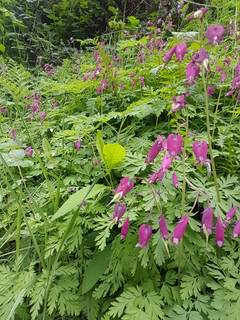
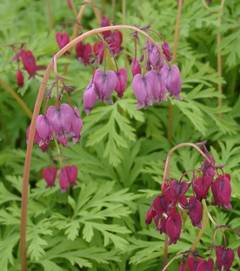
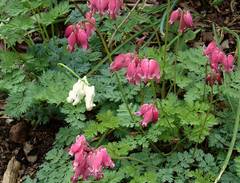
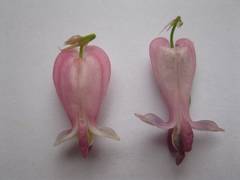
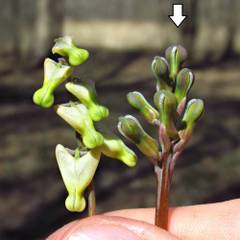
Dicentra is a genus of about 8 to 20 perennial herbs in the poppy family (Papaveraceae), native to woodlands of North America and eastern Asia. Plants grow from rhizomes or fleshy roots and form mounds of finely divided, blue-green to grey-green foliage 6-18 inches (15-45 cm) tall. The nodding flowers are flattened and heart- to locket-shaped, 0.5-1 inch (12-25 mm) long, with two outer petals that flare at the tip in pink, rose, white, or yellow. Most species bloom from mid-spring into summer, and the fringed-leaved types such as D. eximia and D. formosa repeat through the season where the soil stays moist and cool. A few species, including D. scandens, climb by twining leaf tips rather than forming a mound. Spring-blooming woodland species often go dormant and disappear by midsummer in dry or hot sites, leaving a gap in the planting. All parts contain isoquinoline alkaloids that are toxic if eaten and can irritate skin on prolonged contact.
Native Range
Dicentra is native to temperate woodlands and rocky slopes of North America - both eastern and western - and eastern Asia, including China, Korea, and Japan.Suggested Uses
Used in shaded borders, woodland gardens, and along the north side of buildings, spaced 12-18 inches (30-45 cm) apart. The mounded, fern-like foliage pairs with hostas, ferns, and other shade perennials. Container culture suits the compact fringed-leaved types.How to Identify
Appearance
Size & Dimensions
Height6" - 1'6"
Width/Spread8" - 1'6"
Colors
Bloom Information
Flowering runs from April to June in most species, with the fringed-leaved D. eximia and D. formosa reblooming through summer into September where conditions stay cool and moist. Individual sprays last several weeks. Bloom slows or stops during hot, dry spells.
Detailed Descriptions
Flower Description
pink, rose, white, or yellowFoliage Description
blue-green to grey-greenGrowing Conditions
Sun Requirements
Requires 2-6 hours of direct sunlight daily
• Full Sun: 6+ hours of direct sunlight
• Partial Shade: 3-6 hours of direct sunlight
• Full Shade: Less than 3 hours of direct sunlight
Care & Maintenance
Care Guide
Grow Dicentra in part to full shade in moist, humus-rich, well-drained soil with a pH around 5.5-7.0. A leaf-mould mulch keeps the root zone cool, and watering during dry spells delays summer dormancy. The brittle roots are easily damaged, so plants are left undisturbed once settled. Spring-blooming woodland species die back by midsummer, leaving bare ground until the following spring. Division is done in early spring or just after flowering. Crowns rot in waterlogged winter soil.Pruning
Spent flowering stems are sheared back to draw rebloom in the fringed-leaved species. Yellowing foliage is removed as plants enter dormancy. No other pruning is needed.Container Growing
Suitable for container growing
Minimum container size: 2 gallons