Clematis, Genus, glycinoides, Species,
- Genus & species
headache vine
Overview
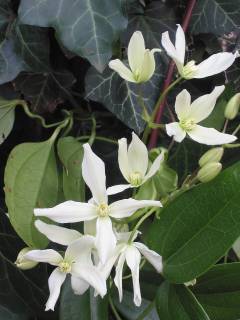
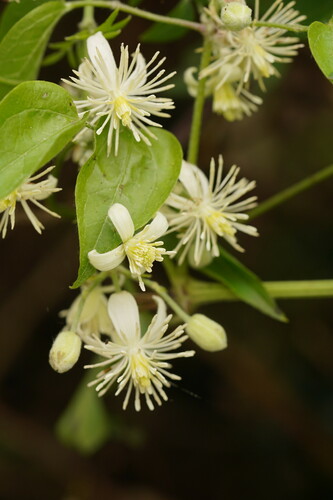
Clematis glycinoides is an evergreen woody climber reaching 10-20 feet (3-6 m) long, climbing by twisting leaf stalks that coil around supports. Leaves are divided into three leaflets, each lance-shaped to oval, 1.5-4 inches (4-10 cm) long, dark green and leathery. Clusters of cream to greenish-white star-shaped flowers, each 0.6-1 inch (1.5-2.5 cm) across with four narrow petal-like sepals, appear in spring. Male and female flowers are borne on separate plants. Female plants develop rounded heads of seeds with long silvery plumes that persist after flowering. The crushed foliage releases a sharp, pungent scent. Growth is rapid, and stems can climb high into trees and shrubs, becoming heavy over time. In open positions without support it forms a dense scrambling mass. The plant can smother small shrubs when left unmanaged.
Native Range
Native to eastern Australia from Queensland to Victoria and Tasmania. Grows in rainforest margins, wet eucalypt forest, and along watercourses, climbing into the canopy in sheltered, moist positions.Suggested Uses
Grown on sturdy trellises, pergolas, and wire frames in shaded and woodland gardens, spaced 6-10 feet (1.8-3 m) apart. Used to cover fences and screen structures in moist positions. The vigorous growth can overwhelm light supports and small shrubs.How to Identify
Appearance
Size & Dimensions
Height10' - 20'
Width/Spread5' - 10'
Bloom Information
Flowers in spring (August to November in its native range), with the main display lasting about four to six weeks. Silvery seed heads follow on female plants and persist into summer. Flowering is heavier in years with good winter rainfall.
Detailed Descriptions
Flower Description
cream to greenish-whiteFoliage Description
dark greenGrowing Conditions
Sun Requirements
Requires 2-5 hours of direct sunlight daily
• Full Sun: 6+ hours of direct sunlight
• Partial Shade: 3-6 hours of direct sunlight
• Full Shade: Less than 3 hours of direct sunlight
Care & Maintenance
Care Guide
Grows in part shade to filtered light in moist, well-drained soils rich in organic matter. Water regularly, as the vine grows in naturally moist forest soils and wilts in extended drought. Tolerates light frost once established. Sap from cut stems contains protoanemonin, which irritates skin and mucous membranes on contact. Few pests are recorded. Cut back after flowering to manage size and prevent stems from smothering supporting plants.Pruning
Cut back hard after flowering or in late winter to control the vigorous growth and reduce weight on supporting plants. Remove tangled and dead stems to maintain air flow. Regrows readily from the base after hard pruning.Pruning Schedule
Prune: November–December
late springsummer