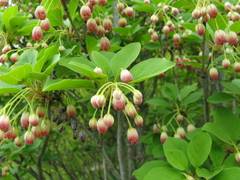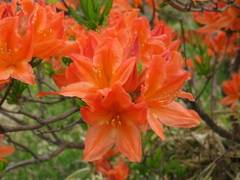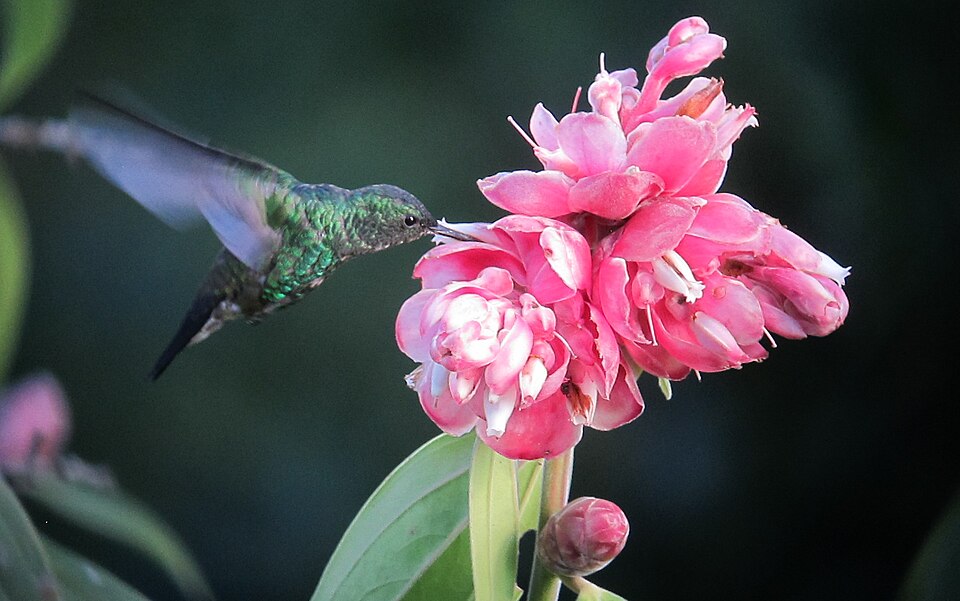
© Félix Uribe from Rionegro, Antioquia, Colombia, some rights reserved (CC-BY-SA) · Wikimedia Commons
Cavendishia, Genus, spp., Multiple species,
- Genus
- Multiple species
cavendishia
Montane Central and South America (Andes)
Overview
Cavendishia is a genus of about 100-130 species of evergreen shrubs in the heath family (Ericaceae), native to the mountains of tropical Central and South America. Many species are epiphytes, growing perched on tree trunks and branches in humid cloud forest, while others are terrestrial on banks and rocky slopes. Plants are 1-10 feet (0.3-3 m) in size, with leathery, alternate leaves that often emerge red or bronze before turning deep green. The flowers are tubular, 0.4-1.2 inches (1-3 cm) long, and waxy, in shades of red, pink, orange, and yellow, frequently with contrasting bands; they hang in dense clusters from brightly coloured bracts and are pollinated by hummingbirds. Rounded berries follow and are eaten by birds; the fruit of some species is edible. Cavendishia grows in cool, wet, frost-free montane climates with high humidity and constant moisture. Plants need an acidic, freely draining, organic rooting medium and are intolerant of drought, heat, and lime. These narrow climate and soil requirements are the main obstacles to growing the genus outside its native range.
Native Range
Native to the montane Neotropics, from southern Mexico and Central America through the Andes to Bolivia, with the highest diversity in Colombia and Ecuador. Plants grow as epiphytes or terrestrials in humid cloud forest, on mossy trunks, banks, and rocky slopes at middle to high elevations.Suggested Uses
Grown in cool, humid greenhouses, conservatories, and tropical montane gardens, often mounted on bark or grown in baskets like other epiphytes to show the hanging flower clusters. In frost-free cloud-forest climates it is used as a flowering shrub for shaded, moist banks. The nectar-rich tubular flowers draw hummingbirds.How to Identify
Appearance
Size & Dimensions
Height1' - 10'
Width/Spread1' - 6'
Bloom Information
In its humid montane home Cavendishia flowers over a long period, often through much of the year, with flushes tied to local wet seasons rather than a fixed month. Each cluster of waxy tubular flowers lasts for weeks. Berries develop gradually after the flowers fade.
Detailed Descriptions
Flower Description
red, pink, orange, or yellowFoliage Description
deep green, red-bronze when youngGrowing Conditions
Sun Requirements
Requires 2-5 hours of direct sunlight daily
• Full Sun: 6+ hours of direct sunlight
• Partial Shade: 3-6 hours of direct sunlight
• Full Shade: Less than 3 hours of direct sunlight
Care & Maintenance
Care Guide
Cavendishia are grown in bright, indirect light or part shade in cool, humid, frost-free conditions found chiefly in greenhouses or tropical montane gardens. The rooting medium is loose, acidic, and organic, similar to an epiphyte or orchid mix, kept evenly moist but never waterlogged. Plants tolerate neither drought nor lime and decline in heat or dry air. Watering with soft, low-mineral water and steady humidity suits them. Propagation is from semi-ripe cuttings or seed, both of which can be slow. Their exacting needs make them uncommon outside specialist and botanical collections.Pruning
Pruning is light, removing spent flower clusters and any dead or straggly stems after flowering to keep a bushy shape. Epiphytic species are tidied rather than hard-pruned. Long stems can be shortened to encourage branching.Container Growing
Suitable for container growing