Carex, Genus, deweyana, Species,
- Genus & species
Dewey's sedge
Temperate North America: eastern Canada, northeastern US, Alaska, Pacific Northwest, Rocky Mountains
Overview
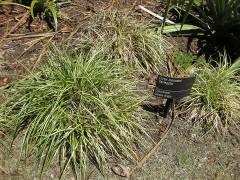
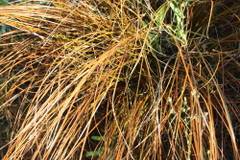
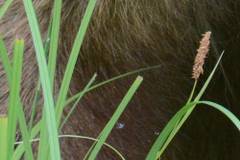
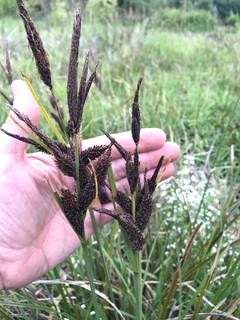
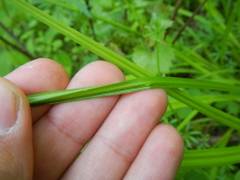
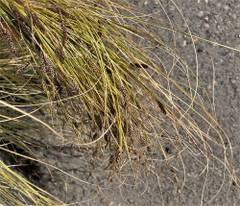
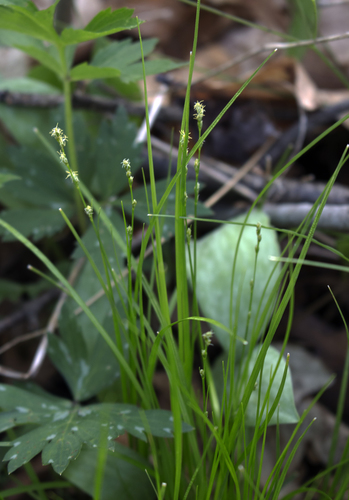
Carex deweyana is a deciduous loosely clumping perennial sedge reaching 12-30 inches (30-75 cm) tall and 12-18 inches (30-45 cm) wide, with thin upright to arching stems and narrow soft foliage. Leaves are flat to slightly folded, pale to medium green, 0.08-0.15 inch (2-4 mm) wide and 10-20 inches (25-50 cm) long. Flowering stems are slender and triangular, with 3-7 small pale green to whitish spikes 0.2-0.5 inch (5-13 mm) long arranged along the upper third of the culm; the lowest spike often has a leaf-like bract. Perigynia are pale green, lance-shaped, 0.15-0.2 inch (4-5 mm) long with a long beak. Bloom occurs from May through July. Plants form discrete clumps that gradually expand without rhizomatous spread; mature clumps reach 12-15 inches (30-38 cm) wide within 3-4 years. Foliage softens and arches in late summer; shade plantings hold green color longer than open sites.
Native Range
Native across temperate North America from Newfoundland and Quebec south to Tennessee, west to Alaska, British Columbia, Idaho, and Colorado. Grows in moist to mesic deciduous, mixed, and conifer forest understories at elevations from sea level to 8,000 feet (2,400 m). Often associated with sugar maple, beech, hemlock, or western redcedar canopies on rich, organically amended soils.Suggested Uses
Used as a shade ground cover, woodland edge planting, and naturalistic understory filler, spaced 12-15 inches (30-38 cm) apart for full coverage in 2-3 years. Plantings combine with Tiarella cordifolia, Asarum canadense, Aquilegia canadensis, and ferns in eastern woodland gardens, or with Polystichum munitum, Mahonia nervosa, and Trillium ovatum in Pacific Northwest forest plantings. Tolerates root competition under maples and oaks.How to Identify
Appearance
Size & Dimensions
Height1' - 2'6"
Width/Spread1' - 1'6"
Bloom Information
Blooms May through July across the range, with peak in mid-May at low elevations and mid-June in northern and montane populations. Each clump produces flowering stems over a 3-4 week window. Perigynia ripen August through September and disperse over the following 4-6 weeks.
Detailed Descriptions
Flower Description
pale green to whitishFoliage Description
pale to medium greenGrowing Conditions
Sun Requirements
Requires 2-6 hours of direct sunlight daily
• Full Sun: 6+ hours of direct sunlight
• Partial Shade: 3-6 hours of direct sunlight
• Full Shade: Less than 3 hours of direct sunlight
Care & Maintenance
Care Guide
Plantings establish in moist, organically rich soil under light to moderate shade; full-sun sites require consistently moist soil to prevent summer leaf scorch. Water during the first growing season; established plants tolerate dry periods of 1-2 weeks but produce thinner foliage in prolonged drought. Few pest or disease problems occur. Old foliage is cut to 3 inches (7.5 cm) in late winter before new growth emerges. Self-seeding is moderate in open soil and supports natural colony expansion. Fertilization is rarely required in forest soils.Pruning
Old foliage is cut back in late February or early March before new growth begins. Spent flower stems can be removed in late summer if seed heads are not desired; otherwise left in place for self-seeding. Mid-season grooming is not required.Pruning Schedule
Prune: February–March
winterearly spring
Container Growing
Suitable for container growing
Minimum container size: 3 gallons